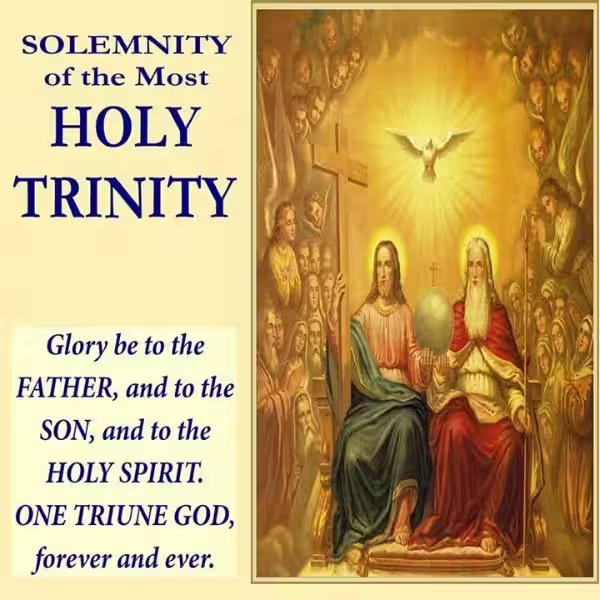
The concept of the Trinity is, perhaps, one of the most profound and uniquely Christian understandings of God. It’s a doctrine that has been debated, contemplated, and cherished by believers for millennia, attempting to explain the seemingly paradoxical nature of God as simultaneously one and three. For many, grasping this truth can feel like trying to hold water in a sieve, slippery and difficult to contain. This is where the idea of a “Trinity Table”, a conceptual tool rather than a literal object, can be incredibly helpful. It’s not a piece of furniture you’d find in a church, but rather a way of organizing our thoughts and scriptures to illuminate this central tenet of faith.
Imagine trying to explain the color blue to someone who has never seen it. You might describe its association with the sky, the ocean, or a specific flower. Similarly, the Trinity isn’t something we can fully dissect and understand with human logic alone. It’s a mystery revealed, not an equation to be solved. The Trinity Table helps us to approach this mystery by presenting the core elements of the doctrine in a structured, accessible way, allowing for deeper reflection and a more robust understanding of who God is as Father, Son, and Holy Spirit.
Deconstructing the Trinity: More Than Just Three Gods
The most common misconception about the Trinity is that it implies polytheism – the belief in multiple gods. This is a fundamental misunderstanding that the Trinity Table aims to dispel. The doctrine asserts that there is one God, and within this single divine essence, there are three co-equal and co-eternal persons: the Father, the Son, and the Holy Spirit. This isn’t about three separate deities sharing a common purpose, but rather one divine Being expressing Himself in three distinct, yet unified, modes of existence. Think of it like this: water can exist as ice, liquid, and steam. These are distinct forms, but they are all fundamentally water. The Trinity is a far more profound mystery, but this analogy can offer a rudimentary starting point.
The Trinity Table helps us visualize this unity and distinction. We can conceptualize it as a table with three legs, all of equal length and strength, supporting a single, solid tabletop. Each leg represents a person of the Trinity – Father, Son, and Holy Spirit. Yet, they are all essential for the stability and integrity of the table. If one leg is missing or weak, the entire structure collapses. Similarly, the Christian faith relies on the unified, yet distinct, work and nature of all three persons of the Godhead. Without the Father’s eternal plan, the Son’s redemptive work, or the Spirit’s ongoing presence, our understanding of God would be incomplete.
In the context of the Trinity Table, the Father is often seen as the source and foundation of divinity. He is the unoriginated God, the one from whom all things originate. Scripture speaks of Him as the Creator of the heavens and the earth, the one who sent His Son into the world. He is characterized by His love, His sovereignty, and His perfect holiness. The Trinity Table helps us to understand that while the Father is fully God, His role is distinct from the Son and the Spirit, not in essence, but in His relationship to them and His actions in salvation history.
Consider the analogy of a family. The father is often the head of the household, the one who provides and protects. In the Trinity, the Father is God, but He is God revealed in a particular way, the one who initiates the plan of salvation. He is the one who eternally begets the Son and from whom the Spirit proceeds. This doesn’t mean He is “more” God than the Son or the Spirit; rather, it describes a relational order within the one Godhead. Understanding the Father’s role as the origin helps us appreciate the divine initiative in our redemption and the profound love that motivated God to send His Son.
The Son: The Revelation and Redemption
The Son, Jesus Christ, occupies a crucial place on the Trinity Table. He is the incarnate Word, the divine Son who became flesh and dwelt among us. He is fully God and fully man, a concept that has also been a source of theological exploration. The Son’s role is to reveal the Father to humanity and to accomplish the work of redemption through His life, death, and resurrection. His sacrifice is the cornerstone of Christian faith, bridging the gap between a holy God and sinful humanity. The Trinity Table highlights that while the Son is distinct from the Father and the Spirit, He is of the same divine essence, sharing in God’s eternal nature.
Think of the Son as the perfect image of the Father. Just as a photograph perfectly represents a person, Jesus perfectly represents God. He said, “Anyone who has seen me has seen the Father” (John 14:9). The Trinity Table helps us to see that Jesus’ humanity does not diminish His divinity, nor does His divinity negate His humanity. He is the bridge, the mediator, the one who embodies God’s love in a tangible, relatable way. His mission was to reconcile us to the Father, making the path to salvation accessible through faith in Him.
The third crucial element on our Trinity Table is the Holy Spirit. He is the divine presence that indwells believers, the empowerment for Christian living, and the one who guides us into truth. While the Father initiated salvation and the Son accomplished it, the Holy Spirit applies it to our lives. He convicts us of sin, regenerates our spirits, seals us as God’s own, and equips us with spiritual gifts. The Trinity Table emphasizes that the Holy Spirit is not merely an impersonal force, but a distinct person of the Godhead, fully God, equal with the Father and the Son.
Imagine the Holy Spirit as the active agent of God in our lives today. If the Father is the architect of the building, and the Son is the builder who laid the foundation and erected the structure, the Holy Spirit is the one who furnishes the interior, making it a dwelling place. He dwells within us, transforming us from the inside out, helping us to live lives that are pleasing to God. He is the Comforter, the Advocate, the one who testifies of Jesus and glorifies the Father. His presence is the assurance of our salvation and the ongoing power for our spiritual growth.
The Trinity Table in Practice: Living Out the Mystery
Understanding the Trinity isn’t just an academic exercise; it has profound implications for how we live our lives as Christians. The Trinity Table serves as a reminder that our faith is rooted in a God who is relationship-oriented, loving, and self-giving. The very nature of God, as Father, Son, and Holy Spirit, is a model for the relationships we are called to cultivate – relationships of love, sacrifice, and mutual dependence. This understanding encourages us to live in community, mirroring the unity within the Godhead.
When we face trials, the Trinity Table reminds us that we are not alone. The Father’s everlasting love surrounds us, the Son’s redeeming grace secures us, and the Holy Spirit’s constant presence empowers us. This doctrinal truth becomes a source of immense comfort and strength. Instead of a distant, unknowable deity, we worship a God who is intimately involved in our lives, a God who is one in essence but three in person, actively working for our good. The Trinity Table, therefore, isn’t just a conceptual aid; it’s a pathway to a deeper, more vibrant relationship with the Triune God.
Frequently Asked Questions about the Trinity Table
What is the Trinity Table in religion?
The Trinity Table is a visual representation or mnemonic device used to explain the Christian doctrine of the Trinity. It typically depicts the relationship between God the Father, God the Son (Jesus Christ), and God the Holy Spirit as one God in three co-equal, co-eternal persons.
How does the Trinity Table illustrate the concept of the Trinity?
The table commonly uses a grid or chart format with columns and rows representing the persons of the Trinity and their divine nature. It aims to show that while there are three distinct persons, they are united in one divine essence or being. For example, a simple table might have “Father,” “Son,” and “Holy Spirit” as row headers, and “Is God” as a column header, indicating that each person is indeed God. It might also show that the Father is not the Son, the Son is not the Holy Spirit, etc., to emphasize their distinctiveness.
What are the key concepts the Trinity Table helps to understand?
The Trinity Table is designed to help understand several key theological concepts:
* Unity of God: That there is only one God.
* Distinction of Persons: That God exists as three distinct persons: Father, Son, and Holy Spirit.
* Co-equality: That each person possesses the fullness of divinity and is equal to the others.
* Co-eternity: That each person has always existed and will always exist.
Are there different versions of the Trinity Table?
Yes, while the core concept remains the same, there can be variations in how the Trinity Table is presented visually. Some might use more complex diagrams or textual explanations alongside the table to further clarify specific nuances of the doctrine, such as the roles or relationships between the persons.
What is the purpose of using a Trinity Table?
The primary purpose of the Trinity Table is to serve as an educational tool for believers and those seeking to understand Christian theology. It simplifies a complex and often counter-intuitive doctrine into a more manageable and memorable format, aiding in study and discussion.