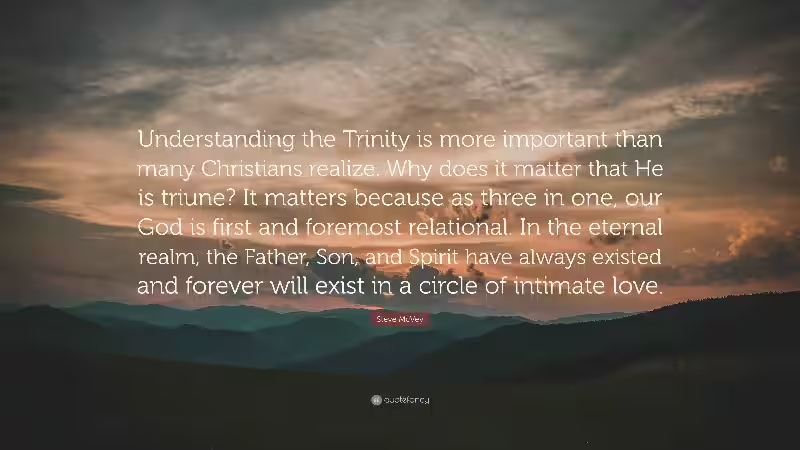
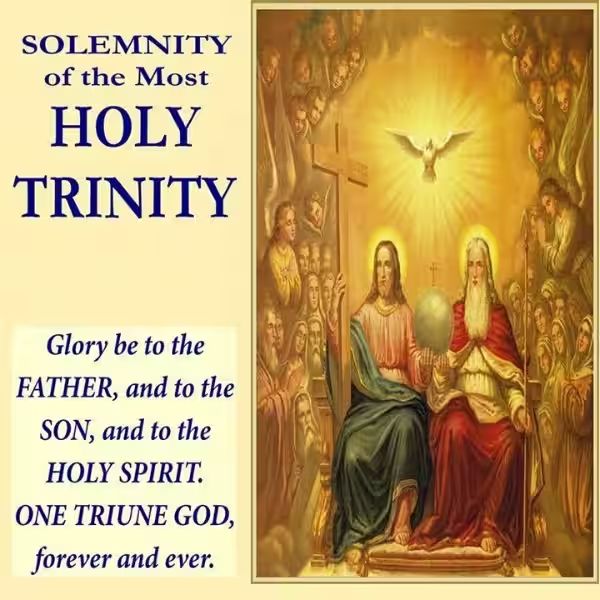
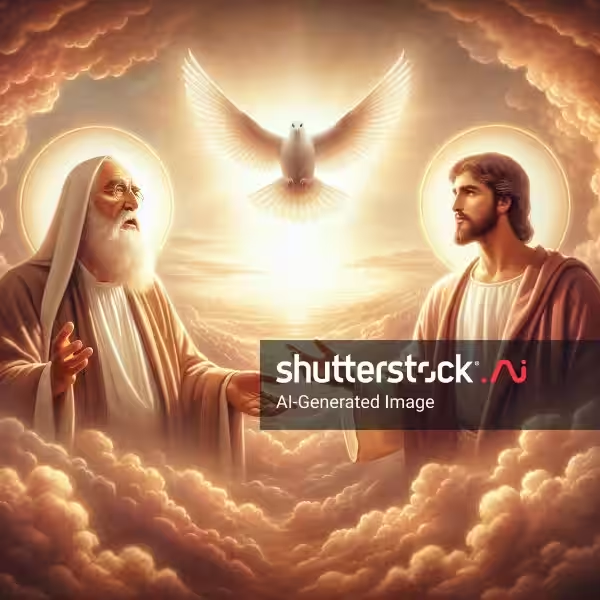
In the grand tapestry of Christian observance, Trinity Sunday stands as a unique and profound celebration. Unlike feasts dedicated to specific events like the Nativity or the Crucifixion, Trinity Sunday focuses on a fundamental doctrine, a core mystery of the Christian faith: the doctrine of the Trinity. This doctrine, often described as God being one in essence, yet three in persons – Father, Son, and Holy Spirit – is not a simple arithmetic problem, but a profound revelation about the very nature of God. Understanding its history and significance offers a deeper appreciation for the richness and complexity of our religious heritage, illuminating how this central tenet has been contemplated, debated, and celebrated throughout centuries of Christian thought and practice.
The journey to establishing Trinity Sunday as a recognized feast is a fascinating narrative that intertwines theological development, liturgical evolution, and the unwavering human desire to comprehend the divine. It’s a story that unfolds over centuries, reflecting the Church’s ongoing effort to articulate and celebrate the incomprehensible nature of God. This article will delve into the historical roots of Trinity Sunday, explore its theological underpinnings, and consider its enduring relevance in contemporary religious life, offering a relatable and informative perspective on this important Christian observance.
The Roots of a Sacred Mystery: Early Christian Contemplation of the Trinity
Long before Trinity Sunday became a fixed date on the liturgical calendar, the concept of the Trinity was deeply embedded in the consciousness of early Christians. While the word “Trinity” itself doesn’t appear in the Bible, the foundational biblical passages that speak of God the Father, Jesus Christ as the Son of God, and the Holy Spirit as God’s active presence laid the groundwork for theological reflection. Think of the Great Commission in Matthew 28:19, where Jesus instructs his disciples to baptize “in the name of the Father and of the Son and of the Holy Spirit.” This, and numerous other scriptural references, hinted at a complex, multifaceted divine being, prompting early theologians to grapple with how to express this truth coherently.
The early Church Fathers, in their efforts to defend and explain the Christian faith to a skeptical world, spent considerable energy developing the doctrine of the Trinity. Figures like Tertullian (in the late 2nd and early 3rd centuries) are credited with first using the Latin term “Trinitas” to describe this concept. They faced immense challenges, navigating the delicate balance between affirming the unity of God (a concept strongly rooted in Jewish monotheism) and acknowledging the divine nature of Jesus and the Holy Spirit. This was not an abstract philosophical exercise; it was crucial for understanding salvation, the role of Christ, and the ongoing work of God in the world. The Council of Nicaea in 325 AD, and later the Council of Constantinople in 381 AD, were pivotal moments where the Church formally articulated its understanding of the Trinity, condemning heresies and affirming the co-equality and co-eternity of the three Persons, a monumental achievement in theological history.
From Theological Formulation to Liturgical Recognition
While the theological groundwork for the Trinity was laid early on, its specific liturgical celebration developed more gradually. For centuries, the mystery of the Trinity was implicitly woven into the fabric of Christian worship through prayers, hymns, and scripture readings that acknowledged all three Persons of the Godhead. There wasn’t a dedicated Sunday for this doctrine; rather, it was a pervasive theme that permeated the entire liturgical year. However, as theological understanding deepened and the Church sought to give a more explicit focus to its core beliefs, the idea of a specific feast began to emerge in various local churches.
The exact origin of Trinity Sunday as a universally celebrated feast is not precisely documented, but it is generally understood to have developed in the Western Church, likely gaining traction in the 11th and 12th centuries. Some traditions point to monasteries in regions like Germany or France as early adopters of a feast dedicated to the Trinity. The motivation was clear: to provide a dedicated space within the liturgical calendar to reflect upon and honor this central mystery, reinforcing its importance for the faithful. The papal approval for such a feast, particularly by Pope John XXII in the early 14th century, solidified its position and paved the way for its widespread adoption across Christendom, marking a significant step in its historical journey.
Theological Underpinnings: Unpacking the Doctrine of the Trinity
The doctrine of the Trinity is often described as the “central mystery of the Christian faith.” This isn’t to say it’s incomprehensible, but rather that it expresses truths about God that transcend human reason and can only be apprehended through divine revelation. At its heart, it affirms one God (monotheism), while simultaneously acknowledging that this one God exists eternally as three distinct Persons: the Father, the Son, and the Holy Spirit. These Persons are co-equal and co-eternal, sharing the same divine essence, yet distinct in their relationships and roles within the Godhead. It’s like a complex symphony where each instrument plays a unique part, yet they all contribute to a single, harmonious masterpiece.
To illustrate this profound concept, consider the analogy of water. Water can exist as ice (solid), liquid (water), and steam (gas). These are distinct states, yet they are all fundamentally water. Similarly, the Father, Son, and Holy Spirit are distinct Persons, yet they are all one God. Another common, though imperfect, analogy is the shamrock, with its three leaves representing the three Persons, all connected to a single stem, symbolizing the one God. These analogies, while helpful for grasping the concept, can never fully encompass the divine mystery. The doctrine asserts that the Father is the unbegotten source, the Son is eternally begotten of the Father, and the Holy Spirit eternally proceeds from the Father and the Son. This intricate relationship is the very life of God, a divine communion of love and being.
Why Celebrate the Trinity? Relevance and Significance Today
Trinity Sunday, celebrated on the Sunday after Pentecost, offers a crucial opportunity for Christians to pause and contemplate this foundational doctrine. In our fast-paced, often secular world, it serves as a powerful reminder of the supernatural reality that underpins our faith. It’s not just an abstract theological concept; it has profound implications for how we understand God’s relationship with humanity, the nature of salvation, and the empowering presence of the Holy Spirit in our lives. By focusing on the Trinity, we are reminded that God is not a distant, impersonal force, but a living, relational Being who actively engages with His creation.
The celebration of Trinity Sunday provides a liturgical anchor for a truth that is otherwise encountered in fragments throughout the year. It allows for focused preaching, teaching, and prayer on the nature of God. For the individual believer, it can deepen their understanding of prayer – we often pray to the Father, through the Son, in the power of the Holy Spirit. It informs our understanding of baptism, which is performed “in the name of the Father, and of the Son, and of the Holy Spirit.” It also reinforces the mission of the Church, which is empowered by the Holy Spirit to continue the work of the Son, in the name of the Father. Ultimately, Trinity Sunday is a celebration of the fullness of God, a God who is both immanent (present with us) and transcendent (beyond our full comprehension), a God of boundless love and intricate divine life.
The development of Trinity Sunday as a specific feast day reflects a broader trend in Christian liturgy to give particular emphasis to significant theological doctrines. While the early Church focused on celebrating the events of salvation history – the life, death, and resurrection of Christ – there was a growing desire to dedicate specific moments for the contemplation of God’s very nature. This wasn’t a sudden imposition but a natural outgrowth of theological reflection and a pastoral desire to instruct and inspire the faithful. The hymns, prayers, and scriptures used on Trinity Sunday are carefully chosen to highlight the distinct yet unified roles of the Father, Son, and Holy Spirit.
The selection of the Sunday after Pentecost was also a deliberate choice. Pentecost, the celebration of the Holy Spirit’s descent and the birth of the Church, naturally leads into a reflection on the relationship between the three Persons of the Trinity. Having celebrated the Father’s eternal plan, the Son’s redemptive work, and the Spirit’s empowering presence, the following Sunday offers a perfect opportunity to synthesize these understandings into a cohesive doctrine. This placement ensures that the mystery of the Trinity is not an isolated theological point but is seen as the source and culmination of God’s redemptive activity throughout salvation history, offering a rich and meaningful liturgical progression for worshippers.
Practices and Devotions Associated with the Trinity
Across various Christian traditions, Trinity Sunday is observed with distinct practices designed to focus devotion on this central mystery. Sermons often delve into the intricacies of Trinitarian theology, using relatable analogies and scriptural examples to make the doctrine accessible. Hymns sung on this day frequently employ language that directly invokes the Father, Son, and Holy Spirit, such as the ancient hymn “Te Deum” or specifically Trinitarian doxologies that offer praise to “the Father, the Son, and the Holy Spirit.” Vestments, particularly in liturgical denominations, might incorporate symbols that represent the Trinity, such as the equilateral triangle or the trefoil, visually reinforcing the theme.
Beyond formal worship, the spirit of Trinity Sunday can inspire personal devotion. This might involve meditating on key scriptural passages related to the Trinity, such as John 1:1-18, Romans 8:1-17, or 1 Corinthians 12:1-13. Many individuals and churches find it beneficial to engage in special prayers of adoration and thanksgiving specifically directed to the Triune God. Some traditions might also encourage the use of Trinitarian prayers, which explicitly address each Person of the Godhead in sequence. The aim is to move beyond intellectual understanding to a heart-level appreciation of God’s triune nature and the loving communion that exists within the Godhead, fostering a deeper and more intimate relationship with the divine.
Conclusion: Embracing the Divine Mystery on Trinity Sunday
Trinity Sunday, with its deep historical roots and profound theological underpinnings, offers a unique and invaluable opportunity for Christians to engage with the very heart of their faith. It is a testament to the Church’s enduring journey of understanding and celebrating the incomprehensible nature of God. From the early Church Fathers wrestling with scriptural revelation to the establishment of a dedicated feast day, the history of Trinity Sunday is a narrative of deep faith, intellectual rigor, and a persistent yearning to grasp the divine mystery.
As we observe Trinity Sunday, we are invited not just to understand a doctrine, but to worship a God who is eternally Father, Son, and Holy Spirit. It is a call to embrace the mystery, acknowledge its transformative power in our lives, and live in the grace and communion of the Triune God. This sacred observance reminds us that our faith is not in a simple, easily defined deity, but in a God of infinite complexity, love, and relational being, a God who has revealed Himself to us in the totality of His being, inviting us into that divine life. Trinity Sunday, therefore, remains a vital and enriching celebration, a cornerstone of Christian devotion that continues to inspire awe and deepen faith across generations.
Frequently Asked Questions: Trinity Sunday History and Religion
What is Trinity Sunday?
Trinity Sunday is a Christian festival observed on the Sunday following Pentecost. It celebrates the Christian doctrine of the Trinity, which is the belief in one God who exists in three co-equal and co-eternal persons: the Father, the Son (Jesus Christ), and the Holy Spirit.
When did Trinity Sunday originate?
The observance of Trinity Sunday as a distinct festival has a debated but generally accepted historical trajectory. While the doctrine of the Trinity was central to early Christianity and debated in early Church councils (like the Council of Nicaea in 325 AD and the Council of Constantinople in 381 AD), specific liturgical celebrations dedicated solely to the Trinity emerged later.
The formal institution of Trinity Sunday is often attributed to Pope John XXII in the early 14th century (around 1334). However, there were earlier instances of devotion and liturgical practices related to the Trinity in local churches and monastic communities, particularly in the Benedictine order, from the 10th and 11th centuries.
Why is it called Trinity Sunday?
The name “Trinity Sunday” directly reflects its purpose: to honor and contemplate the Christian understanding of God as a Trinity of three persons in one divine essence.
What is the theological significance of the Trinity?
The doctrine of the Trinity is a cornerstone of Christian theology. It attempts to explain the nature of God as revealed in Scripture. Christians believe that God is one in His essential being (monotheism), yet He eternally exists as three distinct persons:
The Father: The Creator, the ultimate source of all that exists.
The Son (Jesus Christ): The Word of God made flesh, who became incarnate, lived a human life, died for the sins of humanity, and was resurrected.
The Holy Spirit: The active presence of God in the world and in the lives of believers, who guides, comforts, and empowers.
This doctrine is considered a mystery, surpassing full human comprehension, but is understood as the best way to articulate the relationship between God, Jesus, and the Holy Spirit as presented in the Bible.
How is Trinity Sunday celebrated?
Trinity Sunday is typically observed with special liturgical services in Christian churches. The readings, prayers, hymns, and sermons often focus on the nature of God, the doctrine of the Trinity, and the relationship between the Father, Son, and Holy Spirit. Many churches will use specific liturgical colors, often white, symbolizing purity and glory, to mark the occasion.