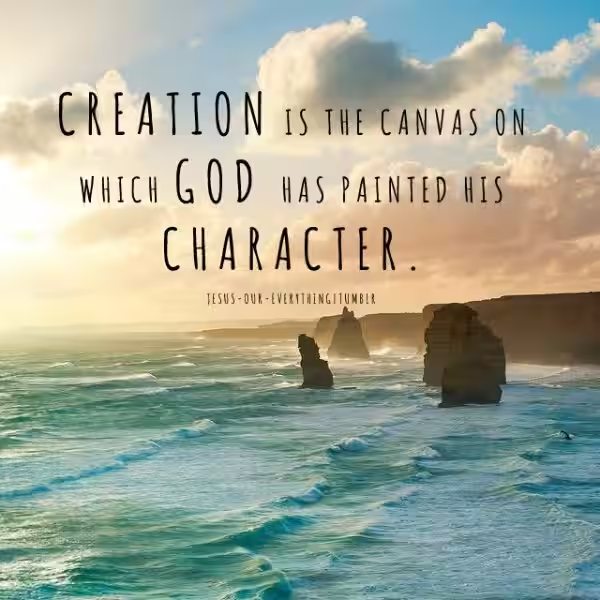
Have you ever gazed up at a starlit sky, felt the gentle rhythm of the seasons, or marveled at the intricate dance of an ant colony, and felt a deep sense of wonder? This overwhelming feeling isn’t just poetic appreciation; it often hints at a profound concept that has shaped human thought for millennia: the created order. This concept, fundamental to many religious traditions, suggests that the universe and everything within it operates according to a divine, purposeful design. It’s not a random, chaotic existence, but rather a meticulously crafted tapestry, woven with intention and imbued with meaning. Understanding this created order can offer a powerful lens through which to view our lives, our relationships, and our place within the grand scheme of existence.
For many, recognizing the created order is the first step in a spiritual journey. It implies a Creator, a divine intelligence behind the breathtaking complexity and harmony we observe. This belief fosters a sense of accountability and purpose, moving us beyond a purely materialistic worldview. Instead of seeing ourselves as accidental byproducts of chance, we are invited to see ourselves as integral parts of a divine plan. This article will delve into what the created order means, explore its manifestations in the natural world, and illuminate its profound impact on religious thought and practice, offering practical insights for a more meaningful life.
The Universe as a Divine Symphony: Unpacking the Concept of Created Order
At its core, the idea of the created order posits that the universe is not a product of blind chance but of deliberate intention. Think of a magnificent orchestra. Each instrument, from the soaring violins to the rumbling percussion, plays its specific part. The conductor, with their intricate knowledge and vision, brings these individual sounds together into a harmonious symphony. Similarly, the created order suggests a divine conductor, orchestrating the vast orchestra of the cosmos. This order is reflected in the predictable laws of physics, the biological imperatives that govern life, and the ethical frameworks that guide human societies. It’s a testament to a mind far greater than our own, a blueprint that underpins all reality.
Religious traditions worldwide often speak of this divine architecture. Whether it’s the Genesis account of creation in Judaism and Christianity, the cosmic egg in some Eastern philosophies, or the intricate divine laws in Islam, the underlying theme is consistent: a purposeful beginning designed by a higher power. This created order provides a framework for understanding existence, offering answers to fundamental questions like “Why are we here?” and “What is our purpose?”. It moves us from a state of existential uncertainty to one of assured significance, knowing that our lives are not insignificant but are part of something much larger and more enduring.
Manifestations of Created Order in the Natural World
The most tangible evidence for the created order can be found all around us, in the breathtaking beauty and intricate functionality of the natural world. Consider the precise orbit of planets around the sun, a celestial ballet that has repeated for billions of years, ensuring stability and predictable patterns. This astronomical order allows for seasons, tides, and ultimately, the conditions necessary for life to flourish on Earth. It’s a cosmic clockwork that inspires awe and points to an intelligent designer. The reliability of these celestial movements offers a sense of cosmic stability that can be profoundly comforting.
Delve deeper into biology, and the evidence becomes even more compelling. The complex DNA molecule, a microscopic blueprint that dictates the characteristics of every living organism, is a marvel of engineering. The interconnectedness of ecosystems, where the survival of one species is often intricately linked to the survival of others, showcases a delicate balance. Think of the humble bee, essential for pollinating countless plants, which in turn sustain other life forms. This intricate web of life, with its built-in checks and balances, speaks of an intelligent design that prioritizes not just existence, but flourishing. These natural systems, from the microscopic to the macroscopic, are often cited as powerful arguments for a created order. The very existence of laws of nature, like gravity or thermodynamics, which govern the universe with unwavering consistency, further reinforces this idea of an ordered creation.
Religious Interpretations and the Human Experience
Religious faiths grapple with the created order in diverse yet often complementary ways. In Abrahamic religions, God is the ultimate architect, creating the universe ex nihilo (out of nothing), imbuing it with purpose and meaning. This divine craftsmanship is seen not only in the physical universe but also in the moral and spiritual realms. Humans, created in the image of God, are given reason and free will, allowing them to participate in and even discern aspects of this created order. This perspective encourages a life of stewardship, a responsibility to care for creation and live in accordance with divine principles, promoting harmony and justice.
Eastern traditions, while often conceptualizing the divine differently, also emphasize an inherent order within existence. Concepts like Dharma in Hinduism, which represents the cosmic order and individual duty, or the Tao in Taoism, the “way” or underlying principle of the universe, all point towards a structured reality. These traditions often highlight the importance of living in accordance with this natural order, seeking enlightenment through understanding and alignment. For individuals, recognizing this created order can lead to a profound sense of belonging and purpose, transforming a potentially chaotic existence into a meaningful journey. It fosters a deeper appreciation for life and a commitment to ethical living, as our actions are seen as having implications within this grand, divine design.
Living in Accordance with the Created Order: Practical Implications for Daily Life
Understanding the created order isn’t merely an intellectual exercise; it has profound implications for how we live our lives. If we believe in a purposeful universe, then our actions gain weight. This perspective encourages us to approach life with intentionality and responsibility. Instead of drifting aimlessly, we are invited to make conscious choices that align with what we perceive as the good, the true, and the beautiful, as dictated by this divine blueprint. This could mean anything from practicing mindful consumption to fostering compassionate relationships, recognizing that our individual choices contribute to the overall harmony – or disharmony – of the world around us.
Furthermore, the concept of the created order can foster a deep sense of gratitude and humility. When we see the universe not as a given, but as a gift, our appreciation for the simple things – a sunrise, clean water, a moment of connection – skyrockets. This can counter the modern tendency towards entitlement and dissatisfaction. It also encourages humility by reminding us of our limitations and the vastness of the intelligence that designed it all. Embracing the created order means cultivating awe and wonder, recognizing that we are part of a grand, unfolding narrative that is far greater than ourselves. This perspective can offer solace during difficult times, as it suggests that even within challenges, there is an underlying order and purpose at play.
One of the most significant benefits of embracing the created order is the cultivation of a stronger sense of purpose and meaning. When we see ourselves as integral components of a divine plan, our daily activities can be imbued with a deeper significance. Even mundane tasks, like caring for our families or contributing to our communities, can be viewed as fulfilling our divinely assigned roles. This shifts our focus from a purely self-centered existence to one that is service-oriented and community-focused. It provides a compass for navigating life’s choices, helping us to prioritize activities that align with our perceived purpose within the larger created order.
This newfound purpose can be a powerful antidote to feelings of alienation and existential dread. Instead of feeling like a lone ship adrift in a vast ocean, we can experience ourselves as valued participants in a grand cosmic drama. This understanding encourages us to develop our talents and gifts, not for personal aggrandizement, but to better serve the overarching purpose of the created order. It’s about discovering our unique contribution to the symphony of existence, playing our part with passion and dedication, knowing that our efforts matter within the grand design. This meaningful engagement with life can lead to greater fulfillment and lasting contentment.
Ethical Living and Responsibilities within the Created Order
The created order inherently carries with it a strong ethical dimension. If the universe is divinely designed, then there are likely principles and guidelines embedded within it that promote well-being and harmony. Religious traditions offer these ethical frameworks, often emphasizing virtues such as compassion, justice, honesty, and stewardship. Living ethically, therefore, becomes not just a matter of personal preference, but a divine imperative, an act of aligning ourselves with the fundamental nature of reality. This perspective elevates ethical behavior from a social contract to a spiritual discipline.
Our responsibilities within the created order extend beyond our interpersonal relationships. They encompass our relationship with the natural world, our fellow human beings, and even our inner spiritual lives. This means acting as responsible stewards of the planet, recognizing its intrinsic value and the interconnectedness of all life. It also means treating others with dignity and respect, seeing the divine spark in every individual. Moreover, it involves cultivating our own inner lives, seeking wisdom and spiritual growth, which are seen as essential for fully participating in and appreciating the created order. By living in accordance with these ethical principles, we contribute to a more harmonious and flourishing existence for all, reflecting the divine intention embedded within creation.
Conclusion: Embracing the Divine Design
The concept of the created order offers a profoundly hopeful and meaningful framework for understanding our existence. From the predictable dance of the stars to the intricate mechanisms of life, the universe whispers of a divine intelligence and a purposeful design. Recognizing this created order invites us to move beyond a materialistic worldview and embrace a life filled with purpose, gratitude, and responsibility. It’s a call to appreciate the breathtaking beauty and complexity of our world, and to see ourselves not as accidental beings, but as cherished participants in a grand, divine narrative.
By living in accordance with the principles inherent in the created order, we can cultivate deeper meaning in our personal lives, foster stronger ethical foundations, and contribute to a more harmonious world. It’s an invitation to live intentionally, to cherish the present moment, and to strive for alignment with the divine blueprint that underpins all of reality. As we continue to explore the wonders of the universe and the depths of our own consciousness, let us remember the divine order that surrounds and sustains us, and let it guide us towards a life of purposeful living and profound fulfillment.
Frequently Asked Questions: Created Order and Religion
What is the concept of “created order” in religion?
The concept of “created order” in religion refers to the belief that the universe and everything within it were deliberately designed and brought into existence by a divine being or beings, following a specific plan or structure. This order is often seen as inherently good, rational, and purposeful, reflecting the nature and will of the Creator.
How do different religions interpret “created order”?
Interpretations vary widely across religions. Many Abrahamic religions (Judaism, Christianity, Islam) believe in a monotheistic God who created the universe ex nihilo (out of nothing) in a structured manner over a period of time, as described in their sacred texts. Eastern religions like Hinduism often describe cyclical creation and dissolution, with a divine force or principle underlying the cosmic order. Indigenous religions may view the created order as animated by spirits and interconnected, with humans having a role in maintaining its balance.
What evidence do religious adherents offer for a created order?
Religious adherents often point to the perceived complexity, beauty, and intelligibility of the natural world as evidence of intelligent design. They might cite the fine-tuning of physical constants that allow for life, the intricate biological mechanisms found in living organisms, or the sense of moral order and purpose in human existence as indicators of a Creator. The existence of sacred texts that describe creation is also a primary source of belief.
Does the concept of “created order” conflict with scientific explanations of the universe?
This depends on the specific religious and scientific interpretations. Some religious views see a literal, detailed account of creation that can conflict with scientific findings, particularly regarding the age of the Earth or the origin of species. Other religious perspectives view scientific explanations and the concept of a created order as compatible, with science describing how the creation process unfolded and religion addressing the who and why behind it. This is often termed “theistic evolution” or “progressive creationism.”
What is the theological significance of believing in a created order?
Belief in a created order typically leads to a sense of awe, reverence, and gratitude towards the Creator. It can provide a framework for understanding humanity’s place in the cosmos, our purpose, and our responsibilities towards creation. It often underpins ethical systems, as the order is seen as reflecting divine values and intentions. It also offers a basis for hope, as the ordered nature of the universe suggests continuity and divine faithfulness.