For many, the Revised Standard Version Catholic Edition (RSV-CE) represents more than just a translation of the Bible; it’s a gateway to a richer, more nuanced understanding of our faith. Whether you’re a lifelong Catholic seeking to deepen your spiritual life or someone exploring the Catholic tradition, the RSV-CE offers a compelling and trustworthy resource. This venerable translation, known for its accuracy and fidelity to the original languages, has become a cornerstone for biblical study and personal devotion within the Catholic Church.
In a world buzzing with information and constant change, the timeless wisdom found within the Revised Standard Version Catholic Edition offers a grounding force. It’s a testament to centuries of theological reflection and a commitment to presenting the sacred texts in a way that is both scholarly and accessible. This article will explore what makes the RSV-CE so valuable, how it can enhance your journey of faith, and why it remains a preferred choice for many seeking a profound connection with God’s word.
The journey to the Revised Standard Version Catholic Edition is a fascinating one, rooted in a desire for a biblical text that prioritized linguistic precision and theological integrity. It’s not a new invention, but rather a thoughtful adaptation and expansion of an existing, highly respected translation. Understanding its origins helps us appreciate its unique strengths and its place within the broader landscape of biblical scholarship.
The foundation of the RSV-CE lies in the Revised Standard Version (RSV) of the Bible, first published in 1952. The RSV itself was an outgrowth of the King James Version, aiming to replace its archaic language with contemporary English while remaining deeply faithful to the original Hebrew, Aramaic, and Greek texts. This commitment to veracity and clarity was a significant advancement. However, the original RSV, while widely respected, lacked the inclusion of the Deuterocanonical books, which are an integral part of the Catholic canon of Scripture.
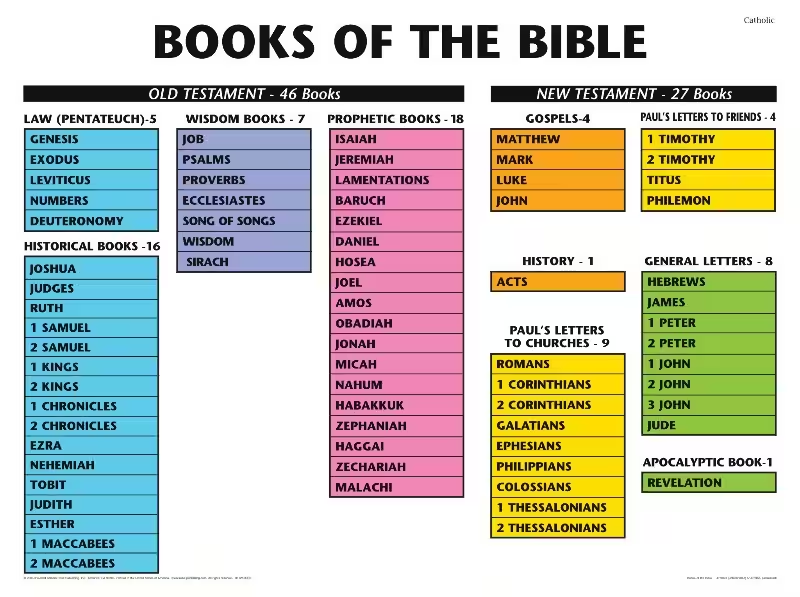
This is where the Revised Standard Version Catholic Edition steps in. Recognizing the need for a translation that met the rigorous standards of the RSV while also adhering to the complete Catholic canon, the Catholic Church officially approved and published the RSV-CE. This edition faithfully incorporates the Deuterocanonical books – such as Tobit, Judith, 1 and 2 Maccabees, Wisdom, Sirach, and Baruch – into the Old Testament. This complete canon is essential for a full understanding of Catholic theology and tradition, providing crucial context for the New Testament and the teachings of Jesus Christ.
Key Features and Benefits of the RSV-CE
What sets the Revised Standard Version Catholic Edition apart? It’s a confluence of elements that contribute to its enduring appeal and its effectiveness as a spiritual tool. From its meticulous translation to its theological soundness, the RSV-CE offers a wealth of benefits for anyone seeking a deeper engagement with Scripture. It’s a translation that encourages contemplation and prayerful reflection.
One of the most celebrated aspects of the Revised Standard Version Catholic Edition is its scholarly approach to translation. The translators were deeply committed to rendering the original languages of Scripture as accurately as possible into clear, dignified English. This means that when you read the RSV-CE, you are encountering a text that strives to convey the nuances of the ancient Hebrew and Greek, avoiding overly interpretive language that might impose a particular theological agenda. This commitment to linguistic precision ensures that the reader is as close to the original meaning as possible, fostering a more authentic encounter with God’s message.
Furthermore, the RSV-CE is known for its theological accuracy and its reverence for Catholic doctrine. Unlike translations that might be driven by external agendas, this edition was developed and approved by Catholic scholars and authorities. This ensures that the translation is in full harmony with the teachings of the Catholic Church, making it a reliable guide for faith formation. For instance, passages that speak to the sacraments, the role of Mary, or the nature of the Church are rendered in a way that reflects Catholic understanding, providing a consistent and faithful interpretation. This doctrinal fidelity is paramount for many who use the RSV-CE for study and prayer.
Enhancing Your Faith Journey with the RSV-CE
The Revised Standard Version Catholic Edition is more than just a book of ancient texts; it’s a living instrument that can profoundly enrich your personal faith journey. Whether you’re engaging in daily prayer, preparing for Mass, or delving into serious biblical study, the RSV-CE offers a unique and invaluable resource. Its clarity and depth can illuminate passages you thought you knew and reveal new insights.
For many Catholics, the Revised Standard Version Catholic Edition serves as a trusted companion for daily scripture reading and prayer. The clarity of its language and the accuracy of its translation make it easier to meditate on verses and allow them to speak to your heart. Imagine reading the Psalms and feeling the raw emotion and profound trust in God, or engaging with the Gospels and experiencing Jesus’ teachings with a renewed sense of clarity. The RSV-CE facilitates this kind of transformative encounter with the divine. It’s a tool for personal spiritual growth, inviting you to ponder God’s word in your everyday life.
Beyond personal devotion, the Revised Standard Version Catholic Edition is an excellent resource for catechesis and theological study. Its inclusion of the Deuterocanonical books provides a complete Old Testament, essential for understanding the full biblical narrative that underpins Catholic theology. For those involved in Bible study groups, RCIA (Rite of Christian Initiation of Adults), or seminary work, the RSV-CE offers a reliable and authoritative text. For example, understanding the book of Wisdom, a Deuterocanonical book, sheds light on the New Testament’s understanding of Christ as the Wisdom of God, a crucial concept for Christian theology. This comprehensive and faithful text supports a deeper intellectual and spiritual engagement with the faith.
To truly appreciate the value of the Revised Standard Version Catholic Edition, it’s helpful to see it in action. How does this translation manifest in practical ways, and what makes it a go-to choice for so many? Let’s explore some specific examples that illustrate its strengths and how it can be a powerful tool for understanding and living out our faith. It’s in these practical applications that the RSV-CE truly shines.
Consider, for instance, the book of Genesis. In the Revised Standard Version Catholic Edition, passages describing creation, the fall of humanity, and the early covenants are rendered with a poetic yet precise language that captures the grandeur and significance of these foundational events. When you read about God’s creation in Genesis 1: “Let there be light; and there was light,” the RSV-CE conveys a sense of divine power and order. The translation’s fidelity to the original Hebrew allows for a deeper appreciation of the subtlety and theological depth of these narratives, which are crucial for understanding God’s relationship with humanity.
Another area where the Revised Standard Version Catholic Edition particularly excels is in the New Testament, especially in the Gospels. The clear and dignified language used to present Jesus’ teachings makes them accessible and impactful. For example, in the Sermon on the Mount (Matthew 5-7), the RSV-CE presents Jesus’ words with an unadorned clarity that highlights their revolutionary nature. When Jesus says, “Blessed are the peacemakers, for they shall be called sons of God” (Matthew 5:9), the RSV-CE’s straightforward phrasing emphasizes the transformative call to holiness at the heart of Christ’s message. This directness and faithfulness in translation makes the Gospel narratives resonate powerfully with contemporary readers, fostering both intellectual understanding and heartfelt devotion.
Conclusion: A Trusted Companion for a Lifelong Journey
The Revised Standard Version Catholic Edition stands as a testament to the enduring power of Scripture and the Church’s commitment to providing accessible, faithful, and profound biblical resources. It’s a translation that has earned the trust of countless individuals and communities, offering a clear and accurate window into the divinely inspired word. Whether you are seeking to deepen your prayer life, engage in serious study, or simply come to know God more intimately, the RSV-CE is an invaluable companion.
In a world that often clamors for our attention, the Revised Standard Version Catholic Edition offers a sanctuary of truth and wisdom. Its meticulous translation, theological integrity, and faithful inclusion of the Catholic canon make it an indispensable tool for anyone on a spiritual journey. By engaging with the RSV-CE, you are not just reading ancient texts; you are entering into a living dialogue with God, a conversation that can transform your life and deepen your understanding of His boundless love and plan for humanity. Embrace the richness of the Revised Standard Version Catholic Edition and allow it to illuminate your path of faith.
Frequently Asked Questions: Revised Standard Version – Catholic Edition
What is the Revised Standard Version – Catholic Edition (RSV-CE)?
The Revised Standard Version – Catholic Edition (RSV-CE) is a revision of the Revised Standard Version (RSV) Bible. It was authorized for use by the Catholic Church and includes the deuterocanonical books (also known as the apocryphal books) that are found in the Septuagint, the ancient Greek translation of the Old Testament, but not in the Hebrew canon.
What is the history of the RSV-CE?
The RSV was first published in 1952. In response to requests from Catholic scholars and bishops, the Catholic biblical scholar Father Henry Wansbrough oversaw a revision of the RSV to make it acceptable for Catholic use. This revised edition, which included the deuterocanonical books, was published in 1966.
What is the difference between the RSV and the RSV-CE?
The primary difference is the inclusion of the deuterocanonical books in the RSV-CE. These books, such as Tobit, Judith, 1 and 2 Maccabees, Wisdom, Sirach, and Baruch, are considered canonical by the Catholic Church but were not part of the original RSV. The RSV-CE also incorporates some minor textual revisions and updated language.
Are the deuterocanonical books accepted by all Christians?
No, the deuterocanonical books are accepted as canonical by the Catholic Church, the Eastern Orthodox Church, and some other Oriental Orthodox churches. They are generally not accepted as canonical by Protestant denominations, who typically adhere to the Hebrew canon of the Old Testament.
What is the translation philosophy of the RSV-CE?
The RSV-CE generally follows a principle of “dynamic equivalence” or “thought-for-thought” translation, aiming to convey the meaning of the original Hebrew and Greek texts in clear and understandable English. It strives for accuracy while also being readable by a modern audience.
Is the RSV-CE widely used in the Catholic Church?
The RSV-CE has been a popular and respected English translation for Catholic use. While other translations like the New American Bible Revised Edition (NABRE) are more commonly used in liturgy in the United States, the RSV-CE remains a preferred choice for personal study and devotional reading among many Catholics.
Where can I find the RSV-CE?
The RSV-CE is available in various formats, including print Bibles, digital versions, and online resources. Many Christian bookstores and online retailers carry it.