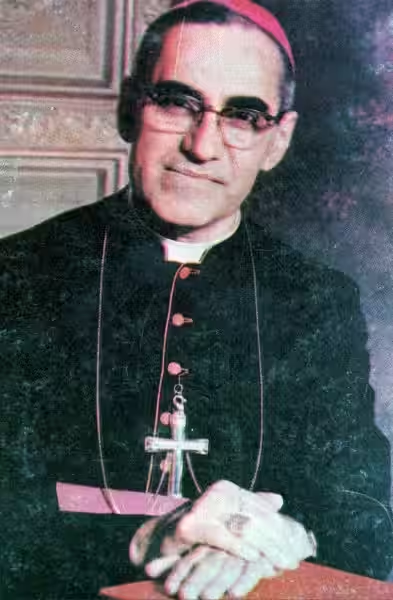
The Oscar Romero life story is one that resonates deeply with anyone who has grappled with the intersection of faith and the struggles of the human condition. Born on August 15, 1917, in Ciudad Barrios, El Salvador, Óscar Arnulfo Romero y Galdámez entered a world marked by stark social inequalities. His childhood wasn’t one of privilege; rather, it was characterized by a modest upbringing, where hard work and faith were central tenets. Even as a young boy, Romero displayed a devout nature, often found in quiet contemplation. This early inclination towards the spiritual would, unbeknownst to him, shape the trajectory of his entire existence.
His family, though not wealthy, instilled in him a strong sense of Catholic morality. These formative years, spent in a rural community, likely exposed him to the realities faced by ordinary Salvadorans, a connection that would prove profoundly influential later in his life. His initial education was local, but his intellectual curiosity and deep faith soon led him down a different path, one that would eventually place him at the very heart of a nation in turmoil. This wasn’t a destiny he actively sought, but rather a path that unfolded, guided by a divine calling and a growing awareness of the world around him.
The Priestly Calling and Early Ministry
Romero’s journey into the priesthood was a deliberate and deeply spiritual one. He entered the minor seminary in San Miguel at the age of thirteen, a significant commitment for someone so young. Later, he pursued his theological studies in Rome, a period of intense learning and spiritual formation. Upon his ordination in 1942, he embarked on his priestly duties with dedication and humility. His early assignments were often in smaller parishes, allowing him to connect directly with the faithful and understand their daily lives, their joys, and their sorrows.
During these initial years, Romero was known as a diligent and orthodox priest, focused on pastoral care and theological scholarship. He was not initially perceived as a radical or a social activist. His focus was on the traditional teachings of the Catholic Church and the spiritual well-being of his parishioners. However, even in these early stages, his genuine concern for people and his ability to listen were evident. These qualities, nurtured by his faith, would become the bedrock of his later, more public, ministry.
The Unexpected Ascent to Archbishop
The Oscar Romero life story took a pivotal turn in 1970 when he was appointed Auxiliary Bishop of San Salvador. This promotion marked his entry into a higher echelon of the Church hierarchy. He continued his work, always striving to be a shepherd to his flock. His intellect and administrative skills were recognized, leading to further appointments. However, it was his appointment as the Archbishop of San Salvador in 1977 that truly thrust him into the national spotlight and presented him with his greatest challenges.
This appointment came at a turbulent time for El Salvador. The country was increasingly polarized, with a wealthy elite controlling most of the resources and a vast majority of the population living in poverty and facing severe human rights abuses. The military government was in power, and dissent was met with brutal repression. Romero, a man of prayer and study, found himself unexpectedly at the helm of a church that was itself divided, and in the midst of a nation teetering on the brink of civil war. His initial approach was one of mediation and conciliation, hoping to bridge the divides and foster peace.
A Voice for the Voiceless: The Transformation of Archbishop Romero
The Oscar Romero life story is, perhaps most powerfully, the story of a profound transformation. As Archbishop, Romero witnessed firsthand the escalating violence, the disappearances, and the systematic oppression of the Salvadoran people. The suffering he saw and heard about began to weigh heavily on his conscience. Initially, he may have sought to remain apolitical, focusing on the spiritual needs of his diocese. However, the brutal realities of his country could not be ignored by a man of deep faith and compassion.
His sermons, broadcast weekly on the radio, began to carry a new urgency and a powerful message of justice. He started to speak out, not with political rhetoric, but with the moral authority of his faith. He condemned the violence, defended the rights of the poor and marginalized, and called for an end to the state-sponsored terror. He famously stated, “I will not be silenced,” a declaration that became a rallying cry for many and a clear indication of his unwavering commitment to his principles. This shift from a more reserved figure to a courageous advocate for the oppressed solidified his role as a beacon of hope for many.
The Power of the Pulpit: Speaking Truth to Power
Archbishop Romero used his platform as Archbishop with remarkable courage and conviction. His Sunday homilies were more than just religious services; they were acts of prophetic witness. He meticulously documented abuses, listened to the testimonies of victims, and then, with the authority of his office, brought these injustices to light. He would often pause his sermons to read letters from ordinary citizens detailing their suffering, effectively giving voice to those who had been silenced by fear and violence. This direct approach made his message unmistakably clear and deeply relatable to the common people.
His words were not abstract theological discussions; they were concrete calls for human dignity and basic rights. He condemned the assassinations of priests and lay workers who were also speaking out for justice. He urged soldiers and police to disobey orders that violated God’s law. He pleaded with the powerful to show mercy and to embrace reconciliation. These were not the pronouncements of a politician, but the passionate pleas of a shepherd who refused to abandon his sheep to the wolves. His unwavering commitment to these principles, however, placed him in increasingly dangerous territory.
The Growing Threat and Unwavering Faith
As Archbishop Romero’s voice grew louder and more influential, so too did the opposition against him. The Oscar Romero life story enters its most poignant phase as he faced mounting pressure and overt threats. The powerful forces benefiting from the status quo saw him as a direct threat to their authority and their control. Death threats became commonplace, and the atmosphere surrounding him grew increasingly perilous. Despite the danger, Romero’s resolve seemed to strengthen, fueled by his deepening faith and his conviction that he was fulfilling God’s will.
He continued to write letters to government officials and international bodies, pleading for intervention and an end to the violence. He found solace and strength in prayer and in his unwavering belief in the resurrection and the ultimate triumph of justice. He understood the risks involved, but his commitment to the Gospel and the teachings of Jesus Christ superseded any personal fear. His faith was not a shield against hardship, but a deep wellspring of courage that enabled him to persevere in the face of overwhelming adversity.
The Ultimate Sacrifice: Martyrdom for the Faith
The Oscar Romero life story culminates in a tragic, yet profoundly significant, act of martyrdom. On March 24, 1980, as he was celebrating Mass at the Chapel of the Divine Providence Hospital in San Salvador, Archbishop Romero was assassinated. A single shot fired by an unknown assailant pierced his heart. He died at the altar, the very place where he had ministered to his flock and proclaimed the truth. His death sent shockwaves across El Salvador and around the world.
His assassination was a direct consequence of his unwavering commitment to justice and his refusal to remain silent. It was a brutal silencing of a voice that had become too powerful for the oppressors to tolerate. However, his death did not end his message. Instead, it amplified it. His martyrdom became a powerful symbol of resistance against injustice and a testament to the enduring power of faith in the face of brutal oppression. The Oscar Romero life story continues to inspire millions, reminding us that even in the darkest of times, one person’s courage, guided by faith, can illuminate the path towards a more just and compassionate world.
Frequently Asked Questions about Oscar Romero’s Life and Religion
Who was Oscar Romero?
Oscar Romero was a Roman Catholic archbishop in El Salvador who became a prominent advocate for the poor and oppressed. He was known for his outspoken criticism of the Salvadorean government’s human rights abuses during a period of civil unrest.
What was Oscar Romero’s religious background and role?
Oscar Romero was a devout Catholic priest who rose through the ranks of the Church. He was ordained a priest, served in various diocesan roles, and was eventually appointed Archbishop of San Salvador in 1977. His faith deeply informed his commitment to social justice.
What were Oscar Romero’s key religious beliefs and how did they influence his actions?
Romero’s religious beliefs were rooted in Catholic social teaching, emphasizing the dignity of every human person and the preferential option for the poor. He believed that true faith required actively working for justice and challenging systems of oppression. This conviction led him to speak out against violence, inequality, and the suffering of his people.
How did Oscar Romero’s religion shape his views on politics and human rights?
For Romero, religion and politics were inseparable when it came to advocating for justice. He saw the suffering of the Salvadorean people as a direct violation of God’s law and the teachings of Christ. He believed the Church had a moral obligation to speak truth to power and to defend the human rights of all, especially those who were most vulnerable.
What is Oscar Romero’s significance in the Catholic Church and beyond?
Oscar Romero is revered as a martyr for his faith and his commitment to justice. He was canonized as a saint by the Catholic Church in 2018. His legacy continues to inspire those fighting for human rights and social justice around the world, demonstrating the power of faith to drive transformative action.