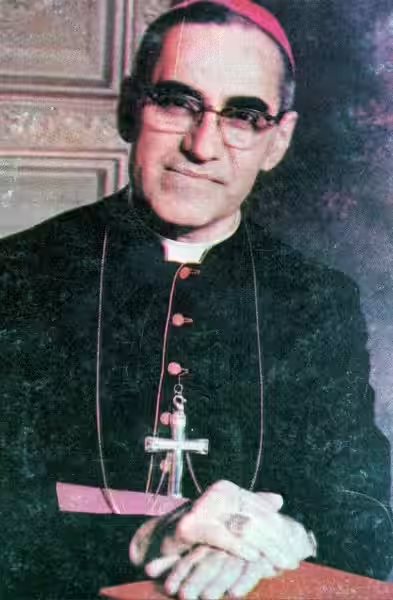
The Seeds of Faith: Oscar Romero’s Early Life and the Roots of His Spirituality
The extraordinary life of Oscar Romero, a man whose unwavering commitment to justice and compassion led him to martyrdom, began in a far more unassuming setting than one might imagine for a future archbishop and global icon. Born in Ciudad Barrios, El Salvador, on August 15, 1917, Oscar Arnulfo Romero y Galdámez was the son of Santos Romero, a telegraph operator, and Guadalupe Galdámez. His early life was shaped by the rhythms of a small rural community, where faith was not merely a ritual but an integral part of daily existence. The family, while not wealthy, was deeply religious, and this environment undoubtedly planted the initial seeds of Romero’s profound spirituality. Even as a young boy, Romero demonstrated a quiet thoughtfulness and a strong sense of duty, qualities that would later define his leadership.
The landscape of Ciudad Barrios, with its rolling hills and close-knit community, provided a formative backdrop for Romero’s upbringing. He was one of seven children, and his childhood experiences likely instilled in him a deep understanding of the struggles and joys of ordinary people. These formative years, spent far from the gilded halls of power, were crucial in shaping his empathetic outlook. It was in this humble setting that his initial religious inclinations began to take root, nurtured by the consistent presence of faith in his home and community. His early education, including his confirmation in the Catholic Church at the age of 11, further solidified his connection to religious life, foreshadowing the path he would eventually embrace.
A Calling Emerges: Education and the Priesthood
The path to the priesthood for Oscar Romero was not a sudden, dramatic revelation but rather a gradual unfolding of a deep-seated calling. Recognizing his intellectual potential and his clear devotion, his family and local clergy encouraged him to pursue higher education. This led him to the minor seminary in San Miguel at the age of 13, a significant step away from the familiar comforts of home. This period marked a crucial turning point in his early life, where he dedicated himself to rigorous studies and spiritual formation. The disciplined environment of the seminary, coupled with his inherent piety, began to shape him into the devoted clergyman he would become. He excelled in his studies, demonstrating a keen mind and a serious approach to his faith.
Upon completing his studies at the minor seminary, Romero continued his theological training in Rome, attending the Pontifical Gregorian University. This international experience broadened his horizons and exposed him to a wider world of theological thought and ecclesiastical practice. During his time in Rome, he was ordained a priest in 1942. The challenges of studying abroad during World War II, including the scarcity of resources and the anxieties of the time, undoubtedly added a layer of resilience to his character. This period of intense academic and spiritual development in his early life was instrumental in preparing him for the complex and often perilous roles he would later undertake, solidifying his commitment to serving God and his flock.
Early Ministry and the Evolving Landscape of Religion in El Salvador
Following his ordination, Father Oscar Romero returned to El Salvador and embarked on a varied pastoral journey. His early ministry was characterized by diligent service and a growing understanding of the needs of the Salvadoran people. He served in various parishes, each experience contributing to his deepening pastoral wisdom. In San Miguel, he was instrumental in establishing a radio station, a forward-thinking initiative that allowed him to reach a wider audience with religious messages and pastoral guidance. This demonstrated an early willingness to embrace new technologies to spread the word of God and connect with the faithful, even those in remote areas.
As Romero ascended through the ranks of the Church, holding positions such as secretary to the bishop and later as a bishop himself, the socio-political climate of El Salvador began to shift dramatically. The growing disparities between the wealthy elite and the impoverished majority became increasingly pronounced. While his early life and initial ministry were largely focused on traditional pastoral duties, the unfolding reality of injustice in his homeland would inevitably influence his perspective and, ultimately, his actions. He observed firsthand the suffering of the poor and the seeds of discontent that were beginning to sprout, setting the stage for his later, more pronounced advocacy for social justice, which was deeply intertwined with his understanding of religious principles.
Navigating a Turbulent Era: Romero as Auxiliary Bishop and Bishop
Romero’s appointment as Auxiliary Bishop of San Salvador in 1970 marked a significant step in his ecclesiastical career, placing him closer to the heart of the nation’s religious and social discourse. During this period, he continued his work with a focus on spiritual renewal and pastoral care. He was known for his devotion to prayer and the sacraments, qualities that remained central to his identity. However, the political and social unrest that was simmering in El Salvador could no longer be ignored. He began to witness the increasing repression and violence directed towards those who spoke out against the injustices, a stark contrast to the quiet spirituality of his early life.
His promotion to Archbishop of San Salvador in 1977 thrust him into a position of even greater influence and responsibility. This was a time when the Church in El Salvador was deeply divided. Some clergy and religious actively engaged in liberation theology, advocating for the poor and marginalized, while others aligned more closely with the established powers. Archbishop Romero, initially perceived by some as a more conservative figure, found himself increasingly compelled by the suffering of his people to speak out. His sermons and pastoral letters began to reflect a profound shift, calling for justice, peace, and an end to human rights abuses, a testament to how his deep-seated religious convictions, forged in his formative years, were now being tested and amplified by the harsh realities of his nation.
The Archbishop’s Voice: Faith in Action Amidst Violence
As Archbishop, Oscar Romero’s sermons became a powerful platform for speaking truth to power. His weekly homilies, delivered from the Metropolitan Cathedral, were broadcast throughout the country and listened to with rapt attention by millions. He didn’t shy away from addressing the systematic injustices and the brutal violence that plagued El Salvador. His messages were grounded in his deep religious faith, drawing heavily from scripture to call for compassion, repentance, and a fundamental reordering of society based on Gospel values. This was a significant evolution from the more private spiritual pursuits of his early life, transforming his faith into a public force for change.
Romero’s unwavering stance resonated with the oppressed and disenfranchised, offering them a voice of hope and solidarity. He openly condemned the killings, disappearances, and torture that were becoming commonplace. His commitment to the poor and the marginalized was not an abstract theological concept but a lived reality, directly informed by his understanding of Christ’s teachings. He famously stated, “A bishop must identify himself with the poor… I want to be a shepherd for all my people, especially the poor.” This public declaration of his pastoral mission, rooted in his religious calling, placed him in direct opposition to the military regime and its death squads.
A Martyr’s Sacrifice: The Ultimate Expression of Faith
The climax of Oscar Romero’s life and legacy arrived on March 24, 1980. While celebrating Mass at a small chapel in a hospital for cancer patients, he was assassinated by a right-wing gunman. The act was a brutal silencing of a prophetic voice, a direct consequence of his courageous advocacy for justice and human rights. His martyrdom sent shockwaves across El Salvador and the world, solidifying his status as a symbol of resistance against oppression and unwavering faith. The seeds of devotion nurtured in his early life had blossomed into a conviction so profound that he was willing to lay down his life for it.
Oscar Romero’s assassination did not silence his message; rather, it amplified it. His life and death became a powerful testament to the transformative power of faith when coupled with a commitment to justice. He demonstrated that true religious devotion calls for active engagement with the world, particularly for the protection of the most vulnerable. His journey from a modest beginning in Ciudad Barrios to becoming a globally recognized martyr underscores the profound impact one individual, guided by deep religious conviction and an unwavering moral compass, can have on the course of history. His legacy continues to inspire movements for peace and social justice around the globe.
Frequently Asked Questions: Oscar Romero – Early Life & Religion
What was Oscar Romero’s early life like?
Oscar Romero was born on August 15, 1917, in Ciudad Barrios, El Salvador. He was the third of seven children. His father, Santos Romero, was a telegraph operator, and his mother, Guadalupe Romero, was a homemaker. Romero received his early education in San Miguel and later entered the minor seminary in San Miguel at the age of 13. He then studied in Nicaragua and Rome before being ordained a priest.
What was Oscar Romero’s religious background and journey?
Oscar Romero was raised in a devout Catholic family. His faith was a central part of his life from a young age. He felt a strong calling to the priesthood and pursued theological studies diligently. He was ordained a priest in 1942. Throughout his life, his religious convictions deepened, particularly as he witnessed the social injustices and suffering in El Salvador, which profoundly influenced his pastoral work and his eventual stance as a champion for the poor and oppressed.