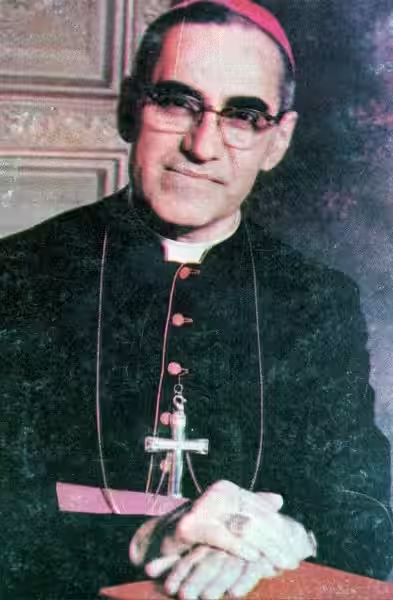
The name Oscar Romero often evokes a powerful image: a shepherd standing firm in the face of immense pressure, a voice crying out for justice in a land torn by violence. His life story, deeply rooted in his Catholic faith, is a testament to the transformative power of conviction and the profound impact one individual can have when they choose to stand with the marginalized. Understanding Oscar Romero’s bio is more than just recounting historical facts; it’s about grasping the essence of a man who lived his faith not just in prayer, but in bold, unwavering action.
Born in rural El Salvador in 1917, Óscar Arnulfo Romero y Galdámez’s early life offered little hint of the seismic shift he would bring to his nation. He was a bright, devout young man, drawn to the priesthood from a young age. His journey through seminary and his subsequent ordination were marked by a dedication to his calling, a deep love for scripture, and a commitment to serving God’s people. This foundational period of his life, before he rose to prominence as Archbishop, laid the groundwork for the man he would become – a man whose religion was not a private affair, but a driving force for public good.
From Humble Beginnings to Archbishop: A Faith Tested
Romero’s early pastoral work saw him serving in various parishes, gaining invaluable experience in connecting with ordinary people. He was known for his dedication to pastoral care, his ability to listen, and his genuine concern for the spiritual and material well-being of his flock. During these formative years, his faith was nurtured through the simple, yet profound, realities of everyday life – the struggles of farmers, the hopes of families, and the quiet resilience of a community facing economic hardship. These experiences would later color his understanding of the injustices plaguing El Salvador.
His ascent within the Church hierarchy was steady. He held various important positions, eventually being appointed as the Archbishop of San Salvador in 1977. This appointment, however, came at a time of escalating political turmoil and brutal repression in El Salvador. The nation was caught in a vise of poverty, inequality, and state-sponsored violence, and the Church, once a bastion of comfort, was increasingly seen as complicit by some, or a target by others. Romero, whose personal inclinations were more conservative and focused on spiritual matters, found himself thrust into the crucible of social and political conflict, a situation that would profoundly shape his ministry and his understanding of his religious obligations.
The Archbishop’s Awakening: A Voice for the Voiceless
The initial years of Romero’s tenure as Archbishop were marked by a cautious approach. He sought to maintain a balance, emphasizing prayer and unity. However, the escalating violence and the systematic abuse of human rights began to weigh heavily on his conscience. A pivotal moment often cited is the murder of his friend, Father Rutilio Grande, a Jesuit priest who was outspoken about social injustices. Grande’s assassination was a brutal wake-up call for Romero, a stark reminder of the dangers faced by those who dared to speak truth to power.
This tragic event, coupled with the relentless suffering he witnessed daily, sparked a profound transformation in Archbishop Romero. His sermons, once focused primarily on theological matters, began to address the political and social realities of El Salvador. He started to fearlessly denounce the violence, the disappearances, and the torture carried out by government forces and paramilitary groups. His weekly radio broadcasts reached millions, becoming a lifeline for many who felt abandoned and unheard. He used his platform not to incite hatred, but to call for justice, peace, and respect for human dignity, grounding his message firmly in Christian teachings and the Gospel.
Religion as a Call to Action: Romero’s Sermons and Ministry
Archbishop Romero’s sermons were not mere theological lectures; they were prophetic pronouncements that resonated with the lived experiences of his people. He would often draw parallels between the suffering of the poor in El Salvador and the narratives of the Old Testament prophets who challenged corrupt rulers and defended the oppressed. For example, when denouncing the systematic starvation of impoverished communities by withholding food aid, he might reference the prophets’ condemnation of those who “grind the faces of the poor.” His religious conviction fueled his courage to speak out, even when threats and intimidation became commonplace.
His ministry became synonymous with solidarity. He visited the poor, the displaced, and the imprisoned. He opened the doors of the archdiocesan offices to those seeking refuge and assistance. He championed the rights of workers, advocating for fair wages and safe working conditions. His actions were a powerful embodiment of his belief that true religion demanded not just personal piety, but an active commitment to alleviating the suffering of others. This practical application of faith made him a symbol of hope for many, a living testament to the Church’s call to serve the least among us.
The Ultimate Sacrifice: Martyrdom and Legacy
The increasing boldness of Archbishop Romero’s pronouncements inevitably drew the ire of those in power. He received numerous death threats, and the pressure to silence him mounted. Yet, he remained steadfast. He saw his role as a shepherd, and a shepherd protects his flock, even at great personal risk. His faith in God’s justice and his unwavering belief in the sanctity of human life propelled him forward, even as the dangers surrounding him intensified.
On March 24, 1980, during the celebration of Mass at a small chapel in San Salvador, Archbishop Oscar Romero was assassinated. A lone gunman, acting on orders from a death squad, shot him as he raised the host. His murder sent shockwaves across the globe, but it did not silence the message he had so powerfully articulated. Instead, his death cemented his legacy as a martyr for justice and a beacon of religious integrity. His bio transformed from that of a courageous church leader to that of a saintly figure who embodied the ultimate sacrifice for his beliefs and his people.
Oscar Romero’s Enduring Influence: A Universal Message
The legacy of Oscar Romero extends far beyond the borders of El Salvador. He has become an internationally recognized figure, celebrated for his unwavering commitment to peace and justice. His teachings and his example continue to inspire activists, theologians, and ordinary people around the world who are striving to create a more equitable and compassionate society. He demonstrated that faith and action are inextricably linked, and that true religious devotion often requires confronting uncomfortable truths and standing up for those who have no voice.
His canonization in 2018 by Pope Francis was a significant event, formally recognizing him as Saint Óscar Arnulfo Romero. This affirmation further solidified his status as a powerful symbol of Christian witness in the face of oppression. For anyone seeking to understand the profound connection between religion, social justice, and personal courage, studying Oscar Romero’s bio offers an invaluable lesson. He reminds us that faith is not passive, but an active force that can, and should, transform the world around us, inspiring us to be voices for the voiceless and champions for the marginalized.
Frequently Asked Questions about Oscar Romero
Who was Oscar Romero?
Oscar Romero was a Catholic bishop and later archbishop of San Salvador, El Salvador. He is widely known for his advocacy for the poor and marginalized and his outspoken criticism of government violence during El Salvador’s civil war.
What was Oscar Romero’s religion?
Oscar Romero was a Roman Catholic. He served as the Archbishop of San Salvador from 1977 until his assassination in 1980.
What is Oscar Romero known for religiously?
Religiously, Oscar Romero is known for his deep faith, his commitment to Catholic social teaching, and his tireless work to defend the human rights of the poor and oppressed, often drawing on his understanding of Gospel values. He is revered as a martyr by many within the Catholic Church.
When was Oscar Romero canonized?
Oscar Romero was canonized as a saint by Pope Francis on October 14, 2018, making him Saint Óscar Arnulfo Romero.
What was Oscar Romero’s stance on social justice?
Oscar Romero was a fervent advocate for social justice. He consistently spoke out against poverty, inequality, political repression, and human rights abuses in El Salvador, aligning his faith with a call for fundamental societal change.