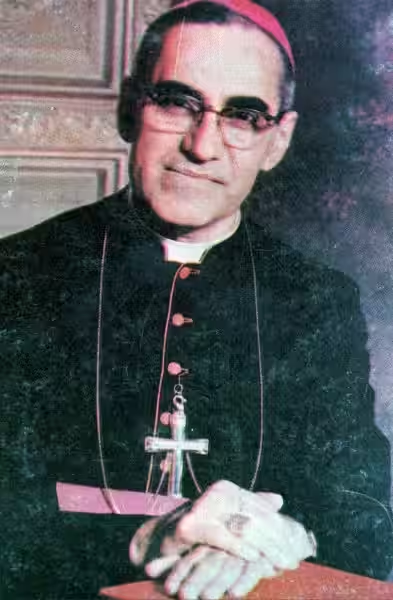
In the annals of religious history, certain figures stand out not merely for their theological pronouncements, but for the profound and often challenging ways they lived out their faith in the crucible of real-world suffering. One such luminous example is Óscar Romero, the Archbishop of San Salvador, whose life and martyrdom continue to resonate as a powerful testament to the intersection of deep religious conviction and unwavering commitment to social justice. His journey, from a more traditional pastoral approach to becoming a voice for the voiceless, offers invaluable lessons for believers and seekers alike in navigating the complexities of faith in a world grappling with inequality and oppression.
The story of Monsignor Romero is not just about a man; it is about the transformative power of faith when it is truly embodied. His transformation, from a relatively conservative clergyman to a fiery advocate for the poor and oppressed, is a narrative that speaks volumes about the active and dynamic nature of religious principles. It reminds us that faith is not a static set of beliefs, but a living, breathing force that demands engagement with the world around us, urging us to act with compassion and courage, especially when faced with injustice. The enduring impact of Monsignor Romero’s commitment to his flock, and the principles he held dear, is a beacon for all who strive to live a faith that is both personal and profoundly outward-looking.
The Seeds of a Shepherd’s Heart: Early Life and Formation
Born in rural El Salvador, the early life of Óscar Romero hinted at a future shaped by a profound sense of duty and service. His upbringing, while not one of extreme poverty, exposed him to the realities of rural life and the societal structures that often favored the few over the many. From a young age, he felt a calling towards the priesthood, a path that would eventually lead him to shoulder the immense responsibility of shepherding a nation in turmoil. His theological studies and early ministerial experiences laid the groundwork for his understanding of Catholic doctrine and the pastoral care of souls.
His path was one of dedicated study and quiet service. He was known for his intellectual rigor and his ability to articulate theological concepts with clarity. However, it was his eventual elevation to Archbishop of San Salvador in 1977 that truly propelled him onto the world stage. This appointment, which many initially believed would usher in a period of quiet conservatism, instead became the catalyst for one of the most significant transformations in modern religious leadership. The sheer weight of the suffering he witnessed daily in his archdiocese began to chip away at any complacency, igniting a fire within him that would burn brightly until his very last breath.
The Turning Point: Witnessing the Suffering of His Flock
The El Salvador of the late 1970s was a nation fractured by political instability, widespread poverty, and escalating violence. The military government, often supported by powerful landowners, wielded significant control, and dissent was met with brutal suppression. It was within this volatile landscape that Archbishop Romero found himself. Initially, his approach was more aligned with traditional church leadership, emphasizing spiritual guidance and internal church matters. However, the daily realities of his people’s plight – the disappearances, the extrajudicial killings, the systemic hunger, and the pervasive fear – began to penetrate his pastoral consciousness in a deeply personal way.
He could not, as a shepherd, stand idly by while his flock was being decimated. The stark contrast between the teachings of Christ, which emphasized love for the poor and marginalized, and the brutal oppression he witnessed, created an internal dissonance that could no longer be ignored. This period marked a profound shift in Monsignor Romero’s ministry. He started to speak out more forcefully, using his Sunday sermons, broadcast across the nation, as a platform to denounce the violence and advocate for peace and justice. His words, carefully chosen and imbued with a deep spiritual authority, began to resonate with ordinary Salvadorans yearning for hope and a voice.
A Voice for the Voiceless: Romero’s Prophetic Ministry
Archbishop Romero’s transformation was not merely symbolic; it was an active embrace of his prophetic calling. He understood that his role extended beyond the sanctuary walls; it demanded engagement with the political and social injustices that plagued El Salvador. His sermons became powerful instruments of conscience, directly challenging the authorities and offering solace and encouragement to those suffering. He spoke with an authority rooted not in political power, but in his unwavering faith and his deep love for his people.
His pronouncements were not abstract theological debates; they were direct calls to action, grounded in the Gospel. He would often say things like, “I will not be silent in the face of such evil.” This commitment to speaking truth to power, even at immense personal risk, cemented his reputation as a true shepherd who embodied the ideals of his faith. He was a living example of how religion can and should be a force for positive change, advocating for human dignity and challenging oppressive systems. His willingness to stand with the marginalized, to share in their suffering, and to amplify their cries for justice, became the hallmark of his prophetic ministry.
Denunciation of Violence and Repression: He consistently condemned the state-sponsored violence and the systematic human rights abuses occurring in El Salvador. He pleaded for an end to the bloodshed and for respect for human life.
Advocacy for the Poor and Marginalized: Romero championed the cause of the impoverished, the peasants, and all those who were systematically excluded and exploited. He reminded the powerful of their moral obligation to care for the vulnerable.
Call for Peace and Reconciliation: While fiercely denouncing injustice, he also consistently called for peace and dialogue, urging all sides to seek a non-violent resolution to the conflict.
The Integral Nature of Faith and Justice: He powerfully articulated that true faith could not be separated from a commitment to justice. To love God, he argued, meant to love one’s neighbor, and that love demanded active engagement with the world’s injustices.
His words were not always popular with the ruling elite, who saw him as a dangerous agitator. However, for the vast majority of Salvadorans, particularly the poor and those who had lost loved ones to the violence, Monsignor Romero was a beacon of hope, a voice that spoke for them when they had no other. His courage in the face of escalating threats was a testament to his profound spiritual conviction and his deep pastoral commitment. He often spoke of the “revolution of love” that he believed could transform society, a love that was active, demanding, and inextricably linked to justice.
Martyrdom and Enduring Legacy
The courage of Monsignor Romero ultimately led to his tragic assassination on March 24, 1980, as he celebrated Mass at a small chapel in San Salvador. He was gunned down by a sniper while at the altar, a brutal act that sent shockwaves across El Salvador and the world. This act of violence, intended to silence his prophetic voice, instead served to amplify it for generations to come. His martyrdom became a powerful symbol of the struggle for justice and the ultimate sacrifice made in the name of faith and conscience.
The legacy of Óscar Romero is immense. He was canonized as a saint by the Catholic Church in 2018, a recognition of his holiness and his exemplary life. However, his sainthood extends far beyond formal church pronouncements. For millions, he remains a living saint, a model of Christian discipleship who demonstrated that faith demands action and that true leadership involves placing oneself at the service of the most vulnerable. His life story continues to inspire activists, clergy, and ordinary people to engage with the challenges of their own societies, reminding them that even in the darkest of times, the voice of conscience, guided by faith and love, can shine a powerful light.
Frequently Asked Questions about Óscar Romero and Religion
Who was Óscar Romero?
Óscar Romero was a Catholic archbishop in El Salvador who became a prominent advocate for the poor and oppressed during the country’s civil war. He was known for his outspoken criticism of government violence and social injustice.
What was Óscar Romero’s stance on religion and politics?
Romero believed that faith and justice were inseparable. He saw his religious role as a moral imperative to speak out against the human rights abuses and economic inequality prevalent in El Salvador. He argued that true Christianity demanded solidarity with the marginalized.
What religious denomination did Óscar Romero belong to?
Óscar Romero was a Roman Catholic. He served as the Archbishop of San Salvador.
Was Óscar Romero a saint?
Yes, Óscar Romero was canonized as a saint by the Catholic Church on October 14, 2018. He is known as Saint Óscar Romero.
What is the significance of Óscar Romero’s religious beliefs in his activism?
His deeply held Catholic faith formed the bedrock of his activism. He drew inspiration from the Gospels, particularly Jesus’s teachings on compassion, justice, and service to the poor. His religious convictions compelled him to defend human dignity and challenge oppressive systems.
Why was Óscar Romero considered a controversial figure within the Church during his lifetime?
Romero’s outspokenness and alignment with liberation theology principles made him controversial among some within the Church hierarchy and conservative circles. His criticism of the government and powerful elites was seen by some as overly political or radical, while others saw him as a prophetic voice for the voiceless.
How did Óscar Romero’s faith influence his martyrdom?
Romero was assassinated on March 24, 1980, while celebrating Mass in a hospital chapel. His murder is widely believed to have been politically motivated, carried out by right-wing death squads in retaliation for his denunciations of state-sponsored violence. His death is seen by many as a martyrdom for his faith and his commitment to justice.
What is the legacy of Óscar Romero’s faith today?
Saint Óscar Romero is revered as a symbol of faith in action, a defender of human rights, and a champion for the poor. His life and teachings continue to inspire religious leaders and activists worldwide to advocate for social justice and stand against oppression.