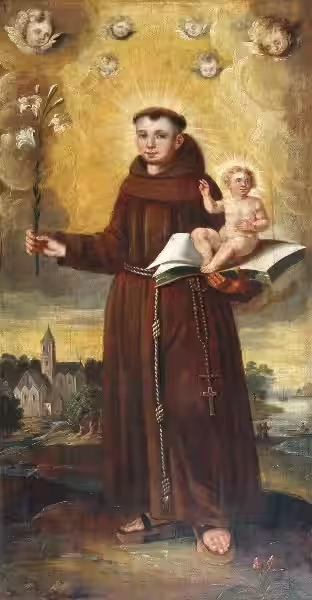
The name “St. Anthony” resonates deeply within Christian tradition, often immediately bringing to mind a kindly figure associated with finding lost things. But who was this revered saint, and what makes his story and his intercessory power so enduringly relevant centuries after his earthly life? Beyond the popular image, St. Anthony of Padua (though he spent most of his life in Italy, he was born in Portugal) was a profound theologian, a powerful preacher, and a fervent advocate for the poor and the marginalized. His life was a testament to unwavering faith, deep humility, and an extraordinary love for Christ and humanity, principles that continue to inspire millions around the globe.
Understanding who was St. Anthony involves delving into his historical context, his spiritual journey, and the remarkable impact he had on the Church and its people. He wasn’t born into a life of privilege but rather into a devout family, setting the stage for a life dedicated to spiritual pursuits. His early years were marked by a burning desire for knowledge and a deep commitment to God’s service, qualities that would define his actions and teachings throughout his life.
The Early Life and Spiritual Awakening of St. Anthony
Born Fernando Martins de Bulhões in Lisbon, Portugal, around 1195, the future St. Anthony was not initially drawn to the Franciscan order. He began his religious life as an Augustinian canon, a path that offered a strong intellectual and monastic foundation. However, a pivotal moment occurred when the relics of five Franciscan friars martyred in Morocco were brought to his monastery. Witnessing their devotion and willingness to sacrifice their lives for their faith ignited a profound spiritual reorientation within young Fernando. He felt an irresistible call to embrace the simpler, itinerant life of the Franciscans, seeking to emulate the martyrs’ courage and spread the Gospel with the same fervor.
This decision to join the Franciscans was not merely a change of habit; it was a radical shift in his life’s direction, driven by a passionate desire to live a life of radical poverty and evangelical zeal. He adopted the name Anthony, in honor of St. Anthony the Great, an early desert father. His early Franciscan life was one of intense prayer, study, and an increasing understanding of scripture. He was deeply moved by the teachings of St. Francis of Assisi, recognizing a shared vision for a Church rooted in humility, service, and a profound love for God’s creation. This spiritual awakening wasn’t just an internal experience; it was the genesis of a life that would be characterized by powerful preaching and an unshakeable commitment to justice and spiritual truth.
From Scholar to Preacher: The Rise of a Spiritual Luminary
St. Anthony’s intellectual prowess was evident from his early years. He dedicated himself to rigorous study, becoming exceptionally knowledgeable in scripture, theology, and canon law. This academic foundation, however, was not pursued for its own sake but as a means to better understand and proclaim God’s word. His initial assignments often involved teaching theology to fellow friars, a role he fulfilled with great distinction. Yet, it was in the realm of preaching that St. Anthony truly shone, captivating audiences with his eloquence, his deep understanding of the faith, and his ability to connect spiritual truths to the everyday lives of ordinary people.
His preaching was not confined to churches or formal settings. St. Anthony was known for his missionary zeal, often traveling to towns and villages to share the Gospel message. He possessed a remarkable gift for making complex theological ideas accessible, using vivid analogies and relatable examples that resonated with farmers, merchants, and laborers alike. For instance, when explaining the importance of good works, he might have used the analogy of a farmer who diligently plants seeds to reap a bountiful harvest, emphasizing that prayer and good deeds are the seeds of salvation. His sermons were not just informative; they were transformative, inspiring people to repent, to live more virtuous lives, and to deepen their relationship with God.
St. Anthony’s Renowned Connection to the Poor and the Lost
While who was St. Anthony is often associated with finding lost items, this popular perception stems from a deeper truth: his profound compassion for those who were suffering, deprived, or spiritually adrift. He was a staunch defender of the poor and the oppressed, often confronting wealthy landowners and corrupt officials who exploited the vulnerable. His sermons frequently included calls for charity, justice, and social responsibility, urging his listeners to care for those less fortunate and to share their abundance.
His reputation for helping people find what was lost extended beyond material possessions. He was seen as a spiritual guide, helping people find their way back to God when they had strayed, find hope in times of despair, and find peace when troubled. The story of a friar who had lost his psalter and prayed to St. Anthony for its return, only to have it miraculously reappear, is a testament to this association. This miraculous intervention, coupled with his unwavering dedication to serving others, solidified his image as a powerful intercessor for those in need, whether they had lost a physical object or a spiritual connection.
The Miraculous Interventions and Enduring Devotion
Throughout his life, and indeed, in the centuries following his death, numerous accounts of miraculous interventions attributed to St. Anthony have been documented. These stories, while varied in their specifics, all point to his powerful intercessory role and his deep love for humanity. Whether it was healing the sick, reconciling estranged individuals, or providing comfort in times of crisis, the faithful have consistently turned to St. Anthony for his assistance.
His canonization, which occurred remarkably quickly after his death in 1231, at the young age of 36, speaks volumes about the immediate and widespread recognition of his sanctity. The Church recognized the extraordinary grace and divine favor that seemed to accompany his life and ministry. Today, devotion to St. Anthony remains incredibly strong, with churches, chapels, and shrines dedicated to him across the globe. The “Little Blue Book,” filled with prayers and novenas to St. Anthony, is a beloved devotional tool for millions seeking his intercession, a tangible link to the enduring legacy of this beloved saint who continues to be a beacon of hope and a powerful advocate for those who call upon him.
Frequently Asked Questions About St. Anthony
Who was St. Anthony?
St. Anthony of Padua (born Fernando Martins de Bulhões) was a Portuguese Catholic priest and friar of the Franciscan Order. He is one of the most popular saints in Christianity.
What religion was St. Anthony?
St. Anthony was a devout follower of Christianity and a prominent figure within the Catholic Church. He was a member of the Franciscan Order.