The figure of Jesus Christ resonates profoundly across the globe, not just within Christian traditions, but also in other major faiths. For billions of Muslims worldwide, Jesus, known as Isa al-Masih, holds a position of immense veneration and respect. Understanding what Muslims think of Jesus Christ is crucial for fostering interfaith dialogue and dispelling common misconceptions. Far from being a mere prophet, Jesus in Islam is a divinely appointed messenger, a sign of God’s power, and a harbinger of future events.
The relationship between Islam and Christianity, though distinct, shares a common thread in recognizing Jesus’s miraculous birth and his pivotal role in salvation history. This article aims to illuminate the multifaceted understanding Muslims have of Jesus, exploring his divine commission, his relationship with the Prophet Muhammad, and his ultimate destiny, offering a comprehensive and relatable perspective for anyone seeking to understand this vital aspect of Islamic faith.
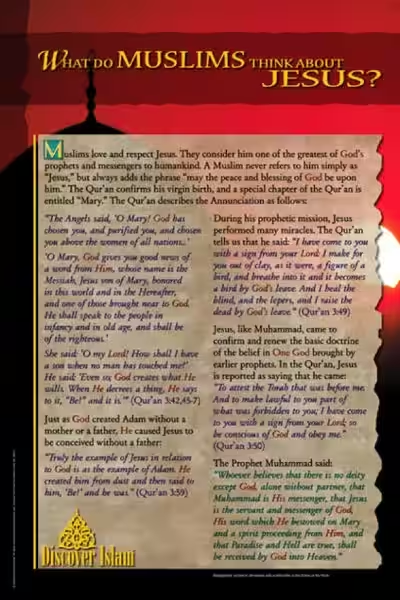
In Islam, Jesus is not considered divine in the Christian sense of being the Son of God, but he is unequivocally a highly revered prophet of Allah. The Quran, the holy book of Islam, dedicates significant passages to Jesus, detailing his immaculate conception, his miraculous birth, his divine mission, and his profound teachings. Muslims believe that Jesus was born to the Virgin Mary (Maryam, who is also highly honored in Islam) through a miraculous act of God, a testament to His omnipotence. This event is seen as a clear sign of God’s power to create without human intervention, similar to the creation of Adam.
The Quran refers to Jesus as “the Word of God” (Kalimatullah) and “a Spirit from Him” (Ruhun Minhu). These titles, while not implying divinity, highlight his unique status and his direct connection to God. Muslims believe Jesus was sent with clear signs and divine guidance to the Children of Israel, performing miracles such as healing the sick and raising the dead by the permission of Allah. These acts were not performed through his own inherent power, but were manifestations of God’s will and support for His messenger.
The Miraculous Birth and Virgin Mary
The narrative of Jesus’s birth is particularly significant in Islam, emphasizing the divine intervention from its very beginning. The Quran recounts Mary’s astonishment and her questioning of how she could conceive a child when no man had touched her. The angel Gabriel (Jibril) explained that this was a direct decree from Allah, a mercy and a sign from Him. This event underscores the Islamic belief in God’s absolute power over creation and His ability to bring about events that defy natural human understanding.
Mary’s purity and devotion are also central to this narrative. She is presented as a righteous and chosen woman, and her son, Jesus, is seen as a blessed offspring born under unique circumstances. This miraculous conception is not seen as a stumbling block but as a powerful affirmation of God’s creative power, a theme that runs through various accounts in the Quran, from the creation of Adam to the resurrection of the dead.
Jesus’s Miracles and Divine Mission
Muslims believe that Jesus performed numerous miracles, all by the will and power of Allah. These miracles served as proof of his prophethood and the divine message he conveyed. The Quran mentions Jesus shaping birds from clay and breathing life into them, healing the blind and the lepers, and even speaking from the cradle as an infant, proclaiming his servitude to God. These extraordinary feats were not just displays of power but were meant to guide humanity towards the worship of the One True God.
The core of Jesus’s mission, as understood in Islam, was to call people to submit to the will of Allah (Islam means submission to God). He preached monotheism, the belief in one God, and urged his followers to live righteous lives. His teachings emphasized compassion, justice, and mercy, principles that are fundamental to Islamic ethics. Muslims view Jesus as someone who lived a life of piety and obedience to God, serving as an exemplary figure for his followers.
Jesus in the Quran: A Detailed Account
The Quran offers a rich and detailed portrayal of Jesus, presenting him as “a sign for mankind and a mercy from Us” (Quran 19:21). His name, Isa, appears frequently, and he is often referred to by honorific titles, emphasizing his elevated status. Unlike some other prophets whose stories might be more briefly mentioned, Jesus’s life and mission are given considerable attention in the Quran, highlighting his importance in the grand tapestry of divine revelation.
The Quranic narrative provides a distinct perspective on Jesus’s life, death, and ascension, which differs from Christian theology in key aspects, particularly concerning the crucifixion and divinity. Understanding these Quranic accounts is essential for grasping the full scope of what Muslims think of Jesus Christ.
The Ascension of Jesus
A significant point of divergence between Islamic and Christian beliefs concerns the crucifixion. The Quran states that Jesus was not crucified, but that it appeared so to those present. Instead, Muslims believe that Allah raised Jesus to Himself in heaven. This event, known as the Ascension, is a cornerstone of Islamic belief regarding Jesus’s earthly departure. It signifies his divine protection and a continuation of his existence in a higher spiritual realm.
This belief in Jesus’s ascension means that Muslims do not accept the concept of his crucifixion and subsequent resurrection in the same way Christians do. Instead, they see it as a divine rescue, a testament to his special status and God’s plan. The Quran states, “And [for] their saying, ‘Indeed, we have killed the Messiah, Jesus, the son of Mary, the messenger of Allah.’ And they did not kill him, nor did they crucify him; but [another] was made to resemble him to them. And indeed, those who differ over it are in doubt about it. They have no knowledge of it except the following of assumption. And they did not kill him, for certain.” (Quran 4:157).
Jesus’s Second Coming
Muslims believe that Jesus will return to Earth before the Day of Judgment. This Second Coming is a significant eschatological event in Islam, and it is often linked to the appearance of the Antichrist (Dajjal). Jesus’s return is not to spread a new religion, but to reinforce the message of Islam and to establish justice and peace in the world. He will break the cross, kill the swine, and abolish the jizya (a historical tax levied on non-Muslims), signifying the triumph of true monotheism.
His return is seen as a divine sign that the end times are near and a confirmation of the ultimate victory of truth over falsehood. This belief in Jesus’s return further solidifies his crucial role in Islamic theology, portraying him as a key figure in the unfolding of God’s plan for humanity.
Jesus’s Relationship with Prophet Muhammad
In Islamic eschatology, Jesus and Prophet Muhammad are seen as two crucial figures in the lineage of prophets, with Muhammad being the final prophet in this chain. While Jesus conveyed God’s message to his people, Prophet Muhammad brought the final and complete revelation of Islam to all of humanity. Muslims do not see them as rivals but as integral parts of a continuous divine mission.
This understanding emphasizes the unity of God’s message throughout history, delivered through various prophets, each tailored to their specific time and community. The relationship is one of mutual respect and fulfillment, with Jesus paving the way for the final message brought by Muhammad.
Jesus as a Harbinger of Muhammad
Islamic tradition holds that Jesus himself foretold the coming of Prophet Muhammad. The Quran mentions Jesus saying, “O children of Israel, indeed I am the messenger of Allah to you, confirming what was before me of the Torah and απαang glad tidings of a messenger to come after me, whose name is Ahmad.” (Quran 61:6). Ahmad is a name often associated with Muhammad. This prophecy is seen as a clear indication of Jesus’s recognition of Muhammad’s prophethood.
This narrative of prophecy and fulfillment is crucial for Muslims, demonstrating the continuity of divine guidance and the ultimate perfection of the message delivered through Prophet Muhammad. It reinforces the belief that Islam is not a new religion but the completion and culmination of all previous divine dispensations.
The Role of Muhammad as the Final Prophet
Prophet Muhammad is considered the Seal of the Prophets in Islam, meaning that no prophet will come after him. His message, the Quran, is believed to be the final and uncorrupted word of God. While Jesus was a prophet sent to the Children of Israel, Prophet Muhammad was sent as a mercy to all worlds. This hierarchical understanding does not diminish Jesus’s importance but places him within the broader framework of Islamic prophecy.
Therefore, for Muslims, the teachings and example of Prophet Muhammad serve as the ultimate guide for life, building upon and completing the divine messages that came before, including those of Jesus.
Common Misconceptions and Similarities
Despite the profound respect Muslims have for Jesus, there are often misunderstandings between Muslims and Christians regarding their respective beliefs. Many non-Muslims are unaware of the high esteem in which Jesus is held in Islam, often assuming that his role is minimized. Conversely, Muslims may not fully grasp the nuances of Christian doctrines like the Trinity or the crucifixion, which are central to their faith.
The key lies in recognizing that while both faiths revere Jesus, their theological frameworks and interpretations of his life and mission are distinct. Understanding these differences and similarities is vital for fostering mutual respect and accurate representation.
Differences in Divinity and Sonship
The most significant theological difference lies in the concept of Jesus’s divinity. Muslims firmly reject the Christian doctrine of the Trinity, which posits God as three persons in one: the Father, the Son (Jesus), and the Holy Spirit. For Muslims, Tawhid (the absolute oneness of God) is the paramount principle. They believe that attributing any divine qualities to Jesus, or considering him the Son of God in a literal sense, is shirk (polytheism), the gravest sin in Islam.
While Christians see Jesus as divine, Muslims see him as a human messenger chosen by God, albeit one with a miraculous birth and a unique spiritual connection. This distinction is fundamental and requires careful explanation.
Shared Values and Reverence
Despite theological differences, there is a shared reverence for Jesus’s moral teachings and his role as a righteous figure. Both Islam and Christianity emphasize Jesus’s compassion, his miracles, and his call to a life of piety and submission to God. The Quran describes Jesus as a “word from Him” and a “spirit from Him,” highlighting his pure and divinely connected nature.
The Virgin Mary is also a highly respected figure in Islam, with an entire chapter in the Quran named after her. This shared respect for key figures and moral principles creates a bridge for understanding and dialogue. Muslims often marvel at the moral lessons conveyed through Jesus’s life and teachings, finding them to be in harmony with the broader principles of Islam.
Conclusion: A Figure of Unity and Respect
In conclusion, what do Muslims think of Jesus Christ is that he is a central and highly revered figure, a beloved prophet, a miraculous messenger, and a sign of God’s power. While not considered divine in the Christian sense, his status is far beyond that of an ordinary human. He is a guiding light whose life and teachings are deeply respected and whose return is eagerly awaited.
Understanding this perspective is not just an academic exercise; it is essential for building bridges of understanding and cooperation between communities. The shared reverence for Jesus Christ, despite differing theological interpretations, offers a powerful foundation for interfaith harmony and a testament to the enduring legacy of this pivotal figure in human history. His story, as told in the Quran, continues to inspire faith, hope, and devotion for Muslims around the world, solidifying his position as an icon of peace and divine guidance.
Frequently Asked Questions: What do Muslims think of Jesus Christ?
Who is Jesus in Islam?
Muslims revere Jesus (Isa in Arabic) as a highly esteemed prophet of God, one of the most important figures in Islam. They believe he was born of the Virgin Mary (Maryam) through a miraculous conception by God’s command.
What are Jesus’s titles in Islam?
Jesus is known by many reverent titles in Islam, including “Messiah” (Al-Masih), “Word of God” (Kalimatullah), and “Spirit of God” (Ruhullah).
Do Muslims believe Jesus was divine?
No, Muslims do not believe Jesus was divine or the son of God in a literal sense. They firmly believe in the absolute oneness of God (Allah) and that Jesus, like all prophets, was a human being chosen by God to convey His message.
What was Jesus’s mission according to Islam?
Muslims believe Jesus was sent by God to guide the Children of Israel back to the worship of the One God. He performed miracles by God’s permission and preached the same fundamental message of submission to God as other prophets, including Muhammad.
Do Muslims believe Jesus was crucified?
Muslims believe that Jesus was not crucified. The Quran states that Jesus was raised to heaven by God, and it was made to appear to his enemies that he was crucified.
Do Muslims believe Jesus will return to Earth?
Yes, Muslims believe that Jesus will return to Earth before the Day of Judgment. They believe he will descend to Earth, uphold justice, defeat the Antichrist, and live out his life before passing away.
What is the relationship between Jesus and Muhammad in Islam?
Muslims see Jesus as a crucial prophet in the chain of prophethood, culminating with the Prophet Muhammad, who is considered the final prophet in Islam. They believe Muhammad’s message confirms and completes the teachings of previous prophets, including Jesus.