The figure of Jesus, known as Isa (Jesus) in Islam, holds a place of immense significance and profound reverence within the Islamic faith. Far from being a mere prophet, Isa is considered one of the most beloved and important messengers of God (Allah), second only to the Prophet Muhammad. Understanding what Muslims believe about Jesus offers a deep insight into the core tenets of Islam, revealing a shared spiritual heritage and a remarkably nuanced perspective that often surprises those unfamiliar with Islamic teachings. This article delves into the multifaceted Islamic view of Isa, exploring his divine role, miraculous birth, teachings, and his ultimate destiny.
In Islam, Jesus is unequivocally recognized as the Son of Mary (Maryam), but not in the Christian sense of being divine or the literal son of God. For Muslims, Allah is One, indivisible, and without partners or offspring. The concept of the Trinity is fundamentally rejected. Therefore, when the Quran refers to Jesus as “Allah’s word” and “a spirit from Him,” these are understood as titles of honor and descriptions of his unique creation and mission, not as indicators of divinity. He is a human being chosen by God, endowed with extraordinary powers and a special role in guiding humanity.
Muslims believe that Isa was chosen by Allah from the very beginning of creation to be a prophet and a clear sign for mankind. His importance is underscored by the fact that he is mentioned by name more than any other prophet in the Quran, highlighting his central role in the divine narrative. Think of it like this: Imagine a renowned architect designing a magnificent city. While many skilled builders contribute to its construction, one particular builder might be given the crucial task of overseeing the most intricate and foundational structures, making their contribution exceptionally noteworthy, even if they are not the architect themselves. Similarly, Isa’s role was pivotal in God’s plan for humanity.
The Miraculous Birth and Early Life of Jesus
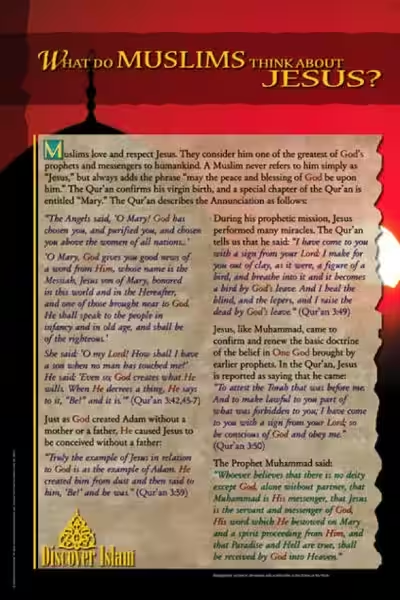
The birth of Jesus is considered one of the greatest miracles in Islamic tradition. The Quran recounts that Mary, a devout and chaste woman, was miraculously impregnated by the angel Gabriel (Jibril), without any human intervention. This virgin birth is a cornerstone of Islamic belief about Isa, emphasizing his pure and divinely ordained existence. The Quran states: “And mention, [O Muhammad], Mary, when she secluded herself from her family. She took a screen against them. Then We sent to her Our Spirit, and he took the form of a well-proportioned human. She said, ‘Indeed, I seek refuge in the Most Merciful from you, if you are God-fearing.’ He said, ‘I am only a messenger of your Lord to give you a pure boy.’” (Quran 19:16-19)
This miraculous conception was a sign from Allah, a testament to His power to create and to bring forth life in extraordinary ways. When questioned by her people about the baby, Mary was miraculously able to point to the infant Jesus, who then spoke from the cradle, proclaiming his prophethood and his servitude to Allah. This infant speech is another profound miracle attributed to Isa, further solidifying his special status. This event served as an immediate validation of his divine mission and a testament to the power of God’s word.
The Prophethood and Teachings of Isa
Muslims believe that Jesus was a Prophet of God, commissioned to guide the Children of Israel and to reinforce the monotheistic message that preceded him. He taught the Oneness of God (Tawhid), emphasized righteousness, compassion, and justice, and called people to submit to Allah’s will. His followers, who were called “al-Hawariyyun” (the Disciples or Apostles), were instrumental in spreading his message. Islam views Jesus’s teachings as consistent with the teachings of all other prophets, including Abraham, Moses, and ultimately Muhammad, all of whom conveyed the same fundamental divine message.
Jesus’s miracles, such as healing the sick, raising the dead, and creating birds from clay, are all seen as divine interventions, performed by the permission of Allah. These miracles were not of his own power, but rather a demonstration of God’s omnipotence working through His chosen messenger. They served as proof of his prophethood and the truth of his message. For example, when Jesus healed a leper, it wasn’t because he possessed inherent healing powers, but because God granted him the ability to perform such feats as a sign to the people.
The Crucifixion and Ascension: A Different Perspective
One of the most significant theological differences between Islam and Christianity lies in their understanding of Jesus’s crucifixion. Muslims do not believe that Jesus was crucified or killed. The Quran states that it was made to appear to them that they had crucified him, but in reality, Allah raised Isa to Himself. This means that someone else was made to look like Jesus and was crucified in his place, while Jesus himself was ascended to heaven.
This belief is rooted in the Quranic verse: “And [for] their saying, ‘Indeed, we have killed the Messiah, Jesus, the son of Mary, the messenger of Allah.’ And they did not kill him, nor did they crucify him; but [another] was made to resemble him to them. And indeed, those who differ over it are in doubt about it. They have no knowledge of it except the following of assumption. And they did not kill him, for certain. Rather, Allah raised him to Himself. And Allah is ever Exalted in Might and Wise.” (Quran 4:157-158). This divine intervention preserved Jesus from death at the hands of his enemies and signifies his special status in God’s eyes.
The Second Coming of Jesus in Islam
A crucial aspect of Islamic eschatology is the belief in Jesus’s second coming to Earth. Muslims believe that Isa will return before the Day of Judgment to defeat the Antichrist (Dajjal), establish justice and peace, and reinforce the message of Islam. He will break the cross, kill the swine, and abolish the jizya (a historical tax levied on non-Muslims in an Islamic state, implying that Islam will be the prevailing religion). His return is seen as a sign of the approaching end times.
During his second coming, Jesus will not bring a new religion, but will rule according to Islamic law, as Prophet Muhammad is considered the final prophet. His presence will be a confirmation of the truth of Islam and a testament to God’s ultimate victory over evil. He will live a normal human life, get married, and eventually die, being buried alongside Prophet Muhammad in Medina, a testament to the continuity of their prophetic missions.
In Islam, Jesus is also viewed as a witness for humanity. On the Day of Judgment, he will testify before Allah about how his message was received by his people. This highlights his ongoing role in the divine accounting of human deeds. He is a constant reminder of God’s mercy, power, and the ultimate accountability that awaits all individuals.
The reverence Muslims hold for Jesus is profound and enduring. He is not just a historical figure but a living presence in their faith, a beacon of divine guidance and a harbinger of ultimate justice. The Islamic perspective on Jesus, or Isa, is a testament to the richness and complexity of Islamic theology, showcasing a deep respect for him as a pivotal messenger of God. His life, miracles, and future return are all integral to the Islamic understanding of God’s plan for creation and humanity’s spiritual journey.
Frequently Asked Questions about Jesus in Islam
Who is Jesus in Islam?
Muslims believe Jesus (Isa in Arabic) is one of the most important prophets of God, born of the Virgin Mary (Maryam). He is highly revered for his piety, wisdom, and miraculous deeds.
Is Jesus considered divine in Islam?
No, Muslims do not believe Jesus is divine or the son of God in a literal sense. They believe he was a human prophet, chosen by God, and that worship is due to God alone.
What are some key beliefs about Jesus in Islam?
Muslims believe Jesus performed miracles by the will of God, such as healing the sick and raising the dead. They also believe he brought a divine message to humanity and was the Messiah.
What happened to Jesus according to Islamic belief?
Muslims believe Jesus was not crucified but was raised to heaven by God. They believe he will return to Earth before the Day of Judgment.
How is Jesus’s relationship with Prophet Muhammad?
Muslims believe Jesus was a prophet who preceded Prophet Muhammad. Prophet Muhammad is considered the final prophet in Islam, bringing the complete and final revelation of God’s message.