In a world often characterized by rapid change and evolving societal landscapes, the enduring influence of religious thought on matters of justice and human dignity remains a cornerstone of ethical discourse. Few documents have articulated this connection as profoundly as Pope Leo XIII’s encyclical, Rerum Novarum, a landmark text published in 1891. This pivotal document, often hailed as the Magna Carta of Catholic social teaching, didn’t just address the pressing economic and social issues of its time; it fundamentally reasserted the vital role of religion, specifically the Catholic faith, in providing a moral compass for a just and equitable society. Understanding Rerum Novarum is not merely an academic exercise; it’s an invitation to explore how religious principles have consistently offered solace, guidance, and a framework for action in the face of human suffering and inequality, a relevance that continues to resonate today.
The echoes of Rerum Novarum reverberate through contemporary discussions about workers’ rights, economic fairness, and the very fabric of our communities. It reminds us that true progress is not solely measured by technological advancement or economic growth, but by the well-being and inherent dignity of every individual. This encyclical, born out of a period of significant industrial upheaval and social unrest, sought to offer a distinctly religious perspective on these challenges, moving beyond purely secular solutions and emphasizing the transformative power of faith in shaping a more compassionate world.
The Genesis of Rerum Novarum: A Response to a Changing World
The late 19th century was a period of unprecedented industrialization, marked by the rise of factories, the growth of urban centers, and the emergence of a vast working class facing often deplorable conditions. The nascent socialist movements offered radical solutions, while laissez-faire capitalism, with its emphasis on unfettered markets, often overlooked the human cost. It was within this volatile context that Pope Leo XIII felt compelled to address what he termed the “new questions” – the pressing social and economic dilemmas of the era. Rerum Novarum was not a spontaneous pronouncement but a carefully considered response, deeply rooted in centuries of Christian tradition and a pastoral concern for the flock.
The encyclical’s very title, meaning “Of New Things,” signals its intent to confront the novel challenges presented by modernity. Leo XIII recognized that the prevailing economic systems were creating significant disparities, leading to widespread poverty and a sense of alienation for many. He understood that the Church, as a spiritual and moral authority, had a duty to speak out against injustice and to offer a vision of society that was grounded in divine principles of love, justice, and solidarity. This was a bold move, asserting that religion was not to be confined to purely private devotion but had a crucial public dimension, actively shaping the ethical landscape of economic and social life.
The Foundational Role of Religion in Social Order
At its core, Rerum Novarum argued that religion, and particularly the teachings of Christianity, provided the indispensable moral foundation for a just and stable society. Leo XIII contended that secular ideologies, while sometimes offering well-intentioned solutions, ultimately lacked the depth and intrinsic motivation to truly foster human flourishing. He saw religion as the ultimate source of human dignity, recognizing that individuals are not merely economic units but beloved creatures of God, possessing inherent worth and rights that transcend material considerations.
The encyclical specifically highlighted several key contributions of religion to social order. Firstly, it emphasized the intrinsic value of human labor, not as a commodity to be exploited, but as a dignified activity that reflects our participation in God’s creation. Secondly, it underscored the importance of family, the fundamental unit of society, and advocated for policies that protected its integrity and stability. Thirdly, it championed the right to private property, not as an absolute entitlement but as a means to promote individual responsibility and contribute to the common good. These principles, derived directly from religious doctrine, offered a powerful counterpoint to the radical ideologies that threatened to dismantle traditional social structures.
The Dignity of Labor and the Rights of Workers
One of the most impactful contributions of Rerum Novarum was its unequivocal defense of the dignity of labor and the rights of working people. Leo XIII vehemently condemned the exploitation of workers, arguing that their labor was not simply a factor of production but a reflection of their God-given talents and their contribution to society. He asserted that workers had a right to a just wage – a wage sufficient to support themselves and their families in dignity, allowing them to live a life befitting their human status. This was a radical departure from the prevailing notion that wages were determined solely by the forces of supply and demand.
The encyclical also recognized the inherent inequality that often existed between employers and employees, and it advocated for the formation of associations and unions as a means for workers to collectively bargain for their rights and improve their working conditions. Leo XIII saw these associations not as instruments of class conflict, but as legitimate bodies that could foster solidarity and mutual support among laborers. This was a crucial endorsement, providing religious legitimacy to the burgeoning labor movement and offering a moral framework for collective action aimed at achieving fairer treatment. For example, imagine a group of factory workers facing dangerous machinery and long hours; Rerum Novarum would affirm their right to organize and collectively negotiate for safety improvements and reasonable working hours.
The Moral Imperative of a Just Wage
The concept of a just wage as articulated in Rerum Novarum is more than just a living wage; it’s a wage that allows a worker to participate fully in society and to provide for their family’s needs, including education and opportunities for spiritual development. Leo XIII argued that employers have a moral obligation to pay such a wage, a duty rooted in the understanding that they are stewards of God’s creation and are responsible for the well-being of those in their employ. This principle challenged the purely economic calculus that often dictated wages, introducing a moral dimension that demanded consideration for the worker’s inherent dignity.
The encyclical further emphasized that the wage should enable a worker to save and to provide for future needs, including illness and old age. This foresight, a direct outgrowth of religious teachings on prudence and responsibility, laid the groundwork for concepts like social security and retirement benefits. The idea is that a just wage isn’t just about surviving today; it’s about enabling a life of dignity and security for the worker and their family across their lifespan. The religious call to care for the less fortunate and to ensure a basic standard of living for all is powerfully present in this aspect of Rerum Novarum.
While Rerum Novarum championed the rights of individuals and the role of associations, it also addressed the essential role of the state in ensuring social justice. Leo XIII argued that the state has a legitimate and necessary function in protecting the rights of its citizens, particularly the most vulnerable. This included intervening to prevent exploitation, ensuring fair labor practices, and promoting the common good. The encyclical rejected both anarchy and totalitarianism, advocating for a balanced approach where the state acts as a just arbiter and protector, not an all-encompassing entity that stifles individual initiative.
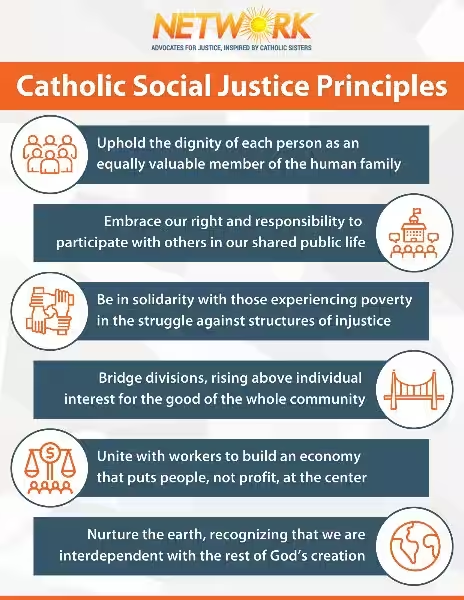
The concept of the common good, deeply embedded in religious philosophy, was central to Leo XIII’s argument. He defined it as the sum of those social conditions which enable individuals to achieve their full human potential. This meant that policies and economic activities should not solely benefit a select few but should contribute to the overall well-being of society. Religion, through its emphasis on charity, solidarity, and universal love, provides the moral impetus for pursuing the common good, encouraging individuals and institutions to look beyond their immediate self-interest for the betterment of all. This is why religious communities have historically been at the forefront of advocating for social welfare programs and charitable initiatives.
Balancing Individual Rights with Societal Needs
Rerum Novarum sought to strike a delicate balance between the protection of individual rights and the promotion of societal needs. The encyclical affirmed the right to private property, but it also stressed that this right comes with responsibilities. Property owners were called to use their wealth not only for their own benefit but also for the benefit of society, contributing to employment and the welfare of their workers. This religious perspective challenged the notion of property as an absolute right, instead framing it within a broader context of stewardship and social obligation.
The encyclical’s emphasis on the common good also meant that the state had a role in regulating economic activities to prevent abuses and to ensure that they served the broader interests of society. This could include regulations on working hours, safety standards, and fair wages. The religious imperative to care for the poor and the marginalized provided the ethical justification for such state intervention, ensuring that economic progress did not come at the expense of human dignity. For instance, a religious leader might advocate for environmental regulations, seeing the protection of God’s creation as a fundamental aspect of the common good.
The Enduring Legacy of Rerum Novarum and Religion’s Continued Relevance
More than a century after its publication, the principles articulated in Rerum Novarum continue to inspire and guide efforts towards social justice worldwide. The encyclical’s robust defense of human dignity, the rights of workers, and the importance of the common good remains remarkably relevant in our contemporary world, which still grapples with issues of economic inequality, exploitation, and social unrest. The document serves as a powerful reminder that religious faith is not merely a private affair but a potent force for positive social change.
The enduring legacy of Rerum Novarum lies in its assertion that a truly just society must be built on a foundation of moral and spiritual values. It calls for a human-centered approach to economics and politics, one that prioritizes the well-being of every individual, especially the most vulnerable. The religious impulse to love one’s neighbor, to act with compassion, and to strive for justice remains a vital engine for progress, offering a hopeful vision for a world where economic activity serves humanity and not the other way around. The ongoing discussions about fair trade, ethical consumption, and the responsibilities of corporations all owe a debt to the foundational insights of this seminal religious document.
Frequently Asked Questions about Rerum Novarum and Religion
What is Rerum Novarum and its connection to religion?
Rerum Novarum, meaning “Of New Things,” is a landmark encyclical letter published by Pope Leo XIII in 1891. It is considered a foundational document of modern Catholic social teaching and directly addresses the social and economic issues of the time, particularly the plight of the working class. Its connection to religion is profound, as it is rooted in Catholic doctrine and moral principles, interpreting them through the lens of contemporary societal challenges. Pope Leo XIII sought to provide a Christian response to socialism, liberalism, and the Industrial Revolution, advocating for principles of justice, charity, and the common good as guided by religious faith.
How does Rerum Novarum relate to the teachings of Christianity?
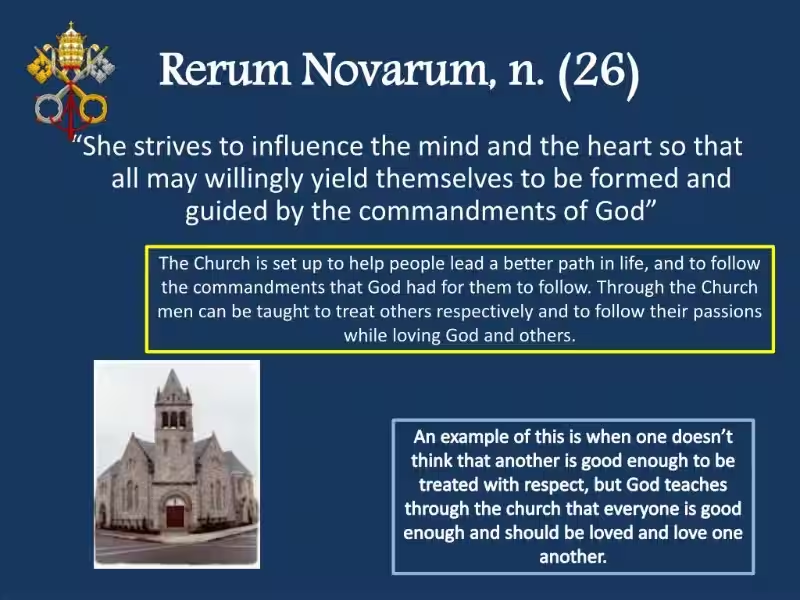
Rerum Novarum draws heavily upon core Christian teachings, including the inherent dignity of every human person as created in the image of God, the concept of the common good, and the ethical obligations of both employers and employees. It emphasizes the sacredness of private property while also stressing that it is not an absolute right and must be used for the benefit of society. The encyclical reiterates Christian principles of solidarity, mutual respect, and the importance of family life, all of which are central to Christian morality and social order. It also calls for a just wage that allows a worker to live a decent life, reflecting the Christian command to care for the poor and vulnerable.
What was the religious context in which Rerum Novarum was written?
Rerum Novarum was written during a period of significant social upheaval and religious questioning. The Industrial Revolution had created vast wealth for some but widespread poverty and harsh working conditions for many. Socialism, as an ideology, was gaining traction as a response to these inequalities, often presenting itself as an alternative to religious solutions. Pope Leo XIII, as the head of the Catholic Church, felt a religious and moral imperative to address these burgeoning societal problems and offer a Christian perspective that would both critique the injustices of the time and offer a path forward that aligned with religious values, thereby affirming the relevance of faith in the public sphere.
How did Rerum Novarum aim to influence religious practice and belief?
Rerum Novarum aimed to demonstrate that Catholic social teaching was not merely theoretical but a practical guide for living a just and faithful life in the modern world. By applying religious principles to concrete social and economic issues, the encyclical sought to show believers that their faith had implications for their economic and political actions. It encouraged the formation of workers’ associations and other forms of collective action rooted in Christian principles, thereby fostering a more active and engaged religious community. Ultimately, it aimed to reinforce the belief that a just society is one that is guided by God’s law and that religious institutions have a vital role to play in promoting social justice and human flourishing.