For millennia, bread has been more than just sustenance; it has been a cornerstone of human civilization, a symbol of abundance, and a sacred element in countless religious traditions. While modern bread often boasts added vitamins and minerals, the simple, unadulterated loaf – known as non-fortified bread – holds a unique and often overlooked significance in the tapestry of faith. This article will explore the profound connections between non-fortified bread and various religious practices, delving into its symbolic meaning, its role in rituals, and its enduring presence in the lives of believers.
The very act of baking bread, from milling grains to the final crusty loaf, is a process that has been imbued with spiritual meaning across cultures. It represents the transformation of raw ingredients into life-giving sustenance, a metaphor for divine providence and the nurturing power of faith. Understanding the genesis of non-fortified bread allows us to appreciate the deeper layers of meaning it carries within religious contexts.
The Sacredness of Simplicity: Non-Fortified Bread as a Symbol
In its most basic form, non-fortified bread is a testament to the beauty of simplicity and purity. It is bread made from flour, water, yeast, and salt – a humble yet complete collection of essential elements. This unembellished nature often resonates deeply with religious teachings that emphasize humility, gratitude, and the appreciation of life’s fundamental blessings. Think of the early Christian communities, where sharing a simple loaf was an act of profound fellowship and remembrance, devoid of the complex additions we see today. This uncomplicated nature makes non-fortified bread a powerful symbol of unconditional divine love and provision.
The absence of artificial enhancements or added nutrients in non-fortified bread can be seen as a reflection of a desire to connect with a more primal, unadulterated form of existence. Many spiritual paths advocate for a life stripped of excess and superficiality, focusing instead on what is truly essential. In this light, non-fortified bread becomes a tangible representation of this philosophy. It is a reminder that true nourishment and spiritual fulfillment can be found in the most basic and natural of things, a message that echoes through the ages in religious discourse.
Bread in Christian Traditions: From the Last Supper to Daily Devotion
Perhaps the most widely recognized religious association with bread lies within Christianity, particularly with the Eucharist, or Holy Communion. Jesus himself, at the Last Supper, broke bread with his disciples, declaring, “This is my body.” This iconic moment forever links non-fortified bread to the sacrifice and redemption central to Christian belief. For many denominations, the bread used in Communion is a simple unleavened or minimally leavened non-fortified bread, deliberately chosen for its symbolic purity and its direct connection to the historical event.
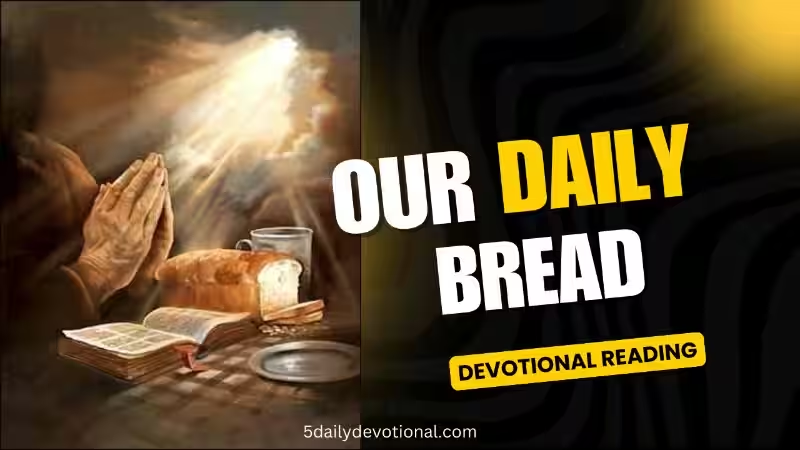
Beyond the sacred ritual of Communion, bread has a long history of being a staple food and a symbol of God’s daily provision for Christians. The Lord’s Prayer, a cornerstone of Christian devotion, includes the petition, “Give us this day our daily bread.” This phrase underscores the reliance on God for sustenance, not just in a spiritual sense, but also for the literal nourishment provided by food, with non-fortified bread being the most fundamental form of that provision for centuries. The act of breaking and sharing bread within Christian households and communities has also fostered a sense of unity, charity, and mutual dependence, reinforcing the idea that believers are part of a larger spiritual family.
Judaism and the Symbolism of Matzah
In Judaism, non-fortified bread, specifically in the form of matzah, holds immense symbolic weight, particularly during the Passover festival. Matzah, an unleavened bread, commemorates the haste with which the Israelites fled Egypt, leaving no time for their dough to rise. This act of eating matzah is a visceral reminder of liberation and freedom from oppression. The simple, cracker-like texture of matzah, made from just flour and water, emphasizes the humility and resilience of the Jewish people during their exodus.
The commandment to eat matzah during Passover is not merely symbolic; it is a direct historical and religious imperative. The preparation and consumption of matzah are central to the Seder meal, a deeply meaningful ritual that retells the story of the Exodus. The absence of leavening in matzah is crucial; it represents the absence of arrogance and the purity of their escape. This focus on non-fortified bread serves as a powerful tool for transmitting religious narratives and values across generations, ensuring that the lessons of freedom and faith are never forgotten. The commandment to eat matzah is a tangible connection to their ancestors’ journey and a reaffirmation of their covenant with God.
Beyond the Abrahamic Faiths: Bread in Other Spiritual Practices
The spiritual significance of bread extends far beyond the Abrahamic religions, weaving its way into the fabric of diverse spiritual traditions. In many ancient pagan rituals, bread, often prepared with simple, natural ingredients, was offered to deities as a sign of gratitude and a plea for fertility and abundance. These offerings were a way to acknowledge the earth’s bounty and the divine forces believed to be responsible for it. The act of sharing this sacred bread within the community reinforced their connection to the land and to each other.
Even in cultures where bread might not be the primary staple, the concept of baked goods made from grains often carries spiritual undertones. These offerings symbolize the fruits of labor and the generosity of nature. The non-fortified nature of these offerings, when they are simple and unadorned, often points to a desire for authenticity and a direct connection with the divine, free from the distractions of artifice. The shared meal, often featuring some form of bread or grain-based product, becomes a sacred space for communion, reflection, and spiritual renewal.
Modern Interpretations and the Enduring Appeal of Non-Fortified Bread
In today’s world, where processed foods and fortified options are ubiquitous, there is a growing resurgence of interest in non-fortified bread. This trend is often driven by a desire for healthier, more natural food choices, but it also echoes a deeper longing for simplicity and authenticity, which aligns perfectly with many religious and spiritual values. Many people are rediscovering the pure taste and satisfying texture of bread made with minimal ingredients, appreciating the craftsmanship and care involved in its creation.
For individuals seeking a more grounded spiritual practice, choosing non-fortified bread can be a small yet meaningful act of conscious consumption. It is a way to connect with the historical roots of their faith, to appreciate the natural world, and to practice gratitude for the simple blessings in life. Whether it’s a grandmother’s traditional sourdough recipe or a loaf from a local artisan bakery, the appeal of non-fortified bread lies in its uncomplicated honesty and its ability to nourish both body and soul, reminding us of the profound connections between our food, our faith, and our fundamental human experience.
Non-fortified bread is bread that has not had any added vitamins or minerals, such as iron or folic acid, during its production. It typically contains only the basic ingredients of flour, water, yeast, and salt.
Why might someone choose non-fortified bread for religious reasons?
Some religious traditions have specific dietary laws or preferences that may lead individuals to seek out non-fortified foods. For example, certain interpretations within Orthodox Judaism may advise against consuming foods fortified with specific ingredients if those ingredients are derived from non-kosher sources, though this is not a universal ruling and depends heavily on individual rabbinic guidance and the specific fortification. Similarly, some individuals following specific dietary practices within other faiths might prefer to avoid processed foods or ingredients that are not naturally present in the original grain.
Are there specific religious prohibitions against fortified bread?
Generally, there are no universal religious prohibitions against fortified bread across major religions. Dietary laws are often complex and can have various interpretations. For instance, in Christianity, there are no specific prohibitions against fortified bread. In Islam, fortification is generally acceptable as long as the added nutrients are derived from permissible (halal) sources and do not contain forbidden ingredients. The primary considerations for religious individuals often revolve around the source of ingredients and the processing methods, which may sometimes influence the choice of fortified versus non-fortified options.
How can I determine if a bread is non-fortified?
The best way to determine if bread is non-fortified is to check the ingredient list on the packaging. Fortified breads will typically list added vitamins and minerals, such as “thiamin mononitrate,” “riboflavin,” “niacin,” “folic acid,” and “reduced iron.” If these are not listed and the ingredients are basic (flour, water, yeast, salt), the bread is likely non-fortified. If you are unsure, you can contact the manufacturer directly.
Do all breads made by religious communities adhere to non-fortification principles?
No, not all breads made by or for religious communities adhere to non-fortification principles. Religious dietary practices are diverse, and the decision to fortify or not fortify often depends on specific interpretations of religious law, the availability of ingredients, and the preferences of the community or individual. For example, while some Orthodox Jewish communities might scrutinize fortification, many mainstream kosher products are fortified. The same applies to other faith traditions.