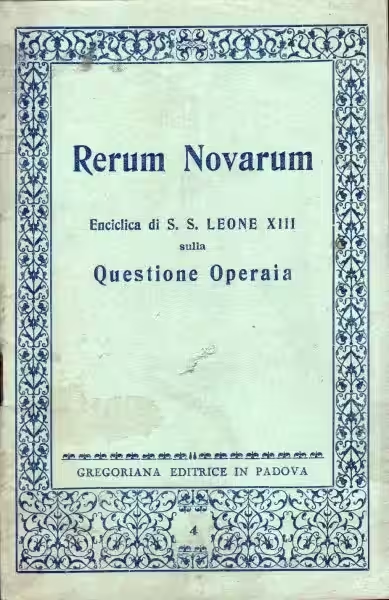
In the late 19th century, a seismic shift was underway across the globe. The Industrial Revolution, with its clanking machinery and burgeoning cities, had dramatically reshaped society. While it brought progress and innovation, it also birthed new and often brutal realities for the working class. Poverty was rampant, working conditions were deplorable, and the gap between the wealthy industrialists and the impoverished laborers widened into a chasm. It was within this crucible of social and economic upheaval that Pope Leo XIII penned an encyclical that would echo through the halls of religious thought and social justice for generations: Rerum Novarum. This landmark document, often translated as “Of New Things,” wasn’t just a theological treatise; it was a religious compass designed to guide the faithful, and indeed all of humanity, through the turbulent waters of modern industrial society.
Understanding Rerum Novarum summary is not merely an academic exercise; it’s an invitation to explore how faith can provide practical and profound answers to some of life’s most persistent challenges. The encyclical grappled with fundamental questions about the dignity of labor, the rights and responsibilities of both employers and employees, the role of the state, and the very nature of a just society. It sought to reconcile the teachings of the Catholic Church with the evolving socio-economic landscape, offering a vision where Christian principles could illuminate a path toward fairness and mutual respect, rather than fueling division and despair. This was a moment when religion was called upon not to retreat from the world, but to actively engage with its complexities, offering a moral framework grounded in divine love and human solidarity.
The Core Tenets of Rerum Novarum: Dignity, Rights, and Responsibilities
At its heart, Rerum Novarum was a powerful affirmation of the inherent dignity of human labor. Pope Leo XIII rejected the prevailing notion that work was a mere commodity to be bought and sold without regard for the human person. Instead, he emphasized that labor is not only essential for survival but is also a noble activity. He argued that workers, through their sweat and effort, contribute to the common good and deserve to be treated with respect and fairness. This was a radical departure from the prevailing capitalist ethos, which often viewed workers as interchangeable cogs in a machine, easily discarded when no longer useful. The encyclical championed the idea that work has intrinsic value, reflecting our participation in God’s creation and our role in building a better world.
The encyclical meticulously laid out the rights and responsibilities of various parties within society. For workers, it affirmed the right to a just wage – a wage sufficient to support a family in dignity, allowing for not just survival but also for a modest level of comfort and the ability to save. This was a direct challenge to the exploitative wage practices of the time. Simultaneously, it stressed the worker’s responsibility to perform their duties diligently and honestly. For employers, it outlined the obligation to provide fair working conditions, to avoid excessive hours, and to ensure the safety and well-being of their employees. Employers, too, had responsibilities to their workers, not just financial but also moral, fostering an environment of mutual trust and respect. The concept of a “family wage,” designed to allow a father to support his household without requiring his wife and children to toil in factories, was a central and enduring theme.
The Role of Religion in Social Reform: A Divine Mandate
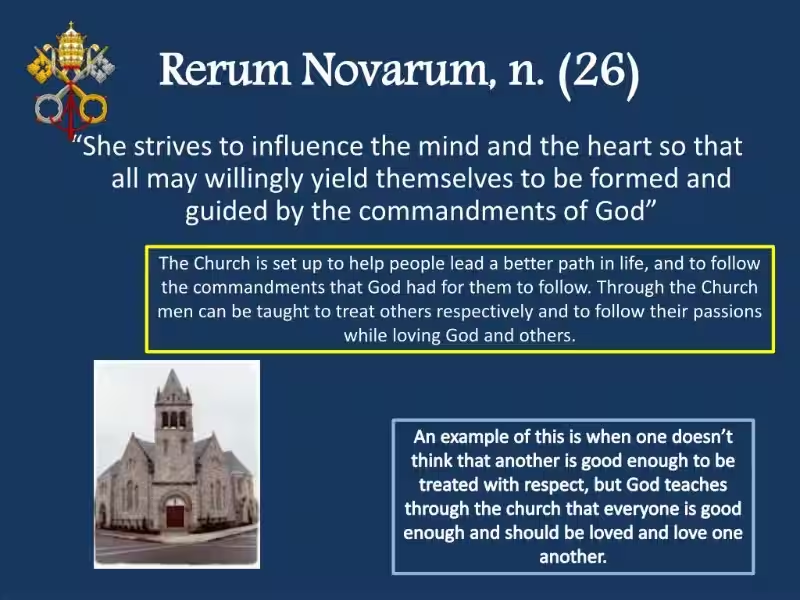
Crucially, Rerum Novarum situated these social and economic concerns within a religious framework. Pope Leo XIII argued that the Church, guided by divine revelation and the teachings of Christ, had a unique and indispensable role to play in addressing the social question. It wasn’t about the Church dictating economic policy, but about infusing economic and social interactions with Christian morality. This meant promoting virtues such as charity, justice, and solidarity, which are foundational to the Christian faith. The encyclical asserted that true social reform could not be achieved through purely secular means, as these often lacked the moral grounding to address the root causes of societal ills, such as greed and the pursuit of self-interest above all else.
The Church’s role, therefore, was to provide a moral compass and to advocate for the rights of the poor and marginalized. This involved not only spiritual guidance but also active engagement in promoting policies that would create a more just society. The encyclical encouraged the formation of workers’ associations and unions, seeing them as legitimate and necessary instruments for workers to collectively bargain for their rights and improve their conditions. This endorsement from the highest echelons of the Church lent significant weight to the burgeoning labor movement, offering it a powerful religious justification and a moral authority that transcended mere economic struggle. It was about recognizing that faith demands action in the world and that caring for our neighbor is a direct expression of our love for God.
Addressing the Conflicts: Private Property, the State, and the Common Good
One of the most significant areas Rerum Novarum summary addresses is the complex relationship between private property and the common good. While upholding the legitimacy of private ownership, a principle deeply rooted in Catholic Social Teaching, the encyclical cautioned against its unfettered accumulation at the expense of others. It argued that private property is not an absolute right but is inherently linked to the responsibility to use it for the benefit of oneself and, importantly, for the benefit of society. The extreme poverty experienced by many workers was seen as a sign that the system of private property was being abused, with wealth concentrated in the hands of a few while many lacked the basic necessities. The encyclical stated that “the right to possess private property is derived from nature, and not from man.”
Furthermore, the encyclical clarified the role of the state in addressing social issues. Pope Leo XIII rejected both extreme laissez-faire capitalism, which advocated minimal government intervention, and socialist ideologies, which he believed undermined individual liberty and the right to private property. Instead, he proposed a balanced approach, where the state has a legitimate role in intervening to protect the rights of the poor and to ensure that justice prevails. This includes enacting laws to regulate working conditions, to prevent exploitation, and to ensure a living wage. The state, therefore, was not an adversary to be feared but a necessary partner, guided by principles of justice and the common good, to create a society where all can flourish. This was a crucial point, as it provided a religious basis for government intervention in economic affairs to protect vulnerable populations.
Practical Applications and Enduring Relevance: From Past to Present
The pronouncements within Rerum Novarum were not merely theoretical pronouncements; they had profound and practical applications for the lives of ordinary people. The encyclical’s emphasis on the dignity of work resonated with laborers, giving them a sense of worth and purpose beyond their immediate economic struggles. The call for just wages provided a powerful argument for fair compensation and spurred the development of labor advocacy. The recognition of workers’ associations empowered individuals to unite and collectively seek better conditions, leading to the formation of numerous unions and professional organizations that continue to advocate for workers’ rights today. For example, think of a baker who, inspired by the encyclical, insists on fair pay for his apprentices and ensures they have safe working conditions, seeing it as a moral imperative.
The enduring relevance of Rerum Novarum is undeniable. Its core principles continue to inform Catholic Social Teaching and have influenced social justice movements worldwide, even beyond the Catholic Church. In a contemporary world still grappling with issues of economic inequality, precarious work, and the ethical implications of globalization, the encyclical’s message remains remarkably pertinent. It serves as a constant reminder that economic activity must be human-centered and guided by ethical considerations, rather than solely by profit motives. The call for solidarity, for the protection of the vulnerable, and for the pursuit of the common good, are timeless messages that continue to offer a religious and moral framework for building a more just and equitable world for all, urging us to ask: how can our faith guide our actions in today’s complex economy?
Rerum Novarum, Latin for “New Things,” is an encyclical issued by Pope Leo XIII in 1891. It is considered a foundational document of modern Catholic social teaching. The encyclical addresses the pressing social and economic issues of its time, particularly the plight of the working class in the Industrial Revolution. It strongly condemns socialism and communism, arguing that they violate fundamental human rights and private property. Simultaneously, it critiques unchecked capitalism, highlighting its tendency to exploit workers and create vast inequalities. The encyclical advocates for a just wage, the right to form unions, the role of the state in protecting workers and the poor, and the importance of private property while emphasizing its social obligations. It affirms the dignity of labor and the need for social harmony based on Christian principles.
How does Rerum Novarum relate to religion?
Rerum Novarum is intrinsically tied to religion, specifically Catholicism. It is an authoritative pronouncement from the Pope, the head of the Catholic Church, intended to guide the faithful and society at large on moral and social matters. The encyclical grounds its arguments in religious principles, drawing upon natural law, scripture, and the teachings of the Church. It asserts that economic and social problems are not merely practical issues but have moral and spiritual dimensions. Religion, in the context of Rerum Novarum, provides the ethical framework for economic activity, emphasizing justice, charity, and the inherent dignity of all human beings as creations of God. It calls for a society where economic systems are ordered towards the common good and the spiritual well-being of individuals, rather than solely profit maximization.