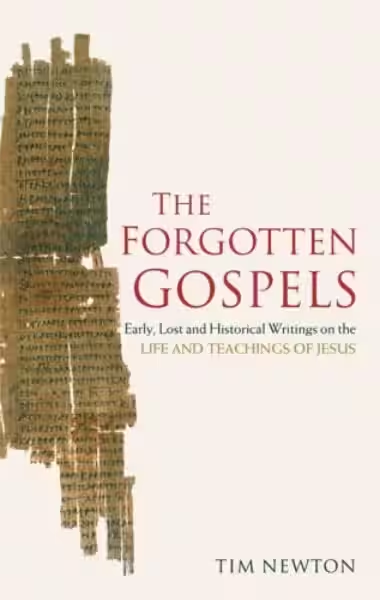
In the grand tapestry of religious history, certain threads, though once vibrant, have faded into the background, their stories largely untold. We often think of religious narratives as fixed, immutable, delivered to us in their entirety. Yet, for centuries, a wealth of early Christian writings existed, offering alternative perspectives and interpretations of the life and teachings of Jesus. These are the so-called “forgotten gospels,” a collection of texts that, while not included in the canonical New Testament, provide a fascinating glimpse into the diverse and often contentious landscape of early Christianity. Their rediscovery and study continue to challenge our assumptions about what early followers believed and how their faith evolved, offering profound insights that resonate even in our contemporary religious discourse.
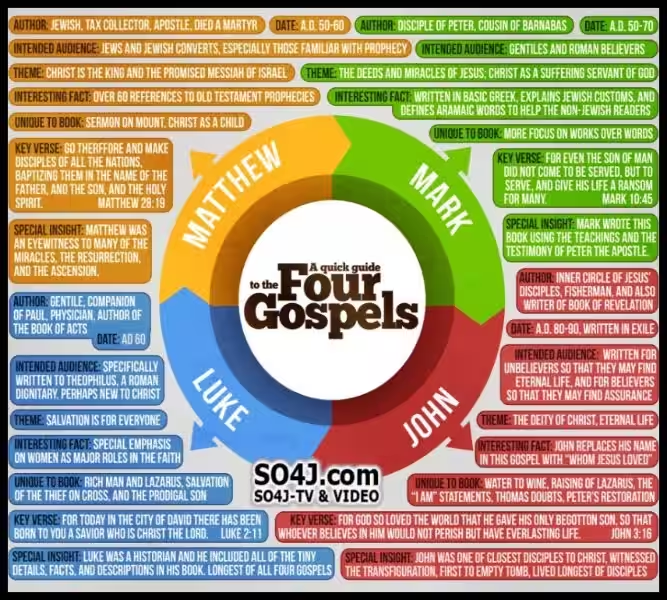
Imagine a vast library, where only a select few volumes are put on prominent display, while countless others remain tucked away on dusty shelves. The canonical Gospels of Matthew, Mark, Luke, and John are those prominently displayed volumes. However, the “forgotten gospels,” such as the Gospel of Thomas, the Gospel of Mary, and the Gospel of Judas, represent those equally ancient, yet less circulated, texts. They don’t invalidate the familiar narratives, but rather, they enrich our understanding by presenting different emphases, priorities, and even theological viewpoints. Exploring these texts is not about replacing what we know, but about expanding our spiritual horizons and appreciating the multifaceted nature of early religious expression.
Beyond the Familiar Four: What Are the “Forgotten Gospels”?
The term “forgotten gospels” is a somewhat modern label applied to a diverse group of early Christian writings that emerged around the same time as the canonical Gospels, but were ultimately not included in the final selection that formed the New Testament. These texts, often referred to as apocryphal gospels, were not necessarily considered heretical by all early Christians; their exclusion was a complex process influenced by various factors, including theological debates, political considerations, and the need for standardization as Christianity grew into a global religion. They offer a window into the early diversity of Christian thought, showcasing a range of beliefs and practices that might surprise many.
Consider the Gospel of Thomas, for instance. Unlike the canonical Gospels, which focus heavily on the narrative of Jesus’ life, death, and resurrection, Thomas is a collection of sayings attributed to Jesus, often presented as direct pronouncements on spiritual truth. It emphasizes the inner spiritual journey, the importance of self-knowledge, and the realization of the divine within. This contrasts with the more outward-focused narratives found in Matthew or John. Similarly, the Gospel of Mary Magdalene offers a perspective that highlights the spiritual authority and teachings of a prominent female disciple, presenting a different dynamic within Jesus’ inner circle than what is typically depicted in the canonical accounts. These texts remind us that early Christianity was not a monolithic entity but a vibrant, evolving movement with multiple streams of spiritual inquiry.
The Gospel of Thomas, discovered in its entirety among the Nag Hammadi library in Egypt in 1945, presents a radical departure from the narrative style of the canonical Gospels. It is a collection of 114 sayings, many of which have parallels in Matthew and Luke, but often with distinct nuances and a more direct, mystical flavor. The emphasis here is not on historical events, but on esoteric knowledge and the unlocking of spiritual potential within the individual. Jesus, in Thomas, is often portrayed as a revealer of hidden truths, guiding his followers towards an understanding of their own divine nature.
For example, one of Thomas’s most famous sayings, “If you bring forth what is within you, what you bring forth will save you. If you do not bring forth what is within you, what you do not bring forth will destroy you,” speaks directly to the power of inner transformation. This is a profoundly relatable concept for anyone seeking personal growth and spiritual fulfillment today. It suggests that salvation or enlightenment comes not from external rituals or pronouncements, but from excavating and actualizing the divine spark that already resides within us. This focus on immanence, the presence of the divine within, is a powerful thread that runs through many of the “forgotten gospels” and continues to resonate in contemporary spiritual practices, from mindfulness to various forms of contemplative prayer.
The Gospel of Mary Magdalene: A Different Voice of Authority
The Gospel of Mary Magdalene, though fragmented, offers a compelling glimpse into the early Christian community and the role of women within it. This text centers on Mary Magdalene, portraying her not merely as a follower but as a spiritual leader and interpreter of Jesus’ teachings. It depicts her receiving a special revelation from Jesus after his resurrection, a revelation that she then shares with the other disciples. This narrative challenges traditional interpretations that often relegated women to secondary roles in early Christianity and highlights the spiritual authority of female disciples.
A key passage describes a dialogue between Mary and Peter. Peter, feeling insecure and perhaps threatened by Mary’s unique connection to Jesus, questions the validity of her teachings and expresses doubt about Jesus revealing such profound truths to a woman. Mary’s response, however, is one of courage and conviction, reminding them of the love and grace Jesus extended to all. This dynamic illustrates the diverse understandings of spiritual leadership and the potential for gender equality in early faith communities. The rediscovery of texts like the Gospel of Mary encourages us to re-examine historical narratives and to consider the possibility of voices and perspectives that have been historically silenced or marginalized, offering a more inclusive and nuanced understanding of our religious heritage.
The “Forgotten Gospels” and the Evolution of Religious Interpretation
The existence and study of these “forgotten gospels” are crucial for understanding the dynamic and evolving nature of religion. Early Christianity was not a finished product delivered on stone tablets; it was a living, breathing movement with diverse interpretations and practices. The process of canonization, while essential for establishing a unified tradition, also involved choices and exclusions. These excluded texts, therefore, serve as vital counterpoints, reminding us that the “truth” of a religion is often a story told from multiple perspectives, and that ongoing interpretation and dialogue are fundamental to its vitality.
Consider how different denominations within Christianity today interpret the same scripture in vastly different ways. This illustrates that even within the accepted canonical texts, there is room for a multitude of understandings. The “forgotten gospels” simply represent an earlier stage of this interpretive process, showcasing a wider spectrum of possibilities. Their presence encourages us to approach our own religious beliefs with critical inquiry and intellectual humility, recognizing that our current understanding is the result of centuries of interpretation, debate, and development. The richness of religious experience is often found not just in the core doctrines but in the exploration of the nuances and variations that have shaped its history.
Relevance for Today’s Religious Seeker
In an age where many are seeking deeper meaning and more personal spiritual connections, the “forgotten gospels” offer a compelling alternative or complement to mainstream religious narratives. They speak to a desire for direct spiritual experience, for inner wisdom, and for the recognition of the divine within oneself and the world. These texts bypass complex theological dogma and often speak in a language of simplicity, paradox, and profound insight.
For the modern religious seeker, engaging with these ancient texts can be a liberating experience. They offer a reminder that spirituality is not a one-size-fits-all proposition. Whether it’s the emphasis on inner knowing in the Gospel of Thomas, the affirmation of female spiritual leadership in the Gospel of Mary, or the radical inclusivity implied by many Gnostic texts (another category often associated with the “forgotten gospels”), these writings provide alternative pathways to understanding the divine and one’s place in the cosmos. They encourage us to look beyond the established doctrines and to explore the vast and often surprising landscape of human spiritual quest, reminding us that the whisper of the unheard can often lead us to the most profound discoveries about ourselves and our faith.
Frequently Asked Questions About Forgotten Gospels
What are the “Forgotten Gospels”?
The “Forgotten Gospels” refers to a collection of ancient Christian texts that were not included in the New Testament canon. These texts, often called apocryphal Gospels, were written around the same time as the canonical Gospels (Matthew, Mark, Luke, and John) but were ultimately rejected by early church leaders for various reasons, including theological differences, perceived authorship issues, or simply not fitting the established narrative.
Why were they “forgotten” or excluded from the Bible?
The exclusion of these texts from the biblical canon was a complex process that occurred over several centuries. Early Church fathers and councils debated which texts were authoritative and reflected true apostolic teaching. Reasons for exclusion included:
Theological Disagreements: Some texts presented doctrines or interpretations of Jesus’ life that were at odds with the developing orthodox Christian theology.
Authorship: Doubts were raised about the actual authors of many of these texts, with claims of authorship by apostles or other early figures sometimes being questioned.
Circulation and Usage: Some texts may not have been widely circulated or accepted by significant portions of the early Christian communities.
Gnostic Influences: Many of the “Forgotten Gospels” are associated with Gnosticism, a diverse religious movement with distinct beliefs about salvation and the nature of reality, which was often considered heretical by mainstream Christianity.
No, the “Forgotten Gospels” are not considered part of the biblical canon in mainstream Christian traditions (Catholic, Orthodox, Protestant). They are generally classified as apocryphal or pseudepigraphal texts.
What kind of information do these texts contain?
These texts offer alternative narratives and perspectives on the life, teachings, and sayings of Jesus Christ. They often focus on different aspects of his ministry, such as his childhood, his private teachings to disciples, or his interactions with specific individuals. Some notable examples include:
The Gospel of Thomas: A collection of sayings attributed to Jesus, often without narrative context.
The Gospel of Mary: Focuses on the role of Mary Magdalene and her teachings from Jesus.
The Infancy Gospel of Thomas: Describes miraculous events attributed to Jesus during his childhood.
The Gospel of Peter: Offers a unique account of the Passion and Resurrection.
Can these texts shed light on early Christianity?
Yes, despite their exclusion from the canon, the “Forgotten Gospels” are invaluable to scholars and historians. They provide crucial insights into:
The diversity of early Christian beliefs and practices: They reveal the wide range of interpretations and theological explorations that existed in the early centuries.
The development of Christian doctrine: By understanding what was rejected, we can better understand what became accepted and why.
The social and cultural context of early Christianity: They offer glimpses into the questions and concerns that preoccupied various Christian communities.
The process of canon formation: Studying these texts helps us understand how the New Testament canon was established.
Are these texts considered heretical?
The term “heretical” is applied by those who adhere to the established orthodox Christian doctrines. From the perspective of the early Church that formed the canon, texts deviating from accepted teachings were often deemed heretical. However, scholars today study these texts with an emphasis on historical and textual analysis rather than theological judgment.
Where can I find these texts?
Many of the “Forgotten Gospels” have been discovered and translated. They are available in scholarly editions, academic works on early Christianity, and online resources dedicated to ancient texts. Popular collections often include the Nag Hammadi library, which contains many Gnostic texts, including several apocryphal Gospels.