The Gospels are the bedrock of Christian faith, four distinct accounts of the life, teachings, death, and resurrection of Jesus Christ. While they all tell the same overarching narrative, a closer look reveals fascinating differences in their perspectives, priorities, and the audiences they were intended for. Understanding these distinctions isn’t about finding contradictions; rather, it’s about appreciating the rich tapestry of witness that has shaped our understanding of Jesus for millennia. It’s akin to hearing four different people describe the same pivotal event – each will focus on what resonated most with them, what they felt was most important to convey.
These four books – Matthew, Mark, Luke, and John – are not simply carbon copies of each other. Instead, they offer unique lenses through which to view the divine. Each author, inspired by the Holy Spirit, crafted their narrative with a specific purpose and audience in mind. This means that while the core message remains unwavering, the emphasis, the selection of events, and even the theological nuances can vary significantly. Exploring these differences allows us to gain a more holistic and profound appreciation of Jesus’ life and its impact.
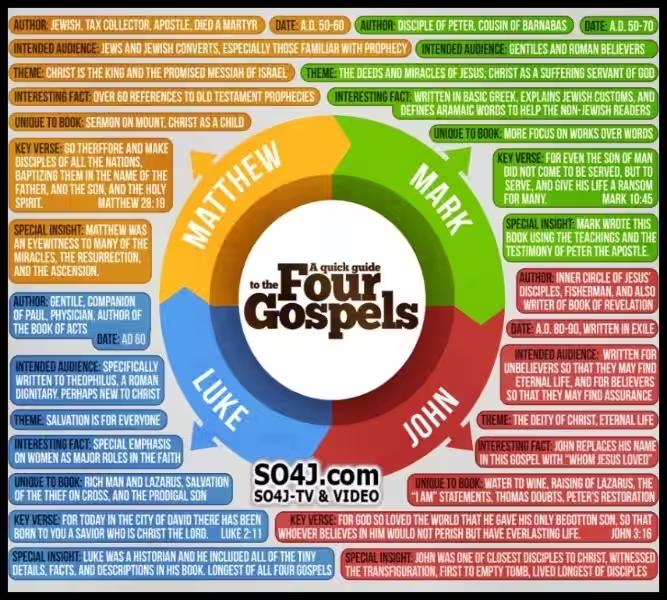
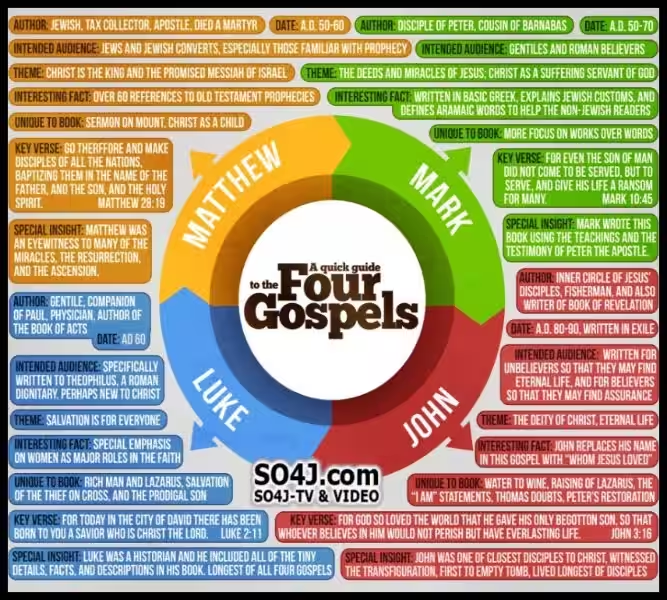
Matthew’s Gospel is often characterized by its Jewish context and Messianic emphasis. He presents Jesus as the long-awaited Messiah, the fulfillment of Old Testament prophecies. This is evident in Matthew’s frequent citations of scripture, meticulously linking Jesus’ life to the ancient covenant. Think of it like a historian meticulously documenting how a modern political leader fulfills the promises of a founding document; Matthew does this for Jesus and the Hebrew Bible.
One significant differentiating factor is Matthew’s structured presentation of Jesus’ teachings. He presents five major discourses, mirroring the five books of the Torah (the Pentateuch). This structure, including the famous Sermon on the Mount, highlights Jesus as a new lawgiver, offering a deeper and more spiritual interpretation of God’s will. For instance, Jesus’ teaching on anger in Matthew 5:22 goes beyond the Old Testament prohibition against murder to address the root of the sin in one’s heart, demonstrating this new, more profound level of obedience.
Mark: The Servant in Action
Mark’s Gospel is the shortest and arguably the most action-packed. It’s a fast-paced narrative that emphasizes Jesus’ power and authority, portraying him as the suffering servant who came to minister. Mark’s writing style is direct and vivid, often using the word “immediately” to convey a sense of urgency and forward momentum. Imagine a news report that cuts straight to the chase, focusing on the most impactful events and pronouncements; that’s Mark’s approach.
A key difference in Mark is its focus on Jesus’ deeds rather than lengthy discourses. While teachings are present, they are often interspersed with accounts of miracles, healings, and exorcisms, showcasing Jesus’ divine power at work. Mark also highlights moments of human reaction to Jesus, both positive and negative, emphasizing the impact he had on those he encountered. For example, the story of the demon-possessed man in Mark 5, where Jesus commands the spirits to leave, is a powerful demonstration of his authority over the spiritual realm.
Luke: The Universal Savior for All
Luke, a physician and a Gentile, writes with a broad, inclusive audience in mind. His Gospel is characterized by its humanity and compassion, emphasizing Jesus’ concern for the marginalized, the poor, the outcasts, and especially women. Luke meticulously traces Jesus’ lineage all the way back to Adam, underscoring his universal relevance for all of humanity. This is like a doctor who takes a comprehensive patient history, aiming to understand everyone’s unique needs and providing care without prejudice.
A striking difference in Luke is his attention to detail and historical accuracy. He often begins his narratives with phrases like “In those days” or “As Luke was told,” giving a sense of documented eyewitness testimony. He also includes unique parables not found in other Gospels, such as the Parable of the Good Samaritan, which powerfully illustrates Jesus’ message of radical love and compassion for those considered enemies. This parable, unlike others, doesn’t just offer a moral lesson; it actively challenges societal norms and prejudices.
John: The Divine Son and the Word Made Flesh
John’s Gospel stands apart with its profound theological depth and mystical tone. It presents Jesus not just as the Messiah, but as the eternal Son of God, the “Word” (Logos) through whom all things were created. John’s Gospel begins with a cosmic perspective, predating creation itself, setting Jesus apart as divine. This is like reading a philosophical treatise that delves into the very essence of existence, exploring the fundamental nature of reality.
A significant difference is John’s focus on “I Am” statements of Jesus, which directly link him to God’s self-revelation in the Old Testament (e.g., “Before Abraham was, I am” in John 8:58). John also presents fewer miracles but emphasizes their symbolic significance, revealing Jesus’ divine nature. For example, the miracle of turning water into wine at the wedding in Cana isn’t just about providing refreshment; it signifies Jesus’ power to transform the ordinary into something extraordinary, a metaphor for his redemptive work. John also includes extended theological discourses, like the Farewell Discourse in chapters 14-17, offering profound insights into Jesus’ relationship with the Father and his followers.
The Synoptic Gospels: A Shared Perspective
Matthew, Mark, and Luke are often referred to as the Synoptic Gospels because they share a great deal of material and can be “viewed together” (syn-optic). Scholars have debated for centuries how to explain these similarities and differences, with theories like Markan priority (the idea that Mark was written first and used by Matthew and Luke) being prominent. These three Gospels offer accounts that are similar in their order of events and their selection of Jesus’ ministry in Galilee.
While they are similar, the differences are still crucial. For example, both Matthew and Luke include the Nativity accounts, but they differ significantly in their details and focus. Matthew emphasizes Joseph’s perspective and the visit of the Magi, highlighting Jesus as the royal heir. Luke, on the other hand, focuses on Mary’s perspective, the angelic annunciation, and the humble birth in Bethlehem, emphasizing Jesus’ humble beginnings and universal appeal. This demonstrates how even in shared narratives, the authors highlight specific aspects to serve their unique purposes.
John’s Unique Contribution: A Different Angle
John’s Gospel, while sharing the same central figure, offers a distinct theological framework and narrative approach. It’s often considered the “spiritual Gospel” due to its emphasis on Jesus’ divinity and the intimate relationship between Jesus and the Father. John’s Gospel contains seven “signs” (miracles) that are symbolic, and he records long, theological discourses rather than short, pithy parables like those found in the Synoptics.
The timing of Jesus’ ministry is another key differentiator. The Synoptic Gospels primarily focus on Jesus’ ministry in Galilee over roughly one year, while John’s Gospel covers a period of about three years and includes multiple trips to Jerusalem for significant Jewish feasts, such as Passover. This extended timeline allows John to explore Jesus’ divine identity more deeply, particularly in relation to the feasts and their symbolic meaning within Jewish tradition. For instance, Jesus’ claim to be the “bread of life” in John 6 takes place during the Feast of Passover, a feast commemorating deliverance and sustenance, powerfully linking Jesus to God’s provision for His people.
Why These Differences Matter for Our Faith
Understanding the unique contributions of each Gospel writer enriches our faith immeasurably. It’s not about picking a favorite, but about appreciating how these different perspectives complement and deepen our understanding of Jesus. Imagine a symphony; each instrument plays a different part, but together they create a magnificent and complete harmony. Similarly, the four Gospels, with their distinct voices, contribute to a richer and more comprehensive portrait of Christ.
These variations invite us to engage with the text more deeply, to ask questions, and to seek a more nuanced understanding of God’s revelation. They offer different entry points into the life of Jesus, catering to various spiritual needs and intellectual curiosities. Whether you are drawn to the prophetic fulfillment in Matthew, the powerful action in Mark, the compassionate humanity in Luke, or the divine mystery in John, there is a window into Christ’s heart that resonates with you. This diversity of witness is a testament to the multifaceted nature of Jesus himself, and a gift to those who seek to know Him.
Frequently Asked Questions: The Four Gospels and Religion
What are the Four Gospels?
The Four Gospels are the first four books of the New Testament: Matthew, Mark, Luke, and John. They are accounts of the life, ministry, death, and resurrection of Jesus Christ.
What is the main difference between the Gospels?
While all four Gospels tell the story of Jesus, they do so from different perspectives and with different emphases, reflecting their intended audiences and authors.
* Matthew is often seen as presenting Jesus as the Messiah and King, emphasizing his fulfillment of Old Testament prophecies and his teachings on the Kingdom of Heaven. It’s often associated with a Jewish Christian audience.
* Mark is the shortest and often considered the earliest Gospel. It portrays Jesus as a powerful servant and active minister, focusing on his deeds and the urgency of his mission. It’s often associated with a Roman or Gentile audience.
* Luke presents Jesus as the Savior of all people, highlighting his compassion for the marginalized, the poor, and women. It emphasizes Jesus’ humanity and his universal mission. Luke also wrote the Book of Acts, continuing the story of the early church.
* John is more theological and reflective, focusing on Jesus’ divine nature and his relationship with God the Father. It uses extensive symbolism and “I am” statements to reveal Jesus’ identity. It’s often associated with an audience seeking a deeper understanding of Jesus’ divinity.
Are there other Gospels besides Matthew, Mark, Luke, and John?
Yes, there are other writings that refer to themselves as Gospels, such as the Gospel of Thomas or the Gospel of Mary. However, these are often referred to as “non-canonical” or “apocryphal” Gospels. The Four Gospels in the New Testament are considered canonical by most Christian traditions because they were accepted by the early church as authoritative and historically reliable accounts of Jesus’ life.
What is “religion”?
“Religion” is a broad term that generally refers to a set of beliefs, practices, and rituals that often relate to the worship of a superhuman power or powers, especially a god or gods. It typically involves a moral code, a spiritual worldview, and often communal worship or fellowship.
How do the Four Gospels relate to religion?
The Four Gospels are foundational texts for Christianity, one of the world’s major religions. They are the primary source of information about Jesus Christ, whose life and teachings are central to Christian faith and practice. Christians believe that by following Jesus’ teachings and accepting his sacrifice, they can have a relationship with God and achieve salvation.
What is meant by “canonical” when referring to the Gospels?
“Canonical” refers to those books that are accepted by a religious community as authoritative and divinely inspired. For Christians, the four Gospels of Matthew, Mark, Luke, and John are canonical, meaning they are considered part of the official scripture of the Bible.