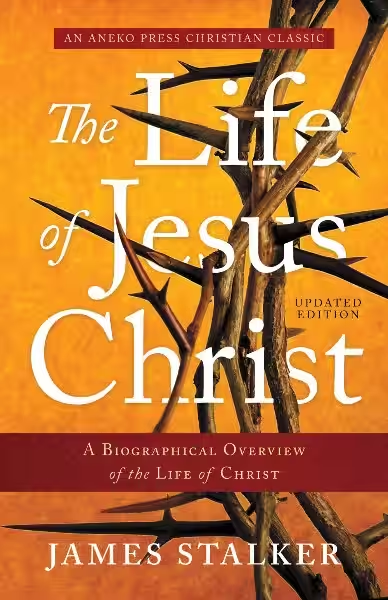
The story of Jesus of Nazareth is arguably the most influential narrative in human history. It has shaped civilizations, inspired countless works of art, and provided a moral compass for billions across millennia. For those seeking to understand this pivotal figure, delving into books about Jesus’ life offers a rich and multifaceted journey. These texts, ranging from ancient scriptures to modern scholarly analyses, provide windows into his teachings, his impact, and the enduring questions surrounding his existence and message. Whether you’re a devout follower, a curious skeptic, or simply fascinated by history’s most compelling figures, exploring these books can be a profoundly rewarding experience.
The allure of Jesus’ life isn’t just about historical curiosity; it’s about grappling with profound questions of faith, morality, and the human condition. The narratives presented in these books about Jesus’ life offer diverse perspectives, inviting readers to engage with his words and actions from various angles. From the foundational accounts in the Gospels to the theological explorations of later centuries, each book contributes to a larger, ever-evolving understanding of who Jesus was and what his life represents. This exploration is not merely academic; it’s a personal quest for meaning that resonates deeply with individuals across the globe.
_The Canonical Foundation: Understanding the Gospels as Primary Sources_
At the heart of any exploration of books about Jesus’ life lie the four canonical Gospels: Matthew, Mark, Luke, and John. These texts, written within the first century of Jesus’ life, are considered by Christians to be divinely inspired accounts of his earthly ministry, crucifixion, and resurrection. They paint vivid pictures of his miracles, his parables, his interactions with disciples and adversaries, and his ultimate sacrifice. When you read passages like Jesus feeding the five thousand in Mark, it’s not just a story; it’s presented as a demonstration of his power and compassion, a tangible example of his ability to meet human needs.
While these Gospels are foundational, it’s important to acknowledge that they are not identical. Each author brings a unique perspective and theological emphasis. Mark, for instance, often portrays Jesus as a man of action, emphasizing his power and his suffering. John, on the other hand, presents a more theological Jesus, focusing on his divine nature and profound pronouncements about his relationship with God the Father. Understanding these differences is key to a nuanced appreciation of the books about Jesus’ life and how they collectively build a comprehensive portrait of the man and his mission.
_Beyond the Gospels: Exploring Early Christian Writings and Historical Context_
The study of books about Jesus’ life extends far beyond the four Gospels. Early Christian writers, known as the Church Fathers, produced a vast body of literature that interpreted, defended, and elaborated upon the Gospel narratives. Figures like Augustine of Hippo, in his monumental work City of God, grappled with the philosophical and theological implications of Jesus’ teachings for society and the individual. These writings offer invaluable insights into how Jesus’ message was understood and applied in the centuries immediately following his life, providing a crucial bridge between the ancient world and later interpretations.
Furthermore, historical and archaeological research continues to shed light on the world in which Jesus lived. Books about Jesus’ life that incorporate this scholarly work help to contextualize his teachings within the socio-political landscape of first-century Judea. Understanding the Roman occupation, the tensions between different Jewish sects, and the everyday customs of the time can illuminate the meaning and impact of Jesus’ words. For example, understanding the concept of “kingdom of God” in its first-century context, as explored in many historical analyses, adds layers of meaning to Jesus’ pronouncements that might otherwise be missed.
_Theological and Philosophical Explorations: Engaging with Jesus’ Message Through the Ages_
Throughout history, theologians and philosophers have engaged deeply with the life and teachings of Jesus, resulting in a remarkable array of books about Jesus’ life that explore his spiritual and ethical dimensions. These works often delve into the core tenets of Christianity, such as love, forgiveness, and redemption, examining their philosophical underpinnings and practical applications. Think of C.S. Lewis’s Mere Christianity, a classic example of apologetics that explains Christian beliefs in a clear, accessible way, using logical arguments and relatable analogies to explore the nature of Jesus and his claims.
These theological explorations aren’t always monolithic. Different traditions and thinkers have offered distinct interpretations of Jesus’ identity and mission. Some books about Jesus’ life focus on his role as a divine savior, while others emphasize his teachings as a model for ethical living. For instance, works on Christian ethics often highlight Jesus’ Sermon on the Mount, analyzing its radical call to humility, compassion, and peacemaking as a blueprint for a transformed life. This diversity of thought enriches the conversation, inviting readers to engage critically and personally with the profound questions Jesus’ life raises.
_Modern Perspectives: Contemporary Analyses and Diverse Interpretations_
In the modern era, books about Jesus’ life continue to evolve, reflecting new scholarly approaches, cultural shifts, and individual quests for understanding. Historians, theologians, and even secular scholars have contributed to this ongoing dialogue, offering critical analyses and diverse interpretations. Some contemporary works aim to present a purely historical Jesus, stripping away centuries of religious dogma to explore what can be definitively known about his life through historical evidence. These books often engage with the challenges of source criticism and the complexities of reconstructing ancient events.
Furthermore, contemporary books about Jesus’ life often explore his impact on different cultures and his relevance to modern social justice movements. They might examine how his teachings on compassion and service have inspired activists fighting poverty, inequality, and oppression. For example, books exploring liberation theology, a movement that emerged in Latin America, re-examine Jesus’ ministry through the lens of the poor and marginalized, highlighting his radical solidarity with those on the fringes of society. This demonstrates that the story of Jesus remains a vibrant and dynamic force, continually being reinterpreted and applied to the challenges of our time.
_The Personal Journey: Finding Meaning in Books About Jesus’ Life_
Ultimately, engaging with books about Jesus’ life is often a deeply personal journey. Regardless of one’s faith tradition or philosophical stance, these narratives offer fertile ground for reflection, introspection, and growth. Whether you are seeking spiritual solace, intellectual stimulation, or a deeper understanding of a foundational figure in human history, there is a wealth of literature waiting to be discovered. Each book, from the ancient Gospels to modern scholarly debates, offers a unique thread in the rich tapestry of Jesus’ enduring legacy.
The process of reading and engaging with these books about Jesus’ life can lead to profound personal insights. It might challenge existing beliefs, deepen faith, or spark a lifelong pursuit of knowledge. The power of these stories lies in their ability to transcend time and culture, speaking to universal human experiences of hope, suffering, love, and the search for meaning. Embracing this exploration, with an open mind and a curious heart, can unlock a deeper understanding not only of Jesus but also of ourselves and the world around us.
Frequently Asked Questions: Books About Jesus’ Life and Religion
What are some recommended books for learning about the life of Jesus?
For a foundational understanding, consider “The Life and Times of Jesus the Messiah” by Alfred Edersheim for a historical and cultural context, or “Simply Jesus” by N.T. Wright for a more accessible theological perspective. The Gospels themselves (Matthew, Mark, Luke, and John) in the Bible are the primary source accounts of Jesus’ life.
Where can I find reliable resources for understanding different religious beliefs?
Reputable sources include academic texts on comparative religion, scholarly articles from journals, and encyclopedias of religion. Websites of established academic institutions and respected religious organizations can also offer valuable information, but it’s important to cross-reference information from various sources.
Are there books that explore Jesus’ teachings from a non-Christian perspective?
Yes, there are historical and academic books that analyze Jesus’ teachings and their impact from a secular or comparative religious standpoint. These often focus on the sociological, philosophical, and historical influences and consequences of his message.
What kind of books are good for someone new to exploring religious topics?
Introductory books on world religions or introductions to major faiths can be a good starting point. Look for books written by authors who aim for neutrality and clarity, or books that specifically guide newcomers through complex theological concepts.
How can I discern between biased and unbiased religious literature?
Look for authors who present multiple viewpoints, acknowledge differing interpretations, and cite their sources. Be wary of literature that promotes a single viewpoint as the absolute truth without engaging with other perspectives. Academic and scholarly works are generally more likely to offer balanced perspectives than devotional or polemical writings.