From its humble beginnings in the Roman Empire to its presence in the global landscape of today, the story of Christianity is inextricably woven with the threads of persecution. This isn’t a tale of a monolithic, unchallenged faith, but rather a testament to resilience, a narrative of individuals and communities who, for centuries, faced immense hardship, discrimination, and violence simply for adhering to their beliefs. Understanding this rich and often harrowing history of Christian persecution is not just an academic exercise; it offers profound insights into the human spirit’s capacity for both immense cruelty and unwavering devotion. It also provides a crucial lens through which to view the challenges faced by religious minorities worldwide, reminding us that the echoes of ancient oppression can still be heard in the present day.
The very foundations of Christianity were laid in an environment that was often hostile. The early followers of Jesus, a small sect within a vast and complex Roman world, found themselves at odds with established Roman customs and religious practices. Their insistence on worshipping one God above all others, their refusal to participate in emperor worship, and their communal gatherings were often viewed with suspicion and met with outright hostility. This initial period, marked by localized and often sporadic persecution, set a precedent that would unfortunately repeat itself across different eras and geographical locations, demonstrating a recurring pattern of tension between dominant societal norms and burgeoning religious movements.
The Crucible of Empires: Early Christian Persecution
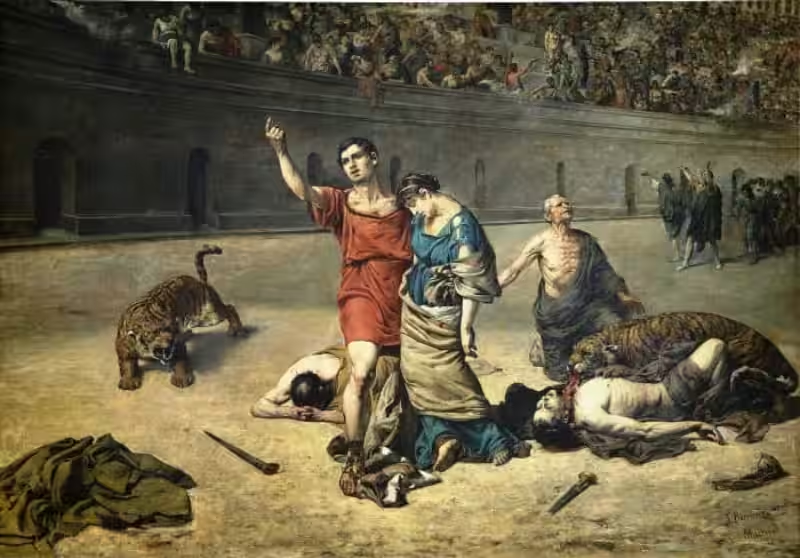
The Roman Empire, for all its advancements, was often a crucible for early Christian believers. While not a constant, systematic extermination, periods of intense persecution did occur, often triggered by scapegoating during times of crisis or by the capricious whims of emperors. The image of Christians being thrown to the lions in the Colosseum, though perhaps an exaggerated simplification, captures the brutal reality faced by many. These were not abstract theological debates; these were life-or-death struggles for the right to practice their faith.
One of the most notorious periods of Christian persecution was under Emperor Nero in the 1st century CE, following the Great Fire of Rome. Nero, seeking a convenient scapegoat, blamed the nascent Christian community for the devastation. This led to horrific atrocities, including public executions, crucifixions, and even burning Christians alive as torches to illuminate the imperial gardens. This exemplifies how a religious minority can be easily targeted and demonized when societal anxieties are high, showcasing a dangerous dynamic that has persisted throughout history.
Beyond the grand spectacles of imperial wrath, everyday discrimination was a constant challenge. Christians were often ostracized from public life, denied certain professions, and subjected to social ridicule. The refusal to offer sacrifices to Roman gods meant they were perceived as unpatriotic and disloyal. This social pressure, coupled with the threat of more severe punishment, tested the conviction and commitment of believers, forging a deep sense of community and mutual support amongst them as they navigated these hostile environments.
The Great Persecutions and the Rise of Martyrs
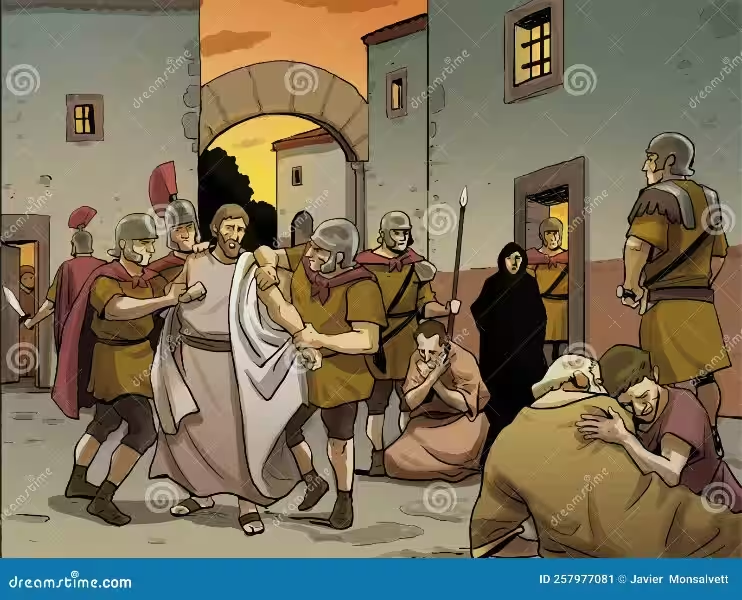
As Christianity grew in influence, so too did the severity and scale of persecution. The “Great Persecutions” of the late 3rd and early 4th centuries, particularly under Emperors Diocletian and Galerius, represent a more systematic and widespread attempt to eradicate the faith. Edicts were issued demanding the destruction of churches, the burning of scriptures, and the imprisonment or execution of clergy and laypeople alike. This era witnessed an explosion of martyrdom, individuals who refused to renounce their faith even in the face of torture and death, becoming powerful symbols of Christian endurance.
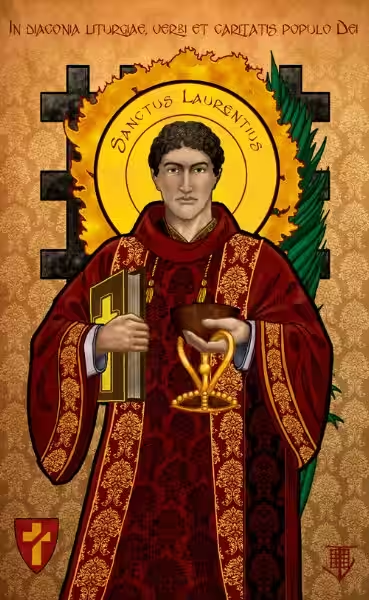
The concept of the martyr is central to understanding Christian persecution history. These individuals, willing to die rather than compromise their beliefs, were not seen as victims by their fellow Christians, but as victors – those who had triumphed over fear and earthly power through their unwavering faith. Stories of martyrs like Perpetua and Felicity, a noblewoman and her slave who faced execution together, became foundational narratives, inspiring subsequent generations to persevere. Their sacrifices were viewed as witnesses to the truth of their faith, solidifying its identity in the face of overwhelming opposition.
The impact of these persecutions was, paradoxically, to strengthen Christianity. The blood of the martyrs, as the early Church father Tertullian famously wrote, became the seed of new Christians. The visible courage and steadfastness of believers in the face of death often led to admiration and curiosity from outsiders, drawing them to the faith. This highlights a profound spiritual dynamic: that suffering endured for a deeply held belief can, paradoxically, lead to growth and expansion.
From Persecuted to Persecutor? The Complexities of Religious History
The triumph of Christianity, culminating in its adoption as the official religion of the Roman Empire under Constantine, marked a dramatic shift. However, this transition introduced its own set of complexities, leading to periods where Christians themselves became perpetrators of persecution. The narrative of Christian persecution history is not a simple linear progression from victimhood to victory; it is a nuanced and often uncomfortable tapestry of evolving power dynamics and shifting societal structures.
Once Christianity gained imperial favor, internal schisms and theological disputes often led to the suppression of dissenting Christian groups. The power of the Church, now intertwined with the state, was sometimes used to enforce doctrinal uniformity, leading to the persecution of heretics and those who held differing interpretations of Christian teachings. This demonstrates how religious authority, when unchecked, can become as oppressive as any secular power.
Furthermore, as Christianity spread throughout Europe and beyond, it frequently encountered and suppressed indigenous religions and cultures. The Crusades, while often framed as holy wars, involved immense violence and subjugation. The Spanish Inquisition, a brutal institution established to combat heresy, employed torture and executions to enforce religious orthodoxy. These instances reveal a darker side of Christian history, where the pursuit of religious purity led to the systematic oppression and elimination of those deemed “other.”
The Shadow of the Inquisition and Beyond
The Spanish Inquisition stands as a stark reminder of the potential for religious power to manifest in terrifying ways. Established in the late 15th century, its primary goal was to root out heresy, particularly among Jews and Muslims who had converted to Christianity but were suspected of secretly practicing their former faiths. The methods employed were often insidious, relying on informants, secret trials, and public auto-da-fés where those condemned were often burned at the stake.
This period highlights the dangers of religious intolerance and the abuse of power in the name of faith. It’s crucial to remember that the individuals targeted by the Inquisition were often innocent of any wrongdoing, their lives destroyed by suspicion and fear. The legacy of such institutions serves as a potent warning against the concentration of religious and political power and the dangers of unchecked ideological fervor.
The subsequent centuries continued to see instances of religious conflict and persecution. The Wars of Religion in Europe, particularly the Thirty Years’ War, were devastating conflicts fueled by religious differences between Catholics and Protestants. While political and territorial ambitions were also at play, religious animosity was a significant driving force. These wars resulted in widespread death, destruction, and displacement, underscoring the tragic consequences when faith becomes a weapon of war.
Tragically, the history of Christian persecution is not confined to dusty archives and ancient texts. In the 21st century, Christians continue to face significant challenges and oppression in many parts of the world. While the forms of persecution may have evolved, the underlying themes of discrimination, violence, and attempts to suppress religious freedom remain eerily familiar. Understanding the historical context is vital to grasping the gravity of these contemporary struggles.
Today, Christians are a religious minority facing persecution in numerous countries, often driven by extremist ideologies, political instability, or entrenched societal prejudices. In some regions, Christians are targeted by violent attacks, their churches are destroyed, and they are forced to flee their homes. This is not a distant historical phenomenon; it is a present-day reality for millions.
Examples of contemporary Christian persecution are sadly abundant. In parts of the Middle East and Africa, Christian communities face threats from extremist groups who seek to impose their vision of religious law. In certain Asian nations, Christians may experience legal restrictions on worship, social discrimination, and even imprisonment for their faith. The specific challenges vary greatly, but the common thread is the denial of fundamental religious freedom.
The Global Landscape of Faith Under Fire
The global landscape of Christian persecution is complex and multifaceted. Data from organizations dedicated to monitoring religious freedom consistently shows that Christians are among the most persecuted religious groups worldwide. This persecution can manifest in various ways, from subtle social ostracism and economic marginalization to outright physical violence and imprisonment.
Consider the situation in countries where conversion from another religion to Christianity is met with severe legal penalties or social ostracization. This creates a climate of fear and intimidation, forcing individuals to practice their faith in secret or abandon it altogether. The right to freedom of religion and belief, a cornerstone of international human rights, is flagrantly violated in such instances.
The persecution of Christians can also be driven by nationalistic or ethnic tensions. In some contexts, Christianity is viewed as a foreign influence, and its adherents are seen as outsiders or disloyal citizens. This can lead to scapegoating and increased hostility, making Christian communities particularly vulnerable during times of political or social unrest. The interconnectedness of religion, politics, and identity plays a significant role in shaping these dynamics.
Lessons from the Long Road: Resilience and Hope
The enduring narrative of Christian persecution history offers profound lessons about human resilience, the power of faith, and the persistent struggle for religious freedom. While the past is filled with stories of suffering, it is also replete with examples of unwavering courage, deep conviction, and the enduring hope that has sustained believers through centuries of adversity.
One of the most striking takeaways from this long history is the remarkable resilience of the human spirit. Despite facing unimaginable hardship, torture, and death, countless Christians have refused to abandon their faith. This endurance is not simply a testament to stubbornness; it is a reflection of a deeply held belief system that provided meaning, purpose, and an unwavering hope for something beyond earthly suffering.
Furthermore, the history of Christian persecution serves as a constant reminder of the fragility of religious freedom. The right to believe and practice one’s faith without fear of reprisal is not a given; it is a right that must be continuously defended and advocated for. By understanding the past, we are better equipped to recognize and combat contemporary forms of religious intolerance and to champion the cause of religious liberty for all. The echoes of those who suffered for their faith centuries ago continue to resonate, urging us towards a future where peaceful coexistence and mutual respect for diverse beliefs are not just ideals, but lived realities.
Christian persecution refers to the mistreatment, discrimination, or violence directed at individuals or groups because of their Christian faith. This can range from social exclusion and economic discrimination to imprisonment, torture, and murder.
What are the historical roots of Christian persecution?
Christian persecution has a long history, dating back to the early centuries of Christianity. The Roman Empire, in its initial stages, viewed Christianity as a threat to its pagan religious and political order, leading to periods of intense persecution, most famously under emperors like Nero and Diocletian.
When did Christian persecution begin?
The earliest instances of persecution against Christians can be traced to the first century AD, shortly after the crucifixion of Jesus Christ, with accusations of treason and atheism by Roman authorities.
What were some major periods of Christian persecution in history?
Major periods include the Roman persecutions (1st-4th centuries), the persecution of Christians in the Sasanian Empire, the suppression of Christianity during various Islamic conquests, the persecution of Protestants during the Reformation and Counter-Reformation, and more recent instances in the 20th and 21st centuries in various parts of the world.
Why were Christians persecuted in the Roman Empire?
Christians were persecuted in the Roman Empire for several reasons: they refused to participate in the state cult and worship Roman gods and the emperor, which was seen as disloyalty. Their monotheistic beliefs were perceived as foreign and potentially disruptive to social order. Accusations of cannibalism and atheism also contributed to their negative image.
Has Christian persecution ended?
No, Christian persecution has not ended. While the nature and intensity of persecution vary geographically and historically, Christians continue to face significant challenges and violence in many parts of the world today due to their faith.
What are some modern examples of Christian persecution?
Modern examples include widespread discrimination and violence in countries like North Korea, Eritrea, Iran, Saudi Arabia, and other regions where religious freedom is severely restricted. This can manifest as forced conversions, destruction of churches, imprisonment, and physical attacks.
What motivates Christian persecution?
Motivations for Christian persecution are diverse and can include religious extremism, political opposition, ethnic or nationalistic tensions, economic rivalry, and historical grievances. In some cases, it is driven by a desire to eliminate or suppress Christian influence and evangelism.
How has Christian persecution impacted the development of Christianity?
Historically, persecution has often strengthened the resolve and faith of Christians, leading to martyrdom and the development of theological defenses. It has also, in some instances, led to the diaspora of Christian communities and the spread of Christianity to new regions.
What are the main religious reasons behind Christian persecution?
Religious reasons often stem from the belief that Christianity is a false religion, a threat to an established religious order, or a proselytizing faith that challenges other religious or secular ideologies. This can be driven by intolerance, a desire to maintain religious purity, or a fear of losing adherents to Christianity.