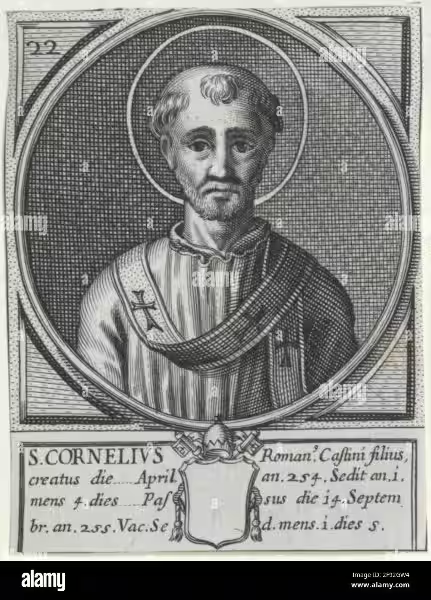
The tapestry of early Christianity is woven with threads of unwavering faith, profound theological debate, and the often-fraught journey of establishing a cohesive spiritual community. Amidst these formative years, the figure of Pope Cornelius stands as a testament to leadership, reconciliation, and the enduring power of the Church. His brief but impactful pontificate, occurring in the mid-3rd century, grappled with issues that would shape Christian doctrine and practice for centuries to come, making his story not just a historical footnote, but a vital lesson in faith, forgiveness, and institutional resilience.
Understanding Pope Cornelius’s role requires appreciating the precarious environment in which he served. The Roman Empire, while occasionally offering periods of relative tolerance, was also prone to intense persecution of Christians. This volatile backdrop meant that leadership within the nascent Church was a dangerous and demanding undertaking. Pope Cornelius, therefore, inherited a position that demanded not only spiritual guidance but also strategic acumen and immense courage. His pontificate, though relatively short, was marked by significant challenges, particularly surrounding the question of how to deal with Christians who had lapsed during times of persecution.
The office of the Bishop of Rome, later known as the Pope, was already assuming a position of considerable influence within the Christian world. This was not due to any single decree, but rather the growing prestige of the Roman Church, its historical lineage, and its perceived apostolic connection to both Saints Peter and Paul. Pope Cornelius, elected in 251 CE, found himself at the helm of a community that, despite its suffering, was expanding and increasingly organized. However, this growth also brought internal divisions and external pressures.
One of the most pressing issues facing Pope Cornelius was the aftermath of the Decian persecution. This brutal campaign, initiated by Emperor Decius, demanded that all citizens offer sacrifices to Roman gods. Many Christians, under duress, complied, either through fear or a desire to protect their families. Upon the cessation of the persecution, these individuals, known as the lapsi, sought readmission into the Church. This sparked a fierce debate within the Christian community, with some advocating for strict penance and others for outright excommunication.
The Lapsi Controversy: A Test of Mercy and Discipline
The question of how to treat the lapsi was a deeply divisive one. On one side stood figures like Novatian, a Roman presbyter who argued for a rigorous and unforgiving approach. Novatian believed that apostasy was an unforgivable sin, and that those who had renounced Christ could never again be fully restored to communion. His views, though appealing to some who felt a profound sense of betrayal, risked alienating a significant portion of the Christian population.
Pope Cornelius, however, championed a more pastoral and merciful path. Influenced by the teachings of Christ on forgiveness and reconciliation, he believed that true repentance deserved a path back to the fold. This was not to say he advocated for a casual dismissal of their actions. Rather, Pope Cornelius insisted that the lapsi undergo a period of penance, demonstrating their contriteness and commitment to their faith before being readmitted. This nuanced approach aimed to balance the need for spiritual accountability with the imperative of Christian charity.
The Council of Rome and the Schism
The position of Pope Cornelius was put to the test at the Council of Rome in 251 CE. This crucial synod was convened to address the lapsi controversy and to settle the emerging schism caused by Novatian. The council, under the leadership of Pope Cornelius, overwhelmingly supported his more compassionate stance. They affirmed that while apostasy was a grave sin, the Church had the authority and the obligation to offer forgiveness to those who genuinely repented.
This decision, however, did not satisfy Novatian and his followers. They broke away from the main Church, forming their own schismatic group that maintained Novatian’s harsh doctrines. The emergence of the Novatian schism was a significant challenge for Pope Cornelius, as it fractured the unity of the Roman Church at a time when solidarity was most needed. Nevertheless, Pope Cornelius remained firm in his commitment to reconciliation, working to heal the divisions within the Church even as he faced external threats.
Theological Ramifications and Lasting Legacy
The decisions made during the pontificate of Pope Cornelius had far-reaching theological implications. The affirmation of the Church’s role in granting absolution and readmitting repentant sinners laid a foundational stone for the sacrament of Penance as it would develop over centuries. This was not merely a matter of administrative policy; it was a deeply theological statement about the nature of God’s mercy and the Church’s ministry.
Furthermore, the confrontation with Novatian highlighted the evolving understanding of the Church’s authority. By asserting the right of the legitimate hierarchy, represented by Pope Cornelius, to make such disciplinary decisions, the role of the Papacy as a central arbiter of faith and order was further solidified. This was a crucial step in the institutional development of the Church, moving it from a collection of scattered communities to a more unified and centrally guided body.
The Papacy as a Symbol of Unity and Continuity
Pope Cornelius’s tenure, though brief, demonstrated the vital role of leadership in navigating spiritual crises. His ability to stand firm against more extreme viewpoints, while still advocating for mercy, showcased a profound understanding of both theological principles and human frailty. The unity of the Church, a constant theme in early Christian writings, was a paramount concern for Pope Cornelius, and his actions reflected this commitment.
The legacy of Pope Cornelius is not one of grand pronouncements or extensive writings. Instead, it resides in his pragmatic leadership and his unwavering commitment to the core tenets of Christian forgiveness. He navigated a turbulent period with grace and conviction, ensuring that the Church remained a beacon of hope and a place of spiritual healing, even in the face of intense pressure. His story reminds us that faith is not just about adherence to dogma, but also about compassion, reconciliation, and the enduring strength of community. The challenges he faced, and the way he addressed them, continue to resonate, offering valuable insights into the ongoing journey of faith.
Frequently Asked Questions About Pope Cornelius
What was Pope Cornelius’s full name?
Pope Cornelius’s full name was Publius Cornelius.
When was Pope Cornelius pope?
Pope Cornelius served as pope from 251 to 253 AD.
What were the major challenges faced by Pope Cornelius during his papacy?
Pope Cornelius faced significant challenges, including the aftermath of the Decian persecution, the issue of the lapsi (Christians who had renounced their faith during persecution), and a schism within the Church led by Novatian.
What was the controversy surrounding the *lapsi*?
The lapsi were Christians who had offered sacrifices to pagan gods or obtained certificates of sacrifice (libelli) during the persecution under Emperor Decius. The controversy centered on whether these individuals could be readmitted to the Church and under what conditions. Some, like Novatian, advocated for a stricter approach, believing they should not be forgiven. Pope Cornelius, however, favored a more merciful approach, allowing for reconciliation after penance.
Who was Novatian and what was his role in the schism?
Novatian was a Roman priest who opposed Pope Cornelius’s lenient policy towards the lapsi. He believed that those who had denied Christ during persecution should be permanently excommunicated and could not be readmitted to the Church. Novatian declared himself pope, creating a schism that divided the Roman Church.
How did Pope Cornelius address the schism caused by Novatian?
Pope Cornelius convened a council in Rome in 251 AD, which condemned Novatian and his teachings. He also appealed to other bishops for support, emphasizing unity within the Church and the importance of pastoral mercy.
What was the significance of the council held under Pope Cornelius?
The council held under Pope Cornelius in 251 AD was significant for condemning Novatianism and reaffirming the Church’s authority to forgive sins, even those committed after baptism, through repentance and penance.
What is Pope Cornelius known for in terms of church governance?
Pope Cornelius is known for his efforts to restore unity and order to the Church after periods of persecution and schism. He emphasized pastoral care and reconciliation, as well as the importance of the Roman See’s authority in resolving doctrinal and disciplinary matters.
Was Pope Cornelius martyred?
While Pope Cornelius died in exile during the reign of Emperor Trebonianus Gallus, it is widely believed that his death was a result of the persecution of Christians, making him a confessor and a saint. Historical sources suggest he was exiled around June 253 AD and died shortly thereafter.
Where is Pope Cornelius buried?
Pope Cornelius is buried in the Catacombs of Callixtus in Rome.
What is Pope Cornelius’s feast day?
Pope Cornelius’s feast day is celebrated on September 16th.
Is Pope Cornelius a patron saint?
Yes, Pope Cornelius is considered the patron saint of the diocese of Piacenza and of those suffering from epilepsy, as some traditions associate him with the healing of this ailment.