The Dawn of a New Faith and the Shadow of Suspicion
In the sprawling tapestry of the Roman Empire, a new thread began to weave itself, subtly at first, then with a growing luminescence: Christianity. Born in the humble regions of Judea, this nascent religion offered a radically different perspective on life, death, and the divine. Its core tenets – love of neighbor, compassion for the poor, and the promise of eternal life through a crucified savior – resonated deeply with many, particularly those marginalized by Roman society. However, this burgeoning movement, with its unconventional practices and unwavering devotion, soon found itself under the harsh glare of an empire deeply rooted in tradition and a pantheon of gods.
The early Christians’ refusal to participate in the state-sanctioned worship of Roman deities, including the emperor himself, was a significant point of friction. For Romans, civic duty and religious observance were inextricably linked. To abstain from offering sacrifices to Jupiter or acknowledging the emperor as divine was not merely a personal eccentricity; it was perceived as treachery, atheism, and a direct threat to the stability of the empire. Imagine a modern-day society where refusing to participate in a national holiday ritual, seen as vital for the country’s well-being, would lead to suspicion and ostracism. This was the environment into which early Christianity was born, a world where conformity was prized and deviation was often met with suspicion.
The Seeds of Conflict: Misunderstandings and Fear
The rapid spread of Christianity, fueled by its message of hope and inclusivity, also contributed to the growing unease among Roman authorities and the populace. Its adherents met in private homes, sharing meals and engaging in rituals that were largely unknown to outsiders. This secrecy, while necessary for their survival, bred rumors and wild accusations. Whispers of cannibalism (misinterpreting the Eucharist) and incest (referring to the Christian concept of brotherhood and sisterhood) spread like wildfire, painting a terrifying picture of this new sect in the minds of many.
Furthermore, the exclusivity of Christian faith – its insistence that Christ was the only way to salvation – stood in stark contrast to the syncretic nature of Roman religion, which readily incorporated foreign gods into its pantheon. This perceived arrogance, coupled with the Christians’ detachment from Roman social and political life, marked them as outsiders and potential subversives. The Roman authorities, accustomed to managing diverse populations, saw this unyielding adherence to a single, obscure deity as a destabilizing force, a challenge to the established order they so carefully maintained.
The Fires of Persecution: From Sporadic Reprisals to Systematic Cruelty
The history of early Christians is inextricably linked with the narrative of persecution. While the intensity and nature of these persecutions varied greatly across time and region, they were a constant and often brutal reality for believers. Initially, persecution was often localized and driven by mob violence or the accusations of individuals. However, as Christianity grew, so did the organized efforts to suppress it.
One of the most infamous early instances of state-sponsored persecution occurred under Emperor Nero in 64 AD. Following the Great Fire of Rome, Nero, seeking a scapegoat, pointed the finger at the Christians. This led to horrifying scenes of savagery, where Christians were reportedly dressed in animal skins and torn apart by dogs, crucified, or set ablaze to serve as human torches in Nero’s gardens. This event marked a turning point, demonstrating the potential for systematic cruelty directed at this new religious group. It was no longer just about social disapproval; it was about active, violent suppression.
Under the Imperial Gaze: Emperors and Edicts of Terror
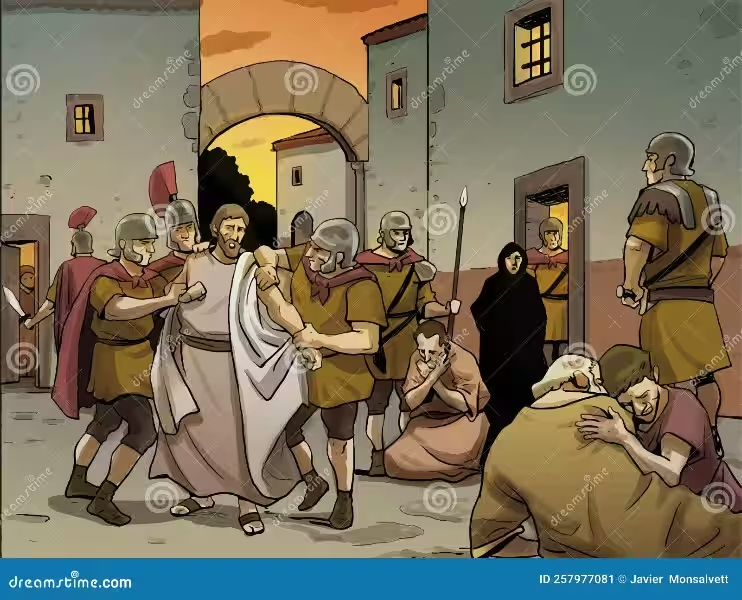
Throughout the first three centuries of Christianity, various emperors wielded their power to quash the faith. Emperors like Decius, Valerian, and Diocletian issued edicts that mandated the sacrifice of pagan gods, demanding that Christians renounce their faith or face severe consequences. These edicts forced believers into impossible choices: betray their convictions and survive, or remain steadfast and face torture, imprisonment, or death. The sheer terror and the systematic nature of these campaigns instilled deep fear within Christian communities, forcing them to adapt and often to practice their faith in hiding.
The impact of these persecutions was profound. They tested the faith of individuals to its absolute limits. Imagine being told you must publicly deny everything you believe in, everything that gives your life meaning, or face losing your home, your family, or your very life. Yet, for many, the commitment to Christ was stronger than their fear of earthly suffering. These trials, while horrific, also served to forge a stronger sense of community and identity among Christians. They learned to rely on each other for support, to share resources, and to find solace in their shared beliefs and the hope of a future resurrection.
The Price of Faith: Martyrs and the Strength of Conviction
The individuals who refused to recant and ultimately died for their faith became known as martyrs. Their stories, often circulated orally and later in written form, served as powerful testaments to the unwavering strength of Christian conviction. Figures like Polycarp of Smyrna, who famously declared he would not deny his Lord even when facing a fiery death, became icons of faithfulness. These martyrs were not seen as victims but as heroes, triumphant in their spiritual victory over earthly powers.
The blood of the martyrs, as the saying goes, became the seed of the Church. While persecution aimed to eradicate Christianity, it often had the opposite effect. The courage and resilience of those who suffered for their faith inspired others to investigate Christianity and, in many cases, to join its ranks. The public spectacle of Christian martyrdom, intended to intimidate, sometimes evoked sympathy and admiration, highlighting the moral bankruptcy of their persecutors and the profound depth of the believers’ commitment. This paradoxical outcome demonstrated that faith, when tested by fire, could emerge stronger and more compelling.
Beyond the Roman Empire: Persecution as a Universal Challenge
While the Roman Empire is a prominent example, the challenge of religious persecution is not confined to any single era or civilization. Throughout history, and even in the present day, individuals and groups who hold beliefs that deviate from the dominant or established norms have faced discrimination, oppression, and violence. The story of early Christians is a powerful reminder that the struggle for religious freedom has been a long and arduous one, marked by immense suffering and extraordinary courage.
The reasons behind religious persecution are often multifaceted. They can stem from political expediency, where a ruling power seeks to consolidate control by suppressing dissenting voices. They can arise from social prejudice and fear of the ‘other’, where unfamiliar beliefs are met with suspicion and hostility. And sometimes, they are fueled by ideological rigidity, where a particular worldview considers all other beliefs to be inherently wrong or dangerous. Understanding the historical context of early Christians persecution provides valuable insights into the enduring human tendency to marginalize and oppress those who differ.
Lessons from the Crucible: Resilience and the Enduring Power of Belief
The enduring legacy of early Christians lies not only in their eventual triumph and the establishment of Christianity as a major world religion but also in the lessons their struggles impart. Their story teaches us about the importance of unwavering conviction in the face of adversity, the power of community and mutual support during times of crisis, and the resilience of the human spirit when driven by deeply held beliefs. The early Christians persecution was a crucible that refined their faith, forging an enduring testament to the strength of the human spirit.
Ultimately, the narrative of early Christians persecution is a testament to the profound human yearning for spiritual truth and the lengths to which people will go to defend their deeply held beliefs. It is a story of immense suffering, yes, but also a story of unyielding hope, profound courage, and the transformative power of faith in the darkest of times. Their journey, from whispered prayers in catacombs to the eventual embrace of their religion by the very empire that sought to destroy them, remains a powerful and relevant chapter in the history of religion and the ongoing human quest for meaning and belonging.
Frequently Asked Questions: Early Christians and Persecution
Why were early Christians persecuted?
Early Christians were persecuted for a variety of reasons. Their refusal to worship the Roman gods and participate in state religious ceremonies was seen as disloyalty and atheism, which could be interpreted as a threat to Roman stability. Accusations of cannibalism (due to misunderstandings of the Eucharist) and incest (due to their practice of calling each other “brother” and “sister”) also fueled popular animosity. Additionally, their exclusive monotheism clashed with the polytheistic Roman society.
Who persecuted early Christians?
Persecution came from both the Roman state and, at times, from hostile pagan mobs. Roman emperors such as Nero, Domitian, Decius, and Diocletian initiated widespread, systematic persecutions. However, localized outbreaks of violence and hostility could also occur without direct imperial decree.
What forms did persecution take?
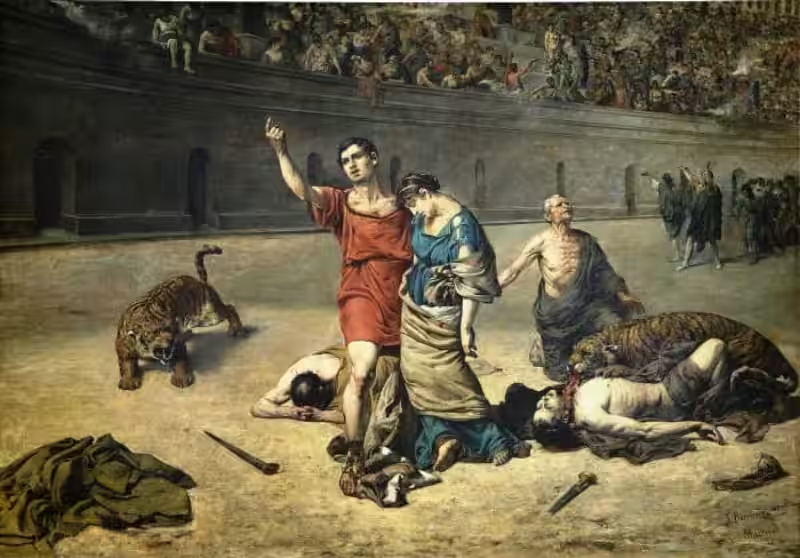
Persecution varied in intensity and form. It could range from social ostracism, confiscation of property, and imprisonment to torture and execution. Common methods of execution included crucifixion, being thrown to wild animals in amphitheatres (especially during the reign of Diocletian), and beheading.
Were all Christians persecuted all the time?
No. Persecution was not constant or uniform across the entire Roman Empire. There were periods of relative peace and tolerance, interspersed with intense waves of persecution. The severity and frequency of persecution often depended on the particular emperor, local governors, and specific political or social circumstances.
How did early Christians respond to persecution?
Early Christians responded in several ways. Some chose to resist and openly proclaim their faith, often leading to martyrdom. Others sought to escape persecution by fleeing to safer regions. Some, under duress, temporarily renounced their faith (apostates). Despite the hardships, the faith often grew stronger through the willingness of many to endure suffering and death for their beliefs.
What was the Edict of Milan?
The Edict of Milan, issued in 313 CE by Emperors Constantine and Licinius, granted religious tolerance throughout the Roman Empire. It officially ended the long period of state-sanctioned persecution of Christians and allowed them to practice their religion openly and freely.
Did persecution stop completely after the Edict of Milan?
While the Edict of Milan brought an end to state-sponsored persecution, it did not immediately erase all animosity or discrimination. However, it marked a significant turning point, and Christianity eventually became the dominant religion of the Roman Empire.