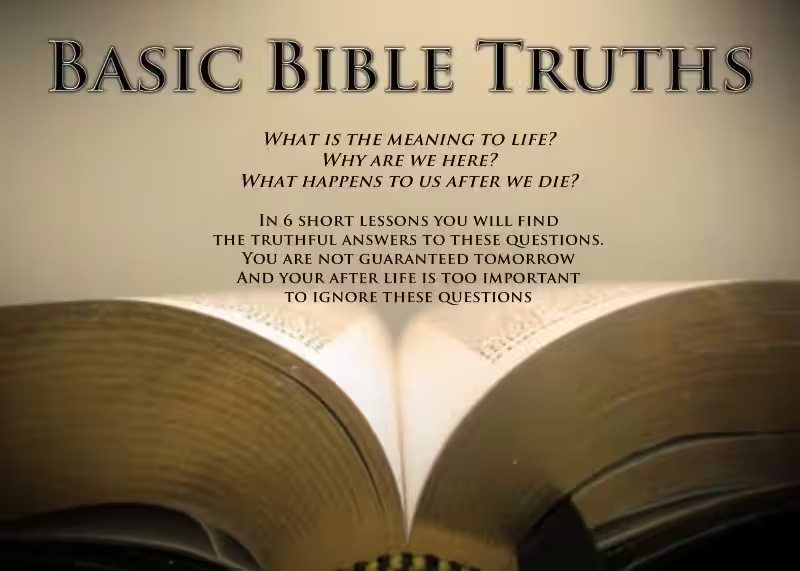
In the vast and often intricate tapestry of human belief, the concept of “God’s truth” stands as a cornerstone for countless individuals. It’s the bedrock upon which faiths are built, the compass that guides moral and ethical decision-making, and the ultimate answer to life’s most profound questions. But what exactly does “God’s truth” entail, and how does it intersect with the diverse world of religion? This exploration delves into the nature of divine truth, its expression through scripture, and the multifaceted ways it shapes our religious experiences, offering insights that are both deeply personal and universally relevant.
The quest for understanding God’s truth is an ancient and ongoing human endeavor. It’s a journey that often begins with a sense of wonder and a yearning for meaning beyond the tangible realities of everyday life. Many find solace and direction in religious texts, believing they contain divine revelations. As the Bible states in John 14:6, Jesus declared, “I am the way and the truth and the life. No one comes to the Father except through me.” This verse, for many believers, encapsulates the essence of God’s truth as a singular path to divine connection and understanding. It speaks to a profound conviction that there is an ultimate reality, a divine blueprint for existence, and that this truth is accessible through faith and adherence to divine teachings.
At its core, the concept of God’s truth suggests that there exists an objective, unchanging reality established by a divine being. This truth isn’t dependent on human opinion or cultural shifts; it is seen as eternal and absolute. Religions often claim to be the custodians and interpreters of this truth, conveying it to humanity through prophets, scriptures, and spiritual experiences. For instance, in the Quran, the divine word is presented as a clear revelation from Allah, guiding believers towards righteousness. The verse, Surah Al-Baqarah 2:185, states, “…the month of Ramadhan is that in which the Quran was revealed as guidance for the people and clear proof of guidance and criterion…” This highlights the belief that divine texts are not mere human compositions but are divinely inspired, serving as a definitive source of truth and moral guidance.
Understanding divine revelation involves recognizing that it’s often conveyed through imperfect human vessels. While the source is considered perfect, the transmission can be influenced by historical context, cultural nuances, and the limitations of human language. This is why diverse interpretations of religious texts exist, leading to the rich spectrum of religious thought we see today. However, the underlying conviction remains: that these texts and traditions offer glimpses into a truth that transcends human understanding. Consider also the wisdom found in the Bhagavad Gita, where Lord Krishna reveals profound truths about duty, destiny, and the nature of the soul, offering guidance for living a righteous life.
Religious scriptures are widely regarded as the primary conduits for God’s truth. These sacred texts, whether the Bible, Quran, Torah, Vedas, or others, are believed to contain the words, commands, and wisdom of the divine. They offer narratives of creation, moral codes, historical accounts, and prophecies, all intended to illuminate the path of righteousness and foster a deeper connection with the divine. The Apostle Paul, in 2 Timothy 3:16, famously wrote, “All Scripture is breathed out by God and profitable for teaching, for reproof, for correction, and for training in righteousness.” This powerful statement underscores the belief in the divine origin and practical utility of scripture as a source of absolute truth for believers.
The interpretation and application of these scriptural truths are central to religious practice. Different denominations and traditions within a faith may emphasize different verses or offer varying perspectives on their meaning. For example, while the Old Testament lays down the Mosaic Law, Christian theology often interprets these laws through the lens of Jesus’ teachings on love and grace. This interpretive process is a crucial aspect of how God’s truth is understood and lived out by individuals and communities. Ultimately, these texts provide a framework for understanding existence, a moral compass, and a source of hope and comfort in times of uncertainty.
The Personal Encounter with Truth
Beyond the written word, many individuals experience God’s truth through personal spiritual encounters. These can manifest as moments of profound insight, inner conviction, or a deep sense of divine presence. These experiences often reinforce or clarify scriptural teachings, providing a personal validation of what is believed to be divine truth. A profound sense of peace that surpasses all understanding, a feeling of being guided in a difficult decision, or a sudden clarity on a complex issue can all be interpreted as manifestations of God’s truth at work in an individual’s life.
These personal encounters are not always dramatic epiphanies; they can be subtle whispers of intuition or a quiet certainty that settles in the heart. For many, prayer and meditation are key practices that open them to these divine communications. The Psalmist in Psalm 46:10 urges, “Be still, and know that I am God.” This simple directive speaks to the power of quiet contemplation in discerning divine truth, suggesting that sometimes, the loudest truths are heard in the silence. These personal experiences contribute to an individual’s evolving understanding of God’s truth, making it a living and dynamic aspect of their faith journey.
The existence of numerous religions, each with its own claims to God’s truth, presents a complex challenge for those seeking understanding. How can one reconcile seemingly conflicting doctrines and practices? This diversity often leads to questions about exclusivity and universality. Some faiths hold that their truth is the only truth, while others embrace a more inclusive perspective, believing that different religions offer valid paths to the same ultimate reality. The concept of “God’s truth” itself can be perceived differently across the religious spectrum, with some emphasizing a personal, relational God, while others focus on an impersonal, all-pervasive divine force.
One approach to navigating this diversity is to focus on the shared ethical principles that often emerge across different religious traditions. Many faiths, for example, advocate for compassion, justice, honesty, and the Golden Rule: “Do unto others as you would have them do unto you.” While the theological underpinnings may differ, the practical expression of these values can be remarkably similar. As the Prophet Muhammad (peace be upon him) is reported to have said in a Hadith: “None of you truly believes until he loves for his brother what he loves for himself.” This principle of empathy and shared humanity is a universal truth that resonates across many belief systems, serving as a bridge between different interpretations of divine will.
The Practical Application of Truth
Ultimately, the significance of God’s truth lies not just in intellectual assent but in its practical application to daily life. Religious teachings aim to transform individuals, shaping their character, actions, and relationships. Living according to God’s truth often involves striving for ethical conduct, showing kindness to others, practicing forgiveness, and contributing positively to the world. It’s about embodying the principles that are believed to be divinely ordained.
For example, a Christian might strive to live out the teachings of Jesus by serving the poor and marginalized, reflecting the command found in Matthew 25:40: “Truly, I say to you, as you did it to one of the least of these my brothers, you did it to me.” Similarly, a Buddhist might endeavor to cultivate mindfulness and compassion as taught by the Buddha, aiming to alleviate suffering in themselves and others. These are not abstract theological debates but tangible actions that demonstrate a commitment to living in accordance with perceived divine truths. The application of these principles fosters a sense of purpose and deepens one’s connection to their faith community and the wider world, making “God’s truth” a living, breathing force.
Frequently Asked Questions: God’s Truth vs. Religion
What is “God’s Truth”?
“God’s Truth” is generally understood as the absolute, unchanging reality of the divine and its connection to existence, as opposed to interpretations or doctrines created by humans. It’s believed by many to be the foundational principles of the universe and the divine nature, accessible through spiritual experience, intuition, or revelation, rather than solely through organized religious structures.
How does “God’s Truth” differ from religion?
Religion, while often aiming to express or follow God’s Truth, is a human construct. It involves organized systems of beliefs, rituals, and practices developed by communities. “God’s Truth,” in this context, is the perceived ultimate reality that religions attempt to articulate. Differences can arise because religious interpretations can vary, evolve, or become dogmatic, potentially diverging from what some believe to be the pure, unadulterated truth of the divine.
Can one experience “God’s Truth” without belonging to a religion?
Yes, many believe that “God’s Truth” can be experienced directly through personal spiritual practices such as meditation, prayer, quiet contemplation, or through deeply felt moments of connection with nature or humanity. These experiences are often seen as independent of, or even preceding, organized religious affiliation.
Are all religions equally valid in their pursuit of “God’s Truth”?
This is a subject of diverse beliefs. Some perspectives hold that all religions are different paths leading to the same ultimate “God’s Truth,” emphasizing shared spiritual principles. Others believe that some religions may be closer to or more accurately represent “God’s Truth” than others, based on their historical origins, theological coherence, or the transformative experiences of their adherents. Still others might argue that “God’s Truth” transcends all specific religious formulations.
How can one discern “God’s Truth” amidst conflicting religious claims?
Discernment is often a matter of personal spiritual insight, seeking wisdom through contemplation and prayer, and examining the fruits of a belief system (e.g., whether it promotes love, compassion, and understanding). Many suggest focusing on core universal values that resonate across different spiritual traditions, rather than getting caught up in the specific doctrines or historical narratives that can divide. Critical thinking and an open heart are often considered essential tools.