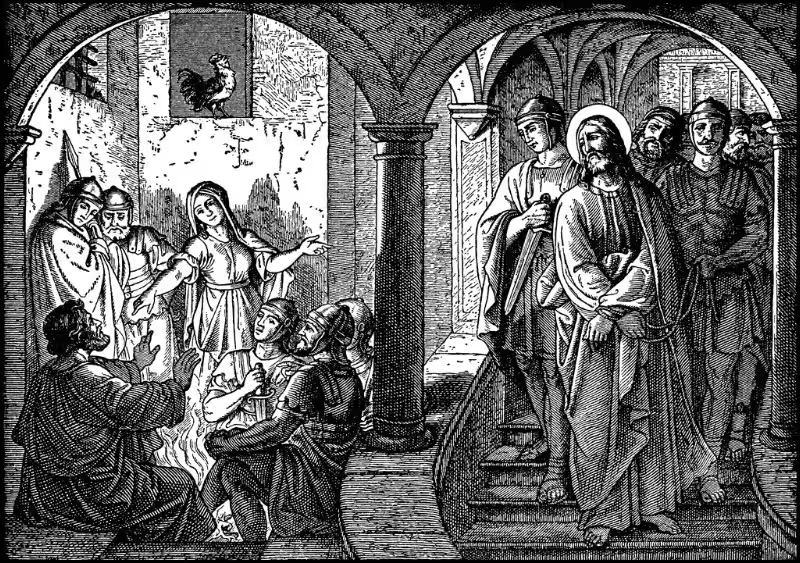
The story of Peter’s threefold denial of Jesus is one of the most poignant and human moments in the New Testament. It’s a narrative that resonates deeply, not just for its theological implications but for its raw portrayal of human frailty. We’ve all experienced moments where we’ve faltered, where our courage has wavered, and where we’ve perhaps said or done things we later regretted. This is precisely what makes the question, “Why did Peter deny Jesus three times?” so compelling and, frankly, so universally relatable.
This isn’t a story about a perfect disciple suddenly collapsing. Peter, in many ways, was the face of early Christianity, the vocal, sometimes impulsive leader among the apostles. His denial, therefore, isn’t just a historical event; it’s a profound lesson in the complexities of faith, the gripping power of fear, and ultimately, the transformative grace of forgiveness. Understanding why Peter denied Jesus three times allows us to explore the very human struggle between conviction and cowardice that many of us face in our own lives.
As Jesus faced his arrest and crucifixion, a palpable sense of dread and uncertainty descended upon his followers. The events unfolded with a terrifying speed and brutality that would shake anyone’s resolve. Jesus himself had predicted his suffering, but even his closest disciples, who had walked with him, witnessed his miracles, and heard his teachings firsthand, found themselves overwhelmed by the unfolding tragedy. For Peter, this was not just about witnessing a friend’s downfall; it was about his own personal safety and survival.
The atmosphere in the courtyard of the high priest was charged with hostility and suspicion. Soldiers, servants, and religious authorities were all present, their faces etched with animosity towards Jesus and his followers. Peter, like the other disciples, had fled when Jesus was arrested. However, driven by a mixture of lingering loyalty and perhaps a desperate hope to understand what was happening, he had followed at a distance and found himself in the outer courtyard. It was here, in this place of vulnerability and immediate danger, that he would face his ultimate test. The question of why did Peter deny Jesus three times begins to reveal itself in the chilling reality of that night.
The First Denial: A Flicker of Uncertainty
The first denial came from a lowly servant girl, her voice sharp and accusatory in the dimly lit courtyard. She recognized Peter, perhaps from his association with Jesus. “You also were with Jesus, the Nazarene,” she declared. Imagine the sudden jolt of fear that must have coursed through Peter. His immediate instinct, a deeply ingrained survival mechanism, was to distance himself from the condemned man who was now the target of immense public and religious fury. He was surrounded by people who clearly despised Jesus.
In that moment, Peter’s bold declarations of loyalty made just hours before – “Though they all fall away because of you, I will never fall away!” – seemed to vanish like mist in the morning sun. He responded with a simple, yet devastating, “I do not know what you are talking about.” This was likely not a calculated lie, but a panicked, almost involuntary, assertion of ignorance. The pressure was immense, and the immediate threat felt very real. The thought of being associated with Jesus, who was now branded a blasphemer and a rebel, was enough to make him shrink back from his commitment.
The situation escalated. After Peter’s initial denial, he moved towards the gate, perhaps trying to escape the oppressive atmosphere. However, another witness, possibly a man, spotted him and remarked to those standing nearby, “This man was with Jesus of Nazareth.” The accusation, now repeated, was harder to dismiss. The eyes of others turned towards Peter, their gazes filled with judgment and suspicion. This second encounter amplified the pressure, forcing him into a corner where he felt even more exposed.
Again, the fear, now coupled with a growing sense of desperation, took hold. He denied it again, this time with an oath: “Men, I do not know this man.” This was a more emphatic denial, a conscious effort to sever any connection. He wasn’t just saying he didn’t know Jesus; he was actively swearing it. The stakes felt higher, and the desire to blend in, to become invisible, was paramount. This repeated denial highlights the internal conflict Peter was experiencing – the battle between his heart’s allegiance and his flesh’s fear.
The Third Denial: The Crowing Rooster and Realization
The final and most damning denial occurred after a short interval, possibly when Peter had moved to a warmer spot, trying to regain some composure. This time, it wasn’t just a single voice. Several people standing around him pointed him out, saying with certainty, “Surely you are one of them, for you speak like a Galilean.” Their accusations were more direct and persistent, their conviction evident. Being from Galilee itself was a marker that could link him to Jesus.
It was at this very moment, as the words left his lips – “I do not know the man!” – that the rooster crowed. This was not some random meteorological event; it was a pre-arranged signal, a natural element woven into the fabric of that fateful night, but one that carried profound significance. Jesus, even in his own hour of suffering, had foretold this very event. The sound of the crowing rooster, echoing through the cold night air, pierced through Peter’s denial like an arrow. It was a stark reminder of Jesus’ prophecy, and in that instant, the weight of his betrayal crashed down upon him. The question of why did Peter deny Jesus three times is answered here not just by fear, but by the painful realization of his profound failure.
The Weight of Betrayal and the Path to Redemption
The immediate aftermath of the third denial was devastating for Peter. The Gospel of Luke vividly describes his reaction: “And the Lord turned and looked at Peter. And Peter remembered the word of the Lord, how he had said to him, ‘Before the rooster crows today, you will deny me three times.’ And Peter went out and wept bitterly.” This was not a fleeting moment of regret; it was a deep, soul-shattering sorrow. He had not only failed Jesus but had broken his own solemn promises, and the awareness of his weakness was crushing.
His weeping was a public display of profound remorse. It was the sound of a man who had lost something precious – his integrity, his courage, and his unbroken fellowship with his Lord, at least in that moment. The shame and guilt must have been unbearable. He had been given every opportunity to stand firm, to be the rock he was meant to be, and he had crumbled under pressure. This is where the story takes a crucial turn, moving beyond the simple question of why did Peter deny Jesus three times to the powerful narrative of what happened next.
The resurrection of Jesus changed everything. After Jesus rose from the dead, his primary focus was not to condemn Peter but to reaffirm his love and restore him. The Gospels recount how Jesus specifically appeared to his disciples, and notably, to Peter. This encounter is not about punishment; it’s about unconditional grace and a deliberate act of restoration. Imagine the apprehension Peter must have felt, facing the man he had so publicly disowned.
Jesus, with his divine insight, didn’t bring up the denial directly at first. Instead, he asked Peter a series of questions designed to help Peter reaffirm his love for him. “Simon, son of John, do you love me more than these?” he asked, not once, but three times, mirroring the three denials. Each time Peter responded with heartfelt affirmation, “Yes, Lord; you know that I love you.” This intentional repetition was a tender, yet powerful, way of cleansing Peter’s thrice-spoken denial with thrice-spoken affirmations of love.
“Feed My Sheep”: A Commission of Restoration
Following Peter’s repeated declarations of love, Jesus gave him a new, profound commission: “Tend my sheep.” This was not just a symbolic gesture; it was a direct mandate to lead and care for the fledgling Christian community. By entrusting Peter with this responsibility, Jesus was not only forgiving him but was also reinstating him to a position of leadership, perhaps even greater than before. The man who had failed to stand firm in a moment of fear was now being called to shepherd the very flock that Jesus himself loved.
This act of forgiveness and reinstatement is the ultimate answer to the question of why did Peter deny Jesus three times, not in explaining his actions, but in revealing the transformative power of divine love. Peter’s story isn’t just about his failure; it’s about his redemption. It shows that even the most profound human weaknesses can be overcome by God’s unwavering grace, and that a stumble, even a grievous one, does not have to be the end of one’s journey of faith.
Lessons for Today: Faith, Fear, and Forgiveness in Our Lives
Peter’s journey offers a timeless and deeply relevant message for us today. We may not face the same immediate physical danger as Peter did that night, but we all encounter situations where our faith is tested, and fear whispers its insidious suggestions. The question of why did Peter deny Jesus three times serves as a mirror, reflecting our own internal struggles with courage, conviction, and the temptation to compromise our values when under pressure.
Our modern world presents its own unique challenges to faith. We might be tempted to stay silent when we see injustice, to water down our beliefs to fit in, or to prioritize personal comfort over standing up for what is right. Like Peter, we might find ourselves denying Christ, not with our words, but with our actions, or our inactions. Understanding Peter’s fall and subsequent restoration can inspire us to confront our own fears and to remember that even in our moments of weakness, redemption is possible.
Peter’s denial reminds us that being a follower of Christ does not mean being perfect. It means acknowledging our imperfections, our susceptibility to fear, and our potential for failure. This realization can be incredibly liberating. It allows us to embrace our humanity without despair, knowing that God’s grace is sufficient even for our greatest shortcomings. When we grapple with why did Peter deny Jesus three times, we are essentially acknowledging that we, too, are capable of such failings.
The example of Peter encourages us to be compassionate towards ourselves and others. Instead of condemning those who stumble, we can offer understanding and support, remembering the power of encouragement in lifting someone back up. This resonates especially in our communities, where mutual support and forgiveness are vital for spiritual growth.
The Enduring Power of Forgiveness
Ultimately, Peter’s story is a testament to the overwhelming power of God’s forgiveness. Jesus did not hold Peter’s denial against him. He met Peter where he was, acknowledged his pain, and lovingly restored him. This divine act of grace is the cornerstone of Christian hope. It assures us that no matter how far we may fall, no matter how deeply we may betray our convictions, there is always the possibility of repentance, restoration, and a renewed commitment to Christ.
The narrative of Peter’s denial is not meant to be a story of condemnation but of hope and transformation. It’s a vivid illustration that our failures do not define us, but rather, how we respond to those failures, aided by God’s grace, can lead us to a more profound and resilient faith. The question of why did Peter deny Jesus three times leads us not to judgment, but to a deeper understanding of God’s boundless love and the enduring strength of His forgiveness.
Frequently Asked Questions: Peter’s Denial of Jesus
Why did Peter deny Jesus three times?
Peter’s denial of Jesus stemmed from a complex mix of fear, self-preservation, and a moment of human weakness. He had witnessed Jesus being arrested and knew that associating with him at that moment would put him in grave danger from the Roman soldiers and the Jewish authorities who were hostile to Jesus. While Peter had previously declared his unwavering loyalty, the intense pressure and fear of suffering a similar fate to Jesus caused him to falter and deny knowing him. This denial, though a profound failure, ultimately led to Peter’s repentance and a deeper commitment to his faith after Jesus’ resurrection.
What is the religious significance of Peter’s denial?
Peter’s denial serves as a powerful reminder of human fallibility and the reality of weakness even in those closest to God. It highlights that even devout followers can experience moments of doubt and fear. However, the biblical narrative also emphasizes the theme of redemption and forgiveness. Peter’s subsequent repentance and restoration by Jesus underscore the boundless mercy and grace available to those who acknowledge their failings and return to God. This story offers hope and encouragement, demonstrating that imperfections do not preclude one from being used by God.