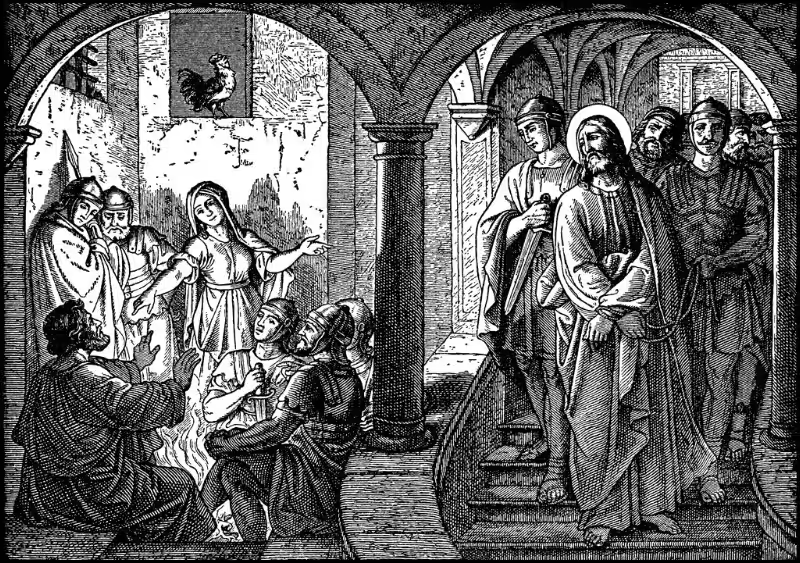
We often look to the great figures of faith for unwavering strength and an example of perfect devotion. The stories of biblical heroes are frequently presented as tales of unblemished courage and unwavering loyalty. However, the reality of the human experience, even for those closest to the divine, is far more complex and, dare I say, relatable. One of the most poignant and enduring narratives of human fallibility in the face of immense pressure is the story of Peter’s denial of Jesus. This pivotal moment, etched in the Gospels, isn’t just a historical event; it’s a mirror reflecting our own struggles with conviction, fear, and the struggle to stand firm when the world presses in. It’s a reminder that even the most devoted can, under duress, falter.
Consider the scene: Jesus, betrayed and arrested, is facing his Passion. His closest disciples, those who walked with him, ate with him, and witnessed his miracles, are scattered and terrified. Among them is Peter, the impetuous fisherman, the rock upon whom Jesus declared he would build his church. Yet, when confronted by servants and guards in the courtyard, asked if he was one of Jesus’ followers, Peter, in a moment of sheer panic and self-preservation, denies his Lord. Not once, but three times. This act of Peter denying Jesus is not presented as a sign of inherent wickedness, but as a stark depiction of how fear can override even the deepest love and commitment.
The Weight of Fear: Why We Might Deny Our Truths
Why would Peter, who had just hours before drawn his sword to defend Jesus, so vehemently disown him? The answer lies in the palpable atmosphere of threat. The arrest was violent, the mood was hostile, and the consequences for associating with Jesus were clearly dire. For Peter, standing alone in the dimly lit courtyard, the immediate danger felt more real than his allegiance to the man he knew to be the Messiah. This isn’t about Peter being a bad person; it’s about understanding the powerful grip of fear. Think about our own lives: how often do we shy away from expressing our beliefs, our values, or our support for something we hold dear, simply because of the potential for discomfort, ridicule, or even professional repercussions? It’s the boss who disapproves of a certain lifestyle choice, the family gathering where faith is mocked, or the social media storm that erupts over a dissenting opinion. In these moments, the instinct for self-preservation can be overpowering.
The psychological pressure to conform, to blend in, to avoid conflict is immense. It’s easier to stay silent than to speak up. It’s safer to nod along than to express a dissenting view. This is the insidious nature of fear. It can whisper doubts, magnify risks, and erode our confidence. The story of Peter denying Jesus three times serves as an uncomfortable but necessary reminder that our convictions are tested not in times of peace and comfort, but in moments of intense pressure. It highlights the human tendency to prioritize immediate safety over long-term integrity, a struggle that resonates deeply with the challenges many face in their daily lives, whether religious or secular.
The Unveiling of Regret: The Rooster’s Crow as a Wake-Up Call
The Gospel accounts are unflinching in their portrayal of the aftermath of Peter’s denials. As the third denial leaves Peter’s lips, the rooster crows, and Jesus, from within the house, turns and looks at him. That look. It’s a moment of profound, silent understanding. It’s not a look of condemnation, but one of deep sorrow, perhaps even pity, acknowledging Peter’s human weakness. This is where the narrative transitions from a depiction of failure to a testament of redemption. The Peter deny Jesus moment is followed by his profound grief, his weeping. This isn’t the weeping of someone caught in a lie, but the agonizing lament of someone who has betrayed something, and someone, they deeply cherish.
This moment of intense regret is crucial for our understanding. It shows that the denial wasn’t the end of Peter’s story, nor the end of his relationship with Jesus. Instead, it was a catalyst for profound self-awareness and repentance. The pain of his failure spurred him to a deeper reliance on God’s grace. Think of times you’ve said or done something you immediately regretted, something that went against your core values. That knot in your stomach, the gnawing feeling of shame – that’s the internal echo of Peter’s sorrow. It’s the painful but necessary realization that we have fallen short, an experience that can, if we allow it, lead us to a place of humility and a renewed commitment to what truly matters.
The Path to Restoration: Grace Beyond Our Failures
The beauty of the Christian narrative, and indeed many spiritual traditions, lies not just in the ideals they present, but in their honest acknowledgment of human imperfection and the promise of restoration. After his resurrection, Jesus doesn’t shun Peter. Instead, he seeks him out. In a poignant encounter by the Sea of Galilee, Jesus asks Peter three times, “Do you love me?” Each affirmation of love from Peter serves as a counterpoint to his earlier denials, a deliberate act of healing and reintegration. This is the heart of the message: our failures, even those as significant as Peter denying Jesus three times, do not have to define us permanently.
This story offers immense hope and encouragement. It teaches us that religion and faith are not about achieving a state of sinless perfection, which is an impossible standard for humanity. Rather, it’s about a journey of growth, a process of falling, learning, and getting back up, empowered by divine grace. When we stumble, when we deny our beliefs out of fear or weakness, the path to restoration is always open. It involves acknowledging our mistakes, embracing the lessons learned, and actively seeking to live in alignment with our deepest convictions. The story of Peter’s denial and subsequent restoration is a powerful reminder that even in our darkest moments of doubt and faltering, religion offers a path towards redemption and a renewed sense of purpose, fueled by an enduring and forgiving love.
Frequently Asked Questions
What does it mean that Peter denied Jesus three times?
In the Christian Gospels, Peter, one of Jesus’ closest disciples, is recorded as having denied knowing Jesus three times before Jesus was crucified. This event is significant as it highlights Peter’s human weakness and fear in a moment of crisis, yet it is often seen as a precursor to his later strong affirmation of faith and leadership in the early church.
What is the religious significance of Peter’s denial?
The denial serves as a powerful narrative of human fallibility and the subsequent redemption and forgiveness offered through faith. It emphasizes that even those closest to Jesus could falter under pressure, and it underscores the importance of repentance and renewed commitment. For many Christians, Peter’s story is a source of encouragement, showing that one’s mistakes do not define their ultimate spiritual journey.
How does Peter’s denial relate to the concept of religion?
Peter’s denial is a foundational event in Christianity, a religion that emphasizes themes of faith, doubt, human imperfection, and divine grace. The story prompts reflection on personal faith, the challenges of discipleship, and the transformative power of forgiveness. It illustrates that religious belief is often tested and can be strengthened through overcoming personal failures.