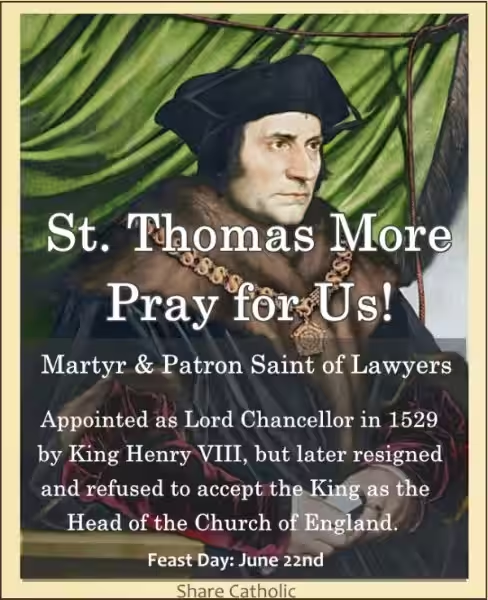
The St. Thomas More feast day, celebrated annually on June 22nd, is far more than just a date on the liturgical calendar. It’s a potent reminder of the profound intersection of faith, conscience, and unwavering moral conviction. For Catholics and many others who admire his principled stand, this feast day offers an opportunity to reflect on a life lived with extraordinary integrity, even in the face of immense pressure. St. Thomas More, a lawyer, statesman, scholar, and ultimately, a martyr, embodies a timeless struggle to remain true to one’s deepest beliefs, even when societal and political tides threaten to sweep them away.
Understanding the significance of the St. Thomas More feast day means delving into the life of a man who navigated the treacherous waters of Tudor England with remarkable intelligence and, crucially, an unshakeable moral compass. He served as Lord Chancellor, a position of immense power and influence, yet his ultimate allegiance lay not with the King, but with his faith. This duality, this commitment to a higher law, is what makes his story resonate so powerfully centuries later, and why his feast day continues to inspire.
Thomas More was born in London in 1478, a product of the vibrant, intellectual ferment of the English Renaissance. He received an excellent education, displaying a keen mind for law and a deep love for learning and literature. His early career saw him rise through the ranks of the legal profession, demonstrating both sharp legal acumen and a compassionate approach to justice. He was known for his integrity, his wit, and his ability to connect with people from all walks of life.
Beyond his professional achievements, More was a devout layman, deeply rooted in his Catholic faith. He spent time in a monastery, contemplating a religious vocation, but ultimately chose to serve God and his community through his secular life. His writings, most famously Utopia, showcased his intellectual prowess and his vision for a more just and equitable society. However, it was his unwavering adherence to his faith that would ultimately define his legacy, making the St. Thomas More feast day a celebration of profound spiritual fortitude.
A Man of Law and Loyalty
More’s legal career was marked by distinction and fairness. He was appointed to numerous important positions, culminating in his appointment as Lord Chancellor in 1529, the highest judicial office in the land. This was a position of immense trust and responsibility, placing him directly in service to King Henry VIII. He was a trusted advisor, a skilled negotiator, and a man of considerable influence within the royal court.
During his tenure, More was respected for his impartiality and his dedication to the rule of law. He strived to administer justice fairly, even when faced with complex political pressures. His commitment to his legal duties was undeniable, but it was always balanced by a deeper commitment to his conscience and his faith, a tension that would ultimately lead to his dramatic downfall. The wisdom and foresight he demonstrated in his legal career foreshadowed the principled stand he would later take, making the St. Thomas More feast day a testament to his lifelong dedication to justice, both earthly and divine.
The defining crisis of Thomas More’s life, and the reason for his eventual martyrdom, stemmed from King Henry VIII’s desire for an annulment of his marriage to Catherine of Aragon and his subsequent break with the Roman Catholic Church. The King demanded that all his subjects swear an oath acknowledging his supremacy over the Church in England and denying the authority of the Pope. For Thomas More, this was a line he could not cross.
His refusal to take the oath was not an act of defiance against the King’s authority in temporal matters, but rather a deeply held conviction that the Pope held spiritual authority. He believed that to acknowledge the King as the supreme head of the Church was to betray his faith and the teachings of centuries. This principled stand, rooted in his unwavering obedience to God’s law above man’s law, is the central narrative that the St. Thomas More feast day commemorates.
The Meaning of Martyrdom: More’s Ultimate Sacrifice
Thomas More’s refusal to compromise his faith led to his imprisonment in the Tower of London and, ultimately, his execution on July 6, 1535. His final words, reportedly, were that he died “the King’s good servant, but God’s first.” These words encapsulate the essence of his martyrdom and the profound message conveyed on the St. Thomas More feast day.
His execution was a stark demonstration of the cost of conscience. He faced accusations of treason, but his true “crime” was his refusal to betray his spiritual allegiance. He did not seek out martyrdom, but he did not shy away from it when it became the inevitable consequence of his commitment to his faith. This makes his story a powerful example of moral courage in the face of overwhelming adversity.
The Power of a Principled Stand
More’s sacrifice was not in vain. His unwavering commitment to his conscience became a beacon for others, both within his lifetime and for generations to come. He demonstrated that true freedom lies not in adhering to popular opinion or political expediency, but in living according to one’s deepest moral and spiritual convictions. This lesson remains incredibly relevant today, as we often face pressures to conform in various aspects of our lives.
The St. Thomas More feast day encourages us to examine our own consciences. Are we willing to stand for what we believe is right, even when it is difficult or unpopular? More’s life serves as a powerful reminder that our internal compass, guided by faith and reason, is a precious and indispensable tool. His story offers a relatable framework for understanding the challenges of living a life of integrity in a complex world.
A Legacy of Conscience in Modern Times
The legacy of St. Thomas More extends far beyond the confines of religious devotion. His steadfastness in the face of tyranny and his unwavering commitment to the primacy of conscience have made him an icon of intellectual and spiritual freedom. His example continues to inspire individuals in all walks of life who grapple with ethical dilemmas or face pressure to compromise their values.
On the St. Thomas More feast day, we are invited to consider the importance of speaking truth to power, of upholding justice, and of living authentically. His life story, from his early legal triumphs to his ultimate sacrifice, offers a compelling narrative of a man who understood that some things are more valuable than life itself. This enduring relevance is why his feast day continues to be observed with such reverence and reflection.
Reflecting on the St. Thomas More Feast Day: What Can We Learn?
The St. Thomas More feast day offers us more than just a historical commemoration; it provides a profound opportunity for personal reflection and spiritual growth. In a world often characterized by compromise and shifting moral landscapes, More’s life stands as a steadfast example of principled living. His journey from esteemed statesman to condemned martyr is a testament to the ultimate power of conviction.
We can draw inspiration from his dedication to both his earthly duties and his heavenly allegiance. He was not a hermit detached from the world, but a man deeply involved in its affairs. Yet, he understood the critical importance of maintaining an inner integrity, a commitment to a higher moral code that transcended political expediency. The lessons from his life, celebrated on his feast day, are universal and deeply relevant to our own contemporary challenges.
The Courage to Be Different
Thomas More’s decision to defy King Henry VIII was not an easy one. It carried immense personal risk, leading to the loss of his position, his freedom, and ultimately, his life. Yet, he chose to embrace that risk rather than betray his deepest convictions. This is the essence of moral courage: the willingness to act in accordance with one’s conscience, even when it incurs significant personal cost.
The St. Thomas More feast day challenges us to consider where our own lines are drawn. In our daily lives, we may not face life-or-death situations, but we do encounter opportunities to compromise our values for convenience, personal gain, or social acceptance. More’s example encourages us to cultivate the inner strength to stand firm when our principles are tested, and to remember that true integrity is forged in the crucible of difficult choices.
Ultimately, the St. Thomas More feast day is a call to action, an invitation to examine our own consciences and our commitment to living a life of integrity. More’s life reminds us that our faith and our moral compass are invaluable guides, even in the most challenging circumstances. He teaches us that true freedom is not the absence of external constraints, but the internal liberty to live in accordance with truth and justice.
By reflecting on the life and sacrifice of St. Thomas More, we are empowered to approach our own lives with greater purpose and a renewed commitment to living out our deepest beliefs. His enduring legacy, celebrated each year on his feast day, continues to illuminate the path for all who seek to live a life of faith, conscience, and unwavering courage.
Frequently Asked Questions about the Feast Day of St. Thomas More
What is the Feast Day of St. Thomas More?
The Feast Day of St. Thomas More is celebrated on June 22nd.
What is the significance of St. Thomas More?
St. Thomas More was an English lawyer, social philosopher, author, statesman, and noted Renaissance humanist. He served as Lord High Chancellor of England from October 1529 to May 1532. He is revered as a saint and martyr in the Catholic Church and is the patron saint of statesmen and politicians.
Why is St. Thomas More venerated?
St. Thomas More is venerated for his unwavering commitment to his principles, particularly his Catholic faith, even in the face of persecution. He refused to swear the Oath of Supremacy, which would have acknowledged King Henry VIII as the supreme head of the Church of England, believing it violated his allegiance to the Pope. This defiance led to his execution for treason.
What religious tradition observes the Feast Day of St. Thomas More?
The Feast Day of St. Thomas More is primarily observed by the Catholic Church. He is also recognized by some other Christian denominations, such as the Anglican Communion, though with a different commemoration date in some cases.
What are some common ways people observe the Feast Day of St. Thomas More?
Observances can include attending Mass, praying special prayers in his honor, reflecting on his life and teachings, and studying his writings or biography. Many also pray for his intercession, especially those involved in public service or who face difficult moral choices.