Embarking on a Romano Tour: More Than Just Sightseeing
When you think of a “Romano tour,” your mind might immediately conjure images of ancient ruins, gladiatorial arenas, and the grandeur of the Roman Empire. While these are undeniably central to the experience, a deeper dive reveals that a Romano tour offers a surprisingly rich and often overlooked dimension: religion. The very foundations of Roman civilization were steeped in a complex pantheon of gods and goddesses, and later, in the genesis and spread of Christianity. Understanding this religious landscape is not just academic; it’s essential to truly grasping the spirit and motivations behind the monumental structures and everyday lives of the people who inhabited this powerful empire.
A well-crafted Romano tour will weave these religious narratives seamlessly into the historical context. Imagine standing in the Pantheon, its awe-inspiring dome a testament to Roman engineering, and learning not just about its architectural brilliance, but about its original purpose as a temple dedicated to all the gods. This duality, the transition from pagan worship to Christian reverence, is a recurring theme that makes a Romano tour profoundly insightful. It’s about witnessing the evolution of belief systems and their tangible impact on the physical world we can still explore today.
The Pagan Heartbeat of Ancient Rome
Before the rise of Christianity, ancient Rome pulsed with a vibrant polytheistic faith. The Romans, known for their pragmatism, adopted and adapted deities from various cultures, creating a syncretic religion that permeated every aspect of their lives. From the grand public ceremonies honoring Jupiter, the king of the gods, on the Capitoline Hill, to the humble household shrines dedicated to Lares and Penates, the spirits of the home, religion was an ever-present force. A key element of any Romano tour focusing on this era would be to explore the remnants of these sacred spaces.
Consider the Roman Forum, the bustling heart of civic and religious life. Here, you’d find temples dedicated to deities associated with specific domains: Vesta, the goddess of the hearth, whose perpetual flame symbolized the city’s life; Saturn, god of agriculture and wealth; and Venus, the goddess of love and beauty. Each structure, each statue, was a focal point for communal worship and individual supplication. A guided Romano tour can illuminate these connections, transforming silent stones into vibrant narrative. For instance, the Vestal Virgins, priestesses of Vesta, held a unique and powerful position in Roman society, their lives dedicated to maintaining the sacred fire, a crucial ritual for the city’s well-being. Their precinct, often included in comprehensive tours, speaks volumes about the importance of specific religious roles and their societal influence.
The Roman pantheon was not a static entity; it was a dynamic system that reflected the Romans’ worldview and aspirations. They believed that the gods influenced everything from military victories to the success of a harvest. Therefore, appeasing them through sacrifices, prayers, and elaborate festivals was not merely a matter of piety, but a practical necessity for ensuring prosperity and stability. A Romano tour can bring these practices to life by visiting sites like the Ara Pacis Augustae, or Altar of Augustan Peace, a monument dedicated to the goddess Pax, personifying peace, and showcasing the religious and political unity Augustus sought to project.
Beyond grand temples, domestic religion was equally significant. Every Roman home, whether a modest apartment in an insula or a sprawling villa, would have had an altar or shrine devoted to household deities, the Lares and Penates. These were the guardians of the family, and offerings were made to them to ensure health, happiness, and protection. When you embark on a Romano tour, especially one that ventures into the residential areas like Pompeii or Ostia Antica, you can witness these intimate spaces. Seeing the preserved shrines, often adorned with faded frescoes depicting mythological scenes or protective symbols, offers a powerful glimpse into the personal faith of ordinary Romans.
The Roman Religion’s Transformation: The Rise of Christianity
The landscape of religion in Rome underwent a seismic shift with the emergence and eventual triumph of Christianity. Initially a minority sect, often viewed with suspicion and even persecuted, Christianity gradually gained traction, its message of salvation and equality resonating with a diverse population. A truly comprehensive Romano tour will inevitably address this profound transition, showcasing the physical evidence of this religious evolution.
The early Christian communities, facing adversity, congregated in secret, often in catacombs beneath the city. These subterranean burial chambers served not only as resting places for the deceased but also as clandestine meeting points for worship. Visiting these catacombs is a moving and often haunting experience, revealing early Christian art, symbols like the ichthys (fish), and inscriptions that speak of faith and hope amidst persecution. A guided Romano tour of the catacombs provides context for the challenges early Christians faced and the resilience of their beliefs.
From Persecution to Pantheon: Christianity’s Ascent
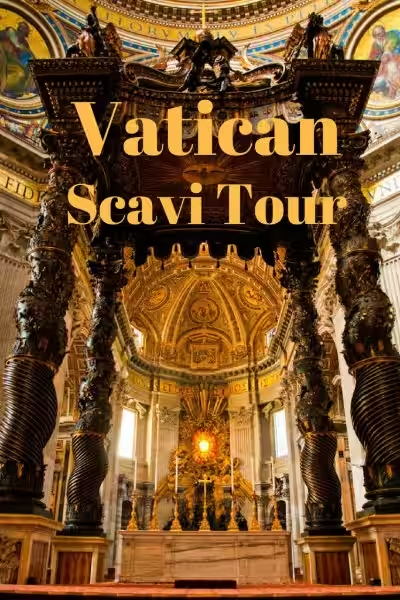
The Edict of Milan in 313 AD, issued by Emperors Constantine and Licinius, granted religious tolerance throughout the Roman Empire, marking a pivotal moment for Christianity. No longer forced into hiding, Christians began to build grand basilicas, adapting existing Roman architectural forms for their new purpose. The Basilica of Saint Peter, for instance, stands on the traditional site of Saint Peter’s martyrdom, a testament to the growing influence and eventual dominance of the new faith. A Romano tour that connects these early Christian sites with the later imperial patronage offers a compelling narrative of religious transformation.
The pagan temples, once the centers of Roman religious life, began to fall into disuse or were repurposed for Christian worship. The Pantheon, originally a temple to all gods, was consecrated as a Christian church in 609 AD, a symbolic act that underscored the complete shift in Rome’s spiritual allegiance. This transformation is a recurring motif throughout a well-executed Romano tour. It’s a powerful reminder that the very stones of Rome bear witness to these profound changes in belief and practice, demonstrating how religion is not static but a dynamic force shaping societies.
Romano Tour: Experiencing Faith in the Eternal City
When you plan your Romano tour, consider how much richer the experience becomes when you engage with its religious history. It’s not just about seeing ancient stones; it’s about understanding the beliefs that inspired their construction, the rituals that were performed within their walls, and the profound impact these faiths had on the lives of the people. From the majestic temples dedicated to Roman gods to the sacred silence of early Christian catacombs and the grandeur of Renaissance-era churches built upon ancient foundations, religion is an indelible thread woven through the fabric of Rome.
A truly immersive Romano tour will offer opportunities to reflect on the enduring power of faith. Whether you are exploring the ruins of a pagan shrine, marveling at the artwork in a Baroque church, or contemplating the lives of early martyrs, you are connecting with a continuous human story of seeking meaning, community, and the divine. This spiritual dimension elevates a simple vacation into a journey of profound discovery, making your Romano tour an unforgettable exploration of both history and the human spirit.
Romano Tour: Religion FAQs
What religious sites can I visit on a Romano Tour?
Romano Tours can include visits to a variety of significant religious sites, depending on the specific itinerary. This can encompass ancient Christian basilicas, early medieval churches, historic synagogues, and sites of pagan worship from the Roman era. We aim to showcase the diverse religious landscape of the regions we explore.
Are Romano Tours suitable for people of all faiths or no faith?
Absolutely. Romano Tours are designed to be educational and enriching for everyone, regardless of their religious beliefs or background. Our focus is on the historical, architectural, and cultural significance of these sites, offering insights into the evolution of religious thought and practice throughout history.
Do Romano Tours require specific religious knowledge?
No, prior religious knowledge is not a prerequisite. Our expert guides will provide comprehensive historical and cultural context for each site, making the information accessible and engaging for all participants.
Can I participate in religious services during a Romano Tour?
While our tours focus on historical exploration, some itineraries may offer opportunities for participants to attend services if they are taking place at a site visited on the tour. This is typically optional and will be clearly communicated in the tour details. Please check the specific itinerary for more information.
Are there any dress code requirements for visiting religious sites on a Romano Tour?
Yes, when visiting active religious sites, it is important to dress respectfully. This usually means covering shoulders and knees. We will always provide specific guidance on dress codes in our pre-tour information for each destination.