We often hear the term “ecology” and understand it to mean the study of how living organisms interact with their environment. But the beauty of language lies in its origins, and the word “ecology” itself is deeply connected to a powerful eco root word that whispers tales of home, dwelling, and stewardship. This ancient root isn’t just about biological systems; it’s profoundly intertwined with the very essence of many religious beliefs, shaping our understanding of the divine, our place within creation, and our responsibilities towards the natural world. Understanding this eco root word unlocks a deeper appreciation for the sacredness of our planet and the spiritual imperatives that call us to protect it.
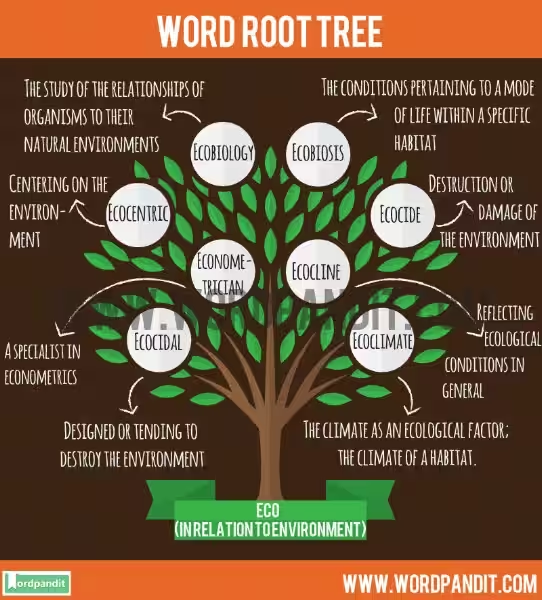
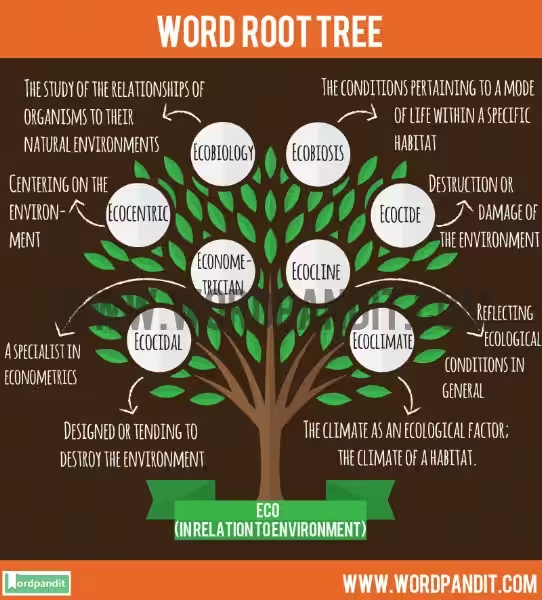
The eco root word, derived from the ancient Greek word “oikos,” signifies “house,” “household,” or “dwelling place.” This fundamental concept of home extends far beyond the walls of our physical residences. It encompasses the entire natural world as our collective dwelling, the vast and intricate ecosystem that sustains all life. When we look at the myriad religious traditions across the globe, we find this intrinsic connection to the earth, this sense of belonging to a grander, divinely appointed home, echoed in their sacred texts, rituals, and ethical frameworks. It’s a powerful reminder that our spiritual journey is not separate from our physical one, but rather intimately bound to the health and well-being of the planet we inhabit.
The Divine Dwelling: God as the Ultimate Eco-Creator
Many religions posit a creator deity who not only brought the universe into existence but also meticulously designed and continuously sustains it. This divine architect, in essence, is the ultimate architect of our eco-dwelling. The act of creation itself is often depicted as an act of profound love and care, where the earth and all its inhabitants are seen as precious gifts. In this view, the natural world isn’t merely a backdrop for human activity but a living testament to the divine presence and power. Consider the concept of God breathing life into the world, or the universe unfolding according to divine will; these narratives highlight a creator deeply invested in the flourishing of their creation, their ultimate eco-dwelling.
Religious narratives frequently emphasize the perfection and harmony of the original creation, a pristine eco-dwelling before the advent of human imperfection. Descriptions of Eden, paradise, or the primordial state often paint a picture of an unspoiled natural world where humanity lived in perfect balance with all other beings. This ideal serves as a spiritual benchmark, a reminder of what was, and what could be again. The concept of a divine plan for the Earth underscores the idea that our planet is not a random occurrence but a purposeful creation, a sacred space entrusted to our care. This profound understanding imbues the natural world with an intrinsic value that transcends mere utility, making it worthy of reverence and protection as God’s magnificent eco-dwelling.
Stewardship and Responsibility: Our Role in the Sacred Eco-System
The notion of eco root word as “home” naturally leads to the concept of stewardship. If the Earth is our divinely appointed dwelling, then humanity often finds itself cast in the role of caretakers or stewards. Religious texts are replete with injunctions and narratives that highlight our responsibility to manage and protect this precious inheritance. This isn’t a burden, but a sacred trust, a duty born out of gratitude for the gift of life and for the eco-dwelling we share. For instance, many traditions speak of “dominion” not as a license to exploit, but as a mandate to rule wisely and responsibly, ensuring the well-being of the entire household.
This call to stewardship manifests in various ways across different faiths. It might involve practicing sustainable living, respecting the sanctity of life in all its forms, or actively working to heal environmental damage. The principle of “tikkun olam” in Judaism, meaning “to repair the world,” directly translates to environmental responsibility. Similarly, the Islamic concept of “khalifah” (vicegerent) emphasizes humanity’s role as a trustee of God’s creation. Even in animistic traditions, where spirits are believed to inhabit natural elements, there’s a deep-seated respect for the environment born from recognizing the inherent sacredness of the eco-system. This understanding calls for a conscious effort to live in harmony with nature, recognizing that our actions have profound consequences for our shared eco-dwelling.
Nature as a Sacred Text: Reading the Divine in the Eco-System
Beyond direct commandments, many religious traditions find spiritual nourishment and divine revelation within the natural world itself. The eco root word’s implication of “home” suggests that the Earth is a place where the divine can be encountered. The intricate patterns of a leaf, the vastness of the ocean, the cycle of seasons – these are often interpreted as divine signatures, “sacred texts” written in the language of nature. Meditating on the beauty and complexity of the natural world can lead to profound spiritual insights and a deeper connection to the creator. This perspective transforms the environment from a mere resource into a sanctuary for spiritual experience.
For example, in Hinduism, the Ganges River is revered as a goddess, a source of purification and spiritual cleansing. Buddhist monks often seek enlightenment in natural settings, finding solace and wisdom in the quietude of forests and mountains. Even in the Abrahamic faiths, the wilderness has often served as a place of spiritual retreat and divine encounter, as seen in the stories of prophets seeking solitude in the desert. This reverence for the natural world as a source of divine wisdom underscores the interconnectedness of all things. When we truly observe and appreciate the eco-system, we are, in a sense, reading pages from a divine book, understanding the creator through their magnificent eco-dwelling.
The Eco-Crisis as a Spiritual Crisis: Reconnecting Faith and Environment
In modern times, the growing eco-crisis presents a significant spiritual challenge. As we witness the degradation of our planet – deforestation, pollution, climate change – it can feel like a betrayal of our sacred eco-dwelling. Many theological scholars and religious leaders argue that the current environmental crisis is not just a scientific or economic problem, but a profound spiritual failing. When we disconnect from nature, when we view it as something separate from ourselves or as a mere commodity to be exploited, we sever a vital spiritual connection.
Re-establishing this connection requires a conscious re-evaluation of our relationship with the Earth, guided by the wisdom embedded within our religious traditions. It means embracing the eco root word’s original meaning of home and acting accordingly. This might involve:
Reinterpreting religious doctrines: Focusing on the ecological dimensions of faith.
Adopting sustainable practices: Aligning our lifestyles with our spiritual values.
Engaging in environmental advocacy: Speaking out for the protection of our planet.
Promoting interfaith dialogue: Collaborating on environmental solutions.
By recognizing the Earth as our sacred eco-dwelling and embracing our role as responsible stewards, we can begin to heal both our planet and our spiritual lives, fostering a deeper harmony between humanity, faith, and the natural world.
Frequently Asked Questions about the Eco Root Word and Religion
What does the root word “eco” mean?
The root word “eco” comes from the Greek word “oikos,” which means “house” or “household.” It is often used to refer to the environment or ecology, referring to the relationships between living organisms and their surroundings, essentially their “household.”
How is the root word “eco” related to religion?
The root word “eco” appears in various religious contexts, particularly within eco-theology or environmental ethics. It signifies the religious understanding of humanity’s relationship with the natural world, often viewing the Earth as a sacred creation or a divine household that needs to be cared for and protected.
Are there specific religions that emphasize the “eco” aspect of their beliefs?
Yes, many religions have traditions that emphasize a connection to nature. For example, Indigenous religions often have deep ecological spiritualties. Some branches of Christianity, Islam, and Buddhism also have developed eco-theological movements that highlight the importance of environmental stewardship as a religious duty.
What are some examples of religious terms or concepts that use the root word “eco”?
While “eco” itself might not always be a direct prefix in traditional religious terminology, the concept is present. For instance, in eco-theology, discussions revolve around “ecocriticism” in religious texts, “eco-justice” as a religious imperative, and the idea of the Earth as God’s creation, which can be understood as a divine “household” to be managed responsibly.