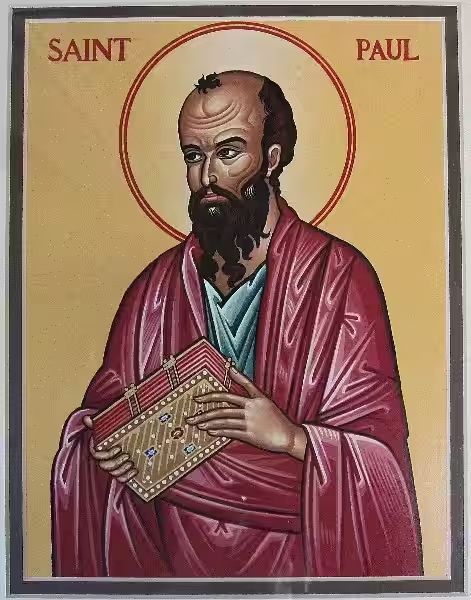
The tapestry of early Christianity is rich and complex, woven with the threads of numerous devoted individuals. Among these figures, none arguably shaped the nascent religion more profoundly than Paul the Apostle. His journey from ardent persecutor to fervent evangelist is a story of radical transformation, a testament to the power of conviction and the enduring appeal of the message he so passionately championed. Understanding Paul’s contributions is not merely an academic exercise; it offers profound insights into the foundational principles of Christianity and its enduring global impact.
What makes Paul’s story so compelling is its sheer dynamism. He didn’t just join a movement; he redefined its trajectory. His intellectual rigor, his unwavering dedication, and his ability to articulate complex theological ideas in accessible ways laid the groundwork for Christian doctrine for centuries to come. His letters, the epistles of Paul, remain some of the most influential texts in the New Testament, offering practical guidance and profound theological reflection that continues to resonate with believers today.
From Persecutor to Prophet: The Conversion of Saul
Before he was known as Paul, he was Saul, a staunch Jew who zealously guarded the traditions of his faith. In fact, Saul was so committed to upholding Mosaic law that he actively opposed the early followers of Jesus, whom he viewed as heretics. His participation in the stoning of Stephen, the first Christian martyr, is a stark illustration of his initial hostility. This period paints a picture of a man driven by deeply held, albeit misguided, convictions, a man who saw the emerging Christian sect as a threat to the very fabric of his religious identity.
The pivotal moment in Saul’s life, and indeed for Christianity, was his encounter on the road to Damascus. According to the biblical narrative, a blinding light and the voice of Jesus Christ himself appeared to him, leading to his dramatic conversion. This experience was not a gentle awakening but a seismic shift that fundamentally altered his worldview and his life’s purpose. Emerging from this encounter, he was no longer Saul the persecutor but Paul the Apostle, commissioned to spread the very message he had once sought to extinguish. This transformation is a powerful narrative of redemption and the potential for profound change, a story that has inspired countless individuals throughout history.
Paul’s impact extends far beyond his personal conversion; it lies in his groundbreaking theological interpretations and his unwavering commitment to a universal gospel. He grappled with a fundamental question: could the salvation offered by Jesus extend beyond those of Jewish heritage to the Gentiles, the non-Jewish peoples of the Roman Empire? This was a radical idea, challenging centuries of tradition and the established boundaries of religious identity.
Paul’s answer was a resounding “yes.” Through his extensive travels and tireless evangelism, he actively preached to Gentiles, establishing churches across the Roman world. His theological arguments, particularly his emphasis on salvation by grace through faith in Jesus Christ, rather than adherence to the Mosaic Law, were instrumental in shaping the identity of Christianity as a distinct religion. He argued that faith in Christ, not circumcision or other ritualistic practices, was the key to reconciliation with God. For example, he explained that just as a gifted present doesn’t require payment, God’s salvation is freely given through faith. This opened the doors for a religion that could transcend ethnic and cultural barriers, a crucial factor in its eventual global spread.
Paul’s Letters: Pillars of Christian Doctrine
Among Paul’s most enduring legacies are his epistles, letters written to the various churches he had founded or ministered to. These letters are not mere historical documents; they are living testaments to his pastoral care, his theological insights, and his unwavering commitment to his converts. Written in plain language, yet rich in theological depth, they provide a window into the challenges and triumphs of early Christian communities.
These epistles cover a wide range of topics, from addressing doctrinal disputes and practical ethical issues to offering profound reflections on the nature of God, Christ, and the Christian life. Consider, for instance, his letter to the Romans, often considered his magnum opus. In it, Paul meticulously lays out his understanding of justification by faith, the concept that humans are declared righteous before God not by their own works but by their belief in Jesus Christ. Other letters, like those to the Corinthians, offer guidance on church order, dealing with sin, and understanding spiritual gifts, providing practical advice that remains relevant for navigating community life within faith traditions.
Key Themes in Paul’s Writings
Several recurring themes permeate Paul’s writings, forming the bedrock of much Christian theology. Justification by grace is perhaps the most central. Paul consistently argues that humanity is inherently flawed and incapable of earning salvation through good deeds. Instead, salvation is a gift from God, freely bestowed upon those who believe in Jesus Christ. This concept was revolutionary, shifting the focus from human effort to divine generosity.
Another vital theme is the unity of believers in Christ. Paul emphasizes that in Christ, there are no divisions based on social status, ethnicity, or gender. He uses powerful metaphors, such as the body of Christ, to illustrate how believers are interconnected and interdependent, each playing a vital role in the functioning of the whole. This vision of inclusivity and spiritual equality was a radical departure from the hierarchical structures of the ancient world and continues to inspire movements for social justice and equality within religious contexts.
The Enduring Impact of Paul the Apostle
The influence of Paul the Apostle is undeniable and immeasurable. He was not just a preacher; he was an intellectual architect who provided the theological framework for Christianity’s expansion and endurance. His tireless missionary journeys, his extensive correspondence, and his profound theological insights transformed a small Jewish sect into a burgeoning global religion.
Without Paul’s work, Christianity might have remained a localized movement, confined to the Jewish diaspora. His strategic engagement with the Roman world, his ability to translate complex spiritual truths into relatable concepts, and his unwavering conviction that the message of Christ was for all people were crucial factors in its dissemination. Today, billions around the world continue to draw inspiration, guidance, and theological understanding from the teachings and writings attributed to Paul the Apostle, a testament to his enduring legacy as a foundational figure in the history of religion.
Frequently Asked Questions about Paul the Apostle and Religion
Who was Paul the Apostle?
Paul the Apostle, originally known as Saul of Tarsus, was a pivotal figure in early Christianity. He was a Jewish rabbi who, after a dramatic conversion experience, became a fervent proponent of Christianity and an influential missionary. He is credited with writing a significant portion of the New Testament, particularly the epistles (letters) that shaped Christian theology and practice.
What was Paul’s role in the development of Christianity?
Paul’s role was transformative. While he did not walk with Jesus during his earthly ministry, his missionary journeys spread Christianity throughout the Roman Empire, reaching Gentiles (non-Jews). His theological writings, especially his emphasis on salvation through faith in Jesus Christ rather than adherence to Jewish law for Gentile converts, became foundational to Christian doctrine.
No, Paul did not invent Christianity. He encountered followers of Jesus after Jesus’ death and resurrection. His contribution was in interpreting and disseminating the teachings of Jesus, particularly to a wider, non-Jewish audience, and in developing the theological framework that would define Christianity as a distinct religion separate from Judaism.
What were Paul’s main religious beliefs?
Paul’s central beliefs revolved around the divinity of Jesus Christ, his death and resurrection as atonement for sins, and salvation achieved through faith in Jesus. He powerfully articulated the idea that Jesus’ sacrifice broke down the barriers between Jews and Gentiles, offering a new covenant based on grace and love. He also emphasized the importance of the Holy Spirit in the lives of believers and the eventual return of Christ.
How did Paul’s background influence his religious views?
Paul’s background as a devout Pharisee deeply influenced his initial persecution of Christians and his subsequent rigorous intellectual and theological approach to Christianity. His education in Jewish law and tradition provided him with a framework to re-interpret Jewish scripture in light of Jesus’ life and teachings, leading to his groundbreaking theological insights. His Roman citizenship also afforded him certain privileges that aided his missionary work.
Is Paul considered a religious authority in Christianity?
Yes, Paul is considered one of the most important religious authorities in Christianity. His epistles are considered scripture and are studied extensively by theologians and believers alike. His interpretations of Jesus’ teachings and his theological arguments have shaped mainstream Christian thought for centuries.
What is the relationship between Paul’s teachings and Judaism?
Paul’s teachings emerged from a Jewish context and deeply engaged with Jewish scripture and tradition. However, his interpretation led to a significant divergence. While he believed Jesus fulfilled Jewish prophecy, he argued that for Gentile converts, adherence to Jewish law (like circumcision) was not necessary for salvation. This marked a crucial step in Christianity becoming a distinct religion from Judaism.
What is the significance of Paul’s conversion experience?
Paul’s conversion on the road to Damascus is a cornerstone of his story. It signifies a radical shift from persecutor to apostle. This transformative experience validated his mission to preach Jesus Christ to the Gentiles and provided a powerful testament to the transformative power of faith.