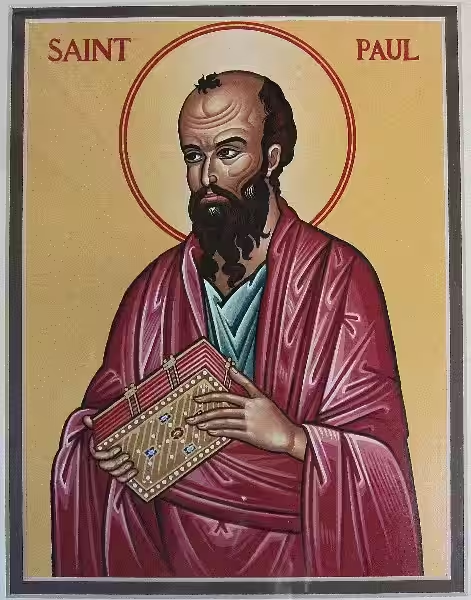
In the tapestry of religious thought, certain threads, though ancient, possess a remarkable capacity for reinvention, offering fresh insights that resonate deeply with contemporary seekers. The New Paul Perspective is one such thread, a dynamic interpretation of the Apostle Paul’s teachings that moves beyond dusty theological debates to offer a vibrant, practical, and profoundly human understanding of faith. It’s not about discarding the past, but rather about re-examining it through a lens that acknowledges our current context, our evolving understanding of the human psyche, and our interconnected global society. This perspective challenges us to engage with Paul’s letters not as static pronouncements, but as living dialogues, conversations brimming with relevance for anyone navigating the complexities of modern life and spirituality.
For many, the name Paul conjures images of complex theological arguments, perhaps even rigid doctrines. However, the New Paul Perspective seeks to unlock the liberating and empowering core of his message. It emphasizes Paul’s radical inclusivity, his focus on the transformative power of grace, and his vision of a unified community where individual worth is paramount. This approach invites us to move beyond historical or cultural limitations that might have previously obscured the accessibility and profound depth of his writings, opening them up for a generation seeking authentic connection and meaningful purpose.
Unpacking the Core Tenets of the New Paul Perspective
At its heart, the New Paul Perspective prioritizes God’s unconditional love and acceptance as the foundation of spiritual life. This isn’t a love earned through perfect adherence to rules, but a freely given gift that empowers individuals to live lives of purpose and compassion. It’s a fundamental shift from a “performance-based” spirituality to one rooted in grace. Think of it like a parent’s love for their child – it’s not dependent on the child’s achievements, but a constant, unwavering force. This perspective highlights Paul’s emphasis on the indwelling Spirit as the source of strength, wisdom, and transformation, enabling believers to overcome challenges and grow in likeness to Christ.
Another crucial element is the emphasis on unity in diversity. Paul’s vision extended far beyond the cultural and social divisions of his time, advocating for a community where distinctions of Jew and Gentile, slave and free, male and female, were rendered irrelevant in Christ. The New Paul Perspective champions this radical inclusivity, urging us to build bridges across our modern divides – be they political, social, or ideological. It calls for a dismantling of exclusionary practices and a celebration of the rich tapestry of humanity, recognizing that our differences are not barriers but opportunities for deeper understanding and collective flourishing.
One of the most transformative aspects of the New Paul Perspective is its robust understanding of grace as liberation. Paul, himself a former persecutor, understood the crushing weight of trying to earn favor through strict adherence to law. He experienced a profound release in discovering that salvation and acceptance come not from our efforts, but from God’s boundless mercy. This perspective liberates individuals from the exhausting cycle of trying to be “good enough,” allowing them to embrace their inherent worth and live from a place of freedom. Imagine a student who has been struggling to meet impossible academic standards; the relief and motivation they feel when a teacher offers genuine encouragement and support, focusing on their effort and potential rather than just grades, is akin to the liberation Paul describes.
This focus on grace has profound implications for how we approach faith. Instead of striving for perfection through rigid rules and regulations, the New Paul Perspective encourages a posture of trust and surrender. It’s about recognizing our limitations and vulnerabilities, and leaning into the strength and guidance of the divine. This doesn’t mean abandoning ethical living; rather, it means that our ethical actions flow not from a sense of obligation or fear, but from a heart overflowing with gratitude and a desire to reflect the love we have received. This shift allows for a more authentic and joyful spiritual journey, one characterized by growth and resilience rather than anxiety and self-condemnation.
The Body of Christ: A Redefined Community
Paul’s metaphor of the church as the “body of Christ” is central to the New Paul Perspective, but it’s understood in a way that transcends mere organizational structure. It’s a call to interdependence and mutual care, where each member, with their unique gifts and contributions, is essential for the health and vitality of the whole. This perspective emphasizes that true community is built on empathy, service, and shared vulnerability. It’s about recognizing that we are stronger together, and that the challenges faced by one are the concerns of all. Consider a sports team: each player has a specific role, and their success depends on their ability to work collaboratively and support one another, celebrating each other’s strengths and compensating for weaknesses.
Furthermore, the New Paul Perspective challenges us to actively cultivate this sense of belonging in our contemporary world, which can often feel isolating. It calls for intentional efforts to break down barriers and foster genuine connection, whether within formal religious communities or in broader social networks. This involves listening deeply to one another, offering practical support, and creating spaces where everyone feels valued and seen. This understanding of the body of Christ is not about uniformity, but about harmonious diversity, where individual uniqueness contributes to the richness and effectiveness of the collective.
Empowerment Through the Spirit: Living a Transformed Life
A cornerstone of the New Paul Perspective is the profound emphasis on the empowering presence of the Holy Spirit. Paul consistently points to the Spirit as the active force within believers, enabling them to live lives that are not only morally upright but also vibrant and flourishing. This isn’t a passive endowment, but a dynamic partnership that equips individuals for service, resilience, and spiritual growth. The Spirit provides discernment, strength in times of trial, and the capacity to love in ways that transcend human limitations. Think of a shy individual who, when given a microphone and a supportive audience, finds a voice they never knew they possessed; the Spirit acts as that empowering force, unlocking potential and revealing hidden capacities.
This understanding of empowerment challenges the notion of faith as a purely intellectual assent or a set of ritualistic practices. The New Paul Perspective underscores that faith is lived out, actively manifesting God’s presence in the world. It calls individuals to embrace their God-given gifts and to actively participate in the ongoing work of God’s Kingdom. This leads to a life characterized by purpose, courage, and a deep sense of inner peace, knowing that one is not alone but is guided and sustained by a divine force committed to their well-being and the betterment of creation.
Navigating Modern Challenges with a New Paul Perspective
In an era marked by rapid technological advancement, global interconnectedness, and often conflicting worldviews, the New Paul Perspective offers a stabilizing and unifying framework. It encourages a critical yet compassionate engagement with the world, equipping individuals to discern truth, resist division, and contribute positively to society. The emphasis on love, justice, and reconciliation provides a powerful antidote to the cynicism and polarization that can pervade modern discourse. This perspective calls us to be informed citizens, compassionate neighbors, and agents of positive change, grounded in an unwavering hope that transcends temporal circumstances.
Ultimately, the New Paul Perspective is an invitation to a deeper, richer, and more authentic spiritual life. It’s a call to move beyond superficial understandings of faith and to embrace the transformative power of grace, the beauty of true community, and the empowering presence of the Spirit. By re-examining Paul’s timeless wisdom through this modern lens, we can discover a faith that is not only personally fulfilling but also profoundly relevant and impactful for the world around us, fostering hope, healing, and enduring connection.
Frequently Asked Questions about New Paul Perspective and Religion
What is the “New Paul Perspective”?
The “New Paul Perspective” is a contemporary interpretation of the teachings of the Apostle Paul, aiming to re-examine and understand his letters and their significance in a modern context. It often emphasizes certain aspects of Paul’s theology over others, sometimes focusing on themes of grace, universalism, or a critique of traditional religious structures.
How does the “New Paul Perspective” relate to established religions?
The “New Paul Perspective” can interact with established religions in various ways. Some who hold this perspective may see themselves as reforming or reinterpreting their existing faith tradition based on their understanding of Paul. Others might find that it leads them away from traditional religious dogma, seeking a more personal or universal spiritual path. It can be seen as both a challenge and a source of renewal within religious frameworks.
Does the “New Paul Perspective” advocate for a specific religion?
No, the “New Paul Perspective” does not inherently advocate for a specific religion. While it often draws heavily from Christian scripture, its interpretations can lead individuals to engage with Christianity in new ways, or to explore spiritual or philosophical ideas that may extend beyond traditional religious boundaries. The focus is on the insights derived from Paul’s writings, which can then inform an individual’s personal beliefs and practices.
Can someone hold a “New Paul Perspective” without being religious?
Yes, it is possible to engage with and find meaning in the “New Paul Perspective” without adhering to a formal religious affiliation. The intellectual and philosophical aspects of re-examining religious texts, particularly the complex writings of Paul, can be appealing to individuals interested in theology, philosophy, or spiritual exploration, regardless of their religious status.
What are some common themes associated with the “New Paul Perspective” regarding religion?
Common themes often include:
* Grace over Law: An emphasis on God’s unmerited favor as the primary means of salvation, often contrasting with rigid adherence to religious laws or rituals.
* Universalism: A belief that ultimately all people will be reconciled with God, often drawing from interpretations of Paul’s message of reconciliation in Christ.
* Critique of Religious Structures: A questioning of institutionalized religion and its potential to become a barrier to authentic spiritual experience.
* Freedom in Christ: An emphasis on spiritual liberty and the liberation from past sins and external regulations.
* Unity of Humanity: A focus on Paul’s message of breaking down divisions (e.g., Jew/Gentile, male/female) and promoting unity in a spiritual community.