The names of the Twelve Apostles echo through the annals of religion, synonymous with the very foundation of Christianity. These were not ordinary men; they were the chosen companions of Jesus Christ, the eyewitnesses to his miracles, the recipients of his teachings, and the ones entrusted with spreading his message across the known world. Their lives, though documented in scripture, often leave us with a profound curiosity about their ultimate fates. While the Bible primarily focuses on their ministry and the early spread of the Gospel, the end of their earthly journeys is a subject steeped in tradition, historical accounts, and enduring faith, painting a picture of martyrdom and natural passing for many.
Understanding how these pivotal figures met their end offers not just a glimpse into the challenges of early Christianity but also a testament to their unwavering commitment. It’s a narrative that continues to inspire millions, reminding us of the sacrifices made in the name of belief. The question of “how did the 12 apostles die” is more than just historical inquiry; it’s a exploration into the legacy of faith and the price of conviction.
The Crucible of Early Christianity: A Time of Persecution
The era in which the Apostles lived and ministered was a turbulent one. The nascent Christian movement was viewed with suspicion, and often outright hostility, by the prevailing Roman and Jewish authorities. This persecution was not a constant, monolithic force but rather a series of localized and sometimes intense waves of oppression. The Apostles, by their very nature of leadership and their public proclamation of a new faith that challenged established norms, were prime targets.
Their unwavering commitment to their mission meant they often found themselves in direct conflict with those who held power. This adversarial environment meant that the possibilities for their demise were varied. While natural causes might have claimed some, the prevailing atmosphere of religious intolerance strongly suggests that many faced far more violent or agonizing ends. The sheer audacity of their message in a world accustomed to different gods and rulers could easily have been interpreted as sedition or blasphemy.
The Shadow of Martyrdom: Facing Violent Ends
For many of the Apostles, their unwavering faith came at the ultimate price: martyrdom. This was not a rare occurrence in the early Church; it was, in many ways, a defining characteristic of its initial growth. Being a follower of Christ often meant living under the constant threat of arrest, torture, and execution. The courage displayed by these men in the face of such terror is a cornerstone of Christian hagiography.
The accounts of their deaths, while not always explicitly detailed in the New Testament, are preserved through early Church historians and tradition. These narratives, when examined, reveal a consistent pattern of violent persecution for those who refused to renounce their beliefs. Imagine a carpenter from Galilee, now a leader of a burgeoning movement, being forced to choose between his life and his lifelong commitment to Jesus. This was the stark reality for many.
Simon Peter, perhaps the most prominent among the Apostles, is widely believed to have met his end through crucifixion. Tradition, particularly as recorded by Eusebius of Caesarea, a 4th-century historian, suggests that Peter was crucified upside down at his own request. He apparently felt unworthy to die in the same manner as Jesus. This detail, if accurate, speaks volumes about his humility and devotion, even in his final moments.
The scenario of his death likely occurred in Rome during the reign of Emperor Nero, a period notorious for its brutal persecution of Christians. Nero, seeking a scapegoat for the Great Fire of Rome in 64 AD, unleashed a wave of terror upon the Christian community. Peter, as a prominent leader, would have been a significant target. His martyrdom is seen as a powerful testament to his steadfastness in the face of unimaginable suffering, a stark contrast to a peaceful passing.
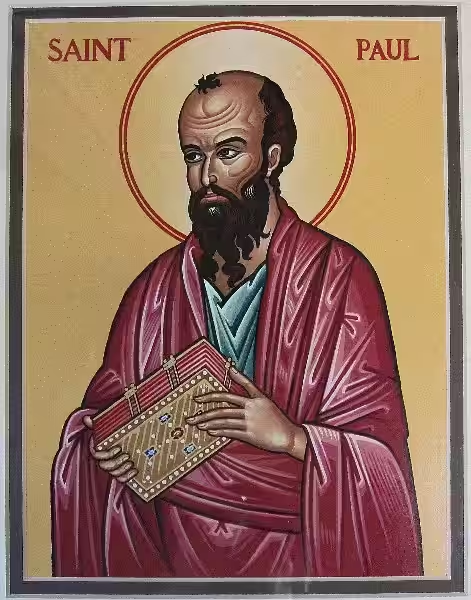
The Story of Paul: Beheaded in Rome
While not one of the original twelve chosen by Jesus during his earthly ministry, Paul the Apostle is often counted among them due to his pivotal role in spreading Christianity. A former persecutor of Christians, his dramatic conversion on the road to Damascus transformed him into one of its most ardent evangelists. His ministry spanned vast distances, establishing churches and writing influential epistles.
Like Peter, Paul is also believed to have been martyred in Rome. The prevailing tradition states that he was beheaded. This mercifully quicker form of execution, compared to crucifixion, still represented a violent end. His death likely occurred around the same time as Peter’s, during Nero’s persecution. The image of Paul, the tireless traveler and prolific writer, facing a swift and brutal end only reinforces the danger inherent in his mission. This was certainly not a death by natural causes.
Andrew and Bartholomew: Diverse Paths to Martyrdom
The fates of other Apostles, like Andrew, Peter’s brother, also point towards violent ends. Tradition holds that Andrew was crucified on an “X”-shaped cross in Patras, Greece. He is said to have preached for three days before succumbing to his suffering. His endurance and preaching even in agony are recurring themes in the narratives of early Christian martyrs.
Bartholomew (often identified with Nathanael) is believed by some traditions to have been flayed alive and then beheaded in Armenia, while others suggest he was crucified. These accounts, while gruesome, highlight the extreme cruelty inflicted upon early Christians. The variety in the methods of execution further emphasizes the widespread and often inventive ways authorities sought to suppress the faith.
The Question of Natural Causes: Were All Apostles Martyred?
While the narratives of martyrdom are abundant and impactful, the question arises: did all twelve apostles die violently? The historical record, and indeed logic, suggests that it is possible, even probable, that some met their end through natural causes. The early Church was composed of men from various backgrounds, and not all would have necessarily been at the forefront of every persecution.
It’s important to distinguish between biblical accounts and later traditions. The New Testament is largely silent on the precise manner of death for most Apostles, focusing instead on their work and teachings. Therefore, many of the more graphic details come from subsequent historical writings and oral traditions passed down through generations.
John: The Lone Survivor (and Natural Death)?
Perhaps the most intriguing case is that of John, the “beloved disciple.” The New Testament offers no account of his violent death. Instead, tradition suggests that John lived to an exceptionally old age, dying in Ephesus. Some accounts even claim that he was the only Apostle not to be martyred, and that he ultimately passed away from natural causes, possibly of old age.
This notion of a peaceful passing stands in stark contrast to the fates of his brethren. It’s possible that John, for reasons not fully understood, managed to avoid the intense persecution that befell others. His longevity would have allowed him to witness the early consolidation of the Christian faith and perhaps play a crucial role in shaping its early theological development through his writings.
Thomas: Missions to the East and a Spear’s End
The Apostle Thomas, known for his initial doubt regarding Jesus’ resurrection, is traditionally believed to have died a martyr in India. Accounts vary, but a common narrative suggests he was pierced by a spear during a religious service. This violent conclusion underscores the far-reaching nature of his missionary work and the inherent dangers associated with spreading Christianity to distant lands. His sacrifice in the East, far from the familiar shores of Galilee, highlights the global ambition of the early Church.
Matthew: The Tax Collector’s End
The Apostle Matthew, formerly a tax collector, is another figure whose death is shrouded in some mystery. Tradition suggests he met his end as a martyr in Ethiopia, possibly by the sword. Like many of his fellow Apostles, his transformation from a despised tax collector to a zealous preacher of the Gospel made him a target for those who opposed the new faith. His dedication to his new calling, even unto death, is a powerful testament.
The Legacy of Their Deaths: Inspiring Generations
The question of “how did the 12 apostles die” is ultimately a testament to their unwavering faith and their willingness to sacrifice everything for the message they carried. Whether through violent martyrdom or, in the case of John, a peaceful passing after a long life, their lives and deaths form the bedrock of Christian belief.
The stories of their suffering and perseverance serve as a powerful source of inspiration for believers throughout history. They demonstrate that the pursuit of truth and the commitment to one’s convictions can lead to extraordinary courage in the face of overwhelming adversity. The price of their faith was immense, but the impact of their message has been immeasurable, shaping the spiritual landscape of the world for millennia. Their ultimate fates, whether a brutal end or a long life, all contributed to the enduring narrative of the early Church.
Frequently Asked Questions About the Apostles’ Deaths
How did the 12 Apostles die?
The Bible does not provide detailed accounts of the deaths of most of the apostles. However, historical traditions and early Christian writings suggest that most of them died as martyrs for their faith. While specific details vary and some accounts are less historically certain than others, here’s a summary of common traditions:
Simon Peter: Traditionally believed to have been crucified upside down in Rome during Nero’s persecution.
Andrew: Believed to have been crucified on an X-shaped cross in Patras, Greece.
James, son of Zebedee: The Bible records his execution by King Herod Agrippa I (Acts 12:2), making him the first apostle to be martyred.
John: The only apostle believed to have died a natural death, though tradition says he was exiled to the island of Patmos.
Philip: Traditionally believed to have been crucified or stoned to death in Hierapolis.
Bartholomew (Nathanael): Traditions vary, with some suggesting he was flayed alive in Armenia or crucified in India or Ethiopia.
Thomas: Believed to have been martyred in India, possibly speared or stoned to death.
Matthew: Traditions suggest he was either beheaded in Ethiopia or died by the sword in Parthia.
James, son of Alphaeus: Less information is available, but some traditions suggest he was stoned to death in Jerusalem or beaten to death in Egypt.
Simon the Zealot: Traditions suggest he was crucified in Persia or Africa.
Thaddaeus (Judas, son of James): Traditions vary, with some suggesting he was clubbed to death or shot with arrows in Beirut.
Matthias: Chosen to replace Judas Iscariot, tradition suggests he was stoned to death and then beheaded in Jerusalem or Cappadocia.
It’s important to note that while these traditions are widely held within Christianity, the exact historical certainty of each death varies, and the New Testament itself only explicitly records the death of James, son of Zebedee.