Religion, in its myriad forms, has always been a cornerstone of human civilization, shaping cultures, guiding ethics, and providing solace. Within the vast tapestry of religious belief, the relationship between Jews and Gentiles stands out as a particularly significant and often complex narrative. This dynamic, woven through millennia of shared history, theological development, and social interaction, offers profound insights into the very nature of faith, identity, and belonging. Understanding the distinct roles and evolving perceptions of both Jews and Gentiles is crucial for appreciating the richness and diversity of religious thought and practice across the globe.
From ancient prophecies to modern dialogue, the distinction between those who are Jewish and those who are not – the Gentiles – has been a constant presence. This isn’t merely a matter of ethnic or cultural difference; it’s deeply rooted in theological frameworks that define chosenness, covenant, and the path to divine connection. Exploring this relationship allows us to delve into the core tenets of Judaism, the development of Christianity, and the broader landscape of interfaith understanding, revealing how these two groups have not only coexisted but have profoundly influenced each other’s religious trajectories.
The Foundation: Defining Jewish Identity and the Gentile Other
At the heart of this discussion lies the concept of Jewish identity. Judaism, as an ancient monotheistic religion, has historically defined itself through a unique covenant with God, established with Abraham and solidified through the Torah. This covenant signifies a special relationship and a set of divine commandments that guide Jewish life, practice, and belief. Consequently, Jewish identity is often understood as both religious and ethnic, passed down through matrilineal descent, but also embraced through conversion.
In contrast, the term “Gentile” is the Hebrew word for “nation” or “people,” and in a religious context, it refers to anyone who is not Jewish. For much of Jewish history, Gentiles were seen as living outside the covenant, their spiritual lives operating on different principles. This distinction, while clear, did not always imply animosity. Rather, it highlighted a distinct spiritual path and a specific set of divine expectations. Think of it like a family with a unique set of traditions; everyone else is part of the larger community, but this family has its own special rituals and heritage.
Theological Perspectives: Covenant, Chosenness, and Divine Revelation
The theological underpinnings of the Jew-Gentile relationship are multifaceted. Judaism emphasizes the concept of chosenness, which is not about inherent superiority but about a divine responsibility to uphold God’s laws and serve as a “light unto the nations.” This chosenness is intrinsically linked to the covenant, a sacred agreement that sets the Jewish people apart. The Torah, the foundational text of Judaism, contains laws and narratives that are specific to the Jewish people’s journey with God.
For Gentiles, their relationship with the divine is often understood through the lens of universal morality and the seven Noahide laws, a set of ethical principles derived from the Torah that are considered binding on all humanity. These laws provide a framework for righteous living for those outside the covenant, demonstrating a belief in God’s overarching concern for all people. This perspective acknowledges that while the covenant is specific, God’s presence and guidance are not limited to any single group; divine grace extends universally.
The Emergence of Christianity: A New Dynamic Between Jews and Gentiles
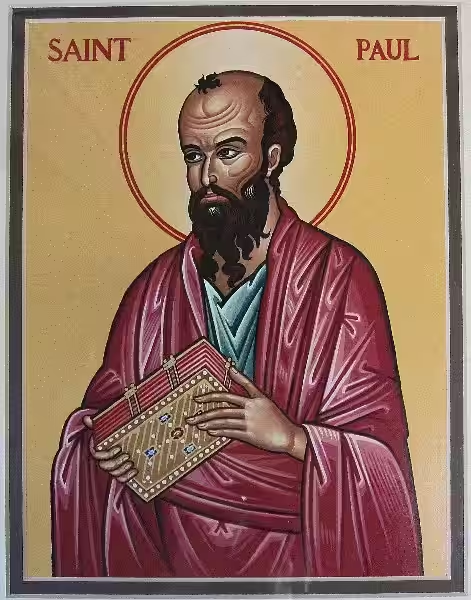
The rise of Christianity presented a significant turning point in the historical and theological relationship between Jews and Gentiles. Jesus himself was Jewish, and his early followers were all Jewish. However, the message of Christianity, particularly through the missionary work of Apostle Paul, began to be actively shared with Gentiles. This expansion led to a profound theological debate within early Christianity regarding the necessity of Jewish law for Gentile converts.
Paul, in particular, argued that salvation through faith in Jesus transcended the requirements of Jewish law. He articulated a vision where the divine covenant was expanded, accessible to Gentiles through faith, thereby bridging the traditional divide. This was a revolutionary concept, as it meant that being part of God’s chosen people was no longer solely dependent on birthright or adherence to specific Mosaic laws, but on acceptance of Jesus as Messiah. This theological shift, while bringing many Gentiles into a new religious fold, also created a significant divergence from Judaism and, at times, led to friction and persecution.
The Transformation of the “Other”: From Separate Paths to Shared Faith (and Conflict)
The early Christian movement’s embrace of Gentiles dramatically altered the perception of the “other.” What was once a distinction between those within and outside the Jewish covenant began to morph into a new duality: Christians and Jews. For a significant period, Christianity, having gained a massive Gentile following, often viewed Judaism through a lens of supersessionism, the belief that Christianity had replaced or fulfilled Judaism. This perspective, unfortunately, led to centuries of anti-Jewish sentiment and persecution, where Jews were often portrayed as rejecting or being blind to the “truth” of Christianity.
Conversely, from a Jewish perspective, the divergence of Christianity, especially its Gentile expansion and later theological developments, was seen as a departure from the original covenant. While many Jews would have recognized the moral uprightness of individual Gentiles, the emergence of a new religion that claimed to supersede their own was a profound challenge. This period underscores how religious narratives, even when originating from shared roots, can evolve into vastly different interpretations of divine will and human destiny, impacting the lives of both Jews and Gentiles for generations.
Modern Dialogue and Mutual Respect: Bridging the Divide
In the contemporary era, there has been a growing and vital movement towards interfaith dialogue and mutual respect between Jews and Gentiles, particularly between Jewish and Christian communities. The horrors of the Holocaust served as a stark and tragic catalyst, forcing a profound re-examination of historical Christian attitudes towards Jews and the dangers of religious prejudice. This has led to significant theological shifts within Christianity, with many denominations officially renouncing supersessionism and embracing a view of Judaism as a living and valid covenant.
This new era of understanding emphasizes finding common ground in shared ethical values, a commitment to peace, and a recognition of the unique spiritual contributions of each tradition. It’s about moving beyond historical animosities and focusing on the shared humanity and spiritual yearnings that connect us all. For example, many interfaith initiatives now focus on social justice projects, working together to address poverty or advocate for human rights, demonstrating that Jews and Gentiles can be powerful allies in building a better world.
The Ongoing Journey: Learning, Understanding, and Coexistence
The relationship between Jews and Gentiles in religion is not a static historical artifact; it’s an ongoing, evolving narrative. The globalized world today presents countless opportunities for meaningful interaction and learning. Many Gentiles are actively seeking to understand Judaism beyond stereotypes, appreciating its rich traditions, intellectual depth, and emphasis on repairing the world (Tikkun Olam).
Similarly, Jewish communities are increasingly engaged in outreach and education, fostering environments where Gentiles can learn about their faith with respect and curiosity. This journey of mutual education and empathy is crucial for dismantling misconceptions and building bridges of genuine understanding. It acknowledges that while distinct religious paths exist, the pursuit of truth, justice, and connection with the divine is a universal human endeavor, enriching the lives of both Jews and Gentiles alike.
Frequently Asked Questions: Gentiles and Jews, Religion
What is the difference between a gentile and a Jew?
A gentile is a person who is not Jewish. A Jew is a person who identifies with the Jewish people, which can be based on Jewish ethnicity, culture, or religion.
Is Judaism a religion or an ethnicity?
Judaism is both a religion and an ethnicity. It encompasses a set of religious beliefs and practices, as well as a shared history, culture, and sense of peoplehood.
Can a gentile convert to Judaism?
Yes, a gentile can convert to Judaism through a formal conversion process overseen by a rabbinical court.
Are there any religious restrictions for gentiles interacting with Jews or Jewish religious practices?
Generally, there are no religious restrictions preventing gentiles from interacting with Jews or observing Jewish religious practices, provided it is done respectfully. However, certain specific rituals or prayers may be reserved for Jews.
Does Judaism believe in salvation for non-Jews?
Traditional Jewish thought holds that righteous individuals of all nations can have a share in the World to Come. The focus is on righteous action rather than specific religious affiliation.
Are there any proselytizing efforts in Judaism towards gentiles?
Historically, Judaism has not been a proselytizing religion in the same way as some other major faiths. While conversion is possible, active efforts to convert gentiles are not a central tenet of Judaism.