The story of the Jews, their profound relationship with God, and their history is not merely a chronicle of a single people, but a foundational narrative that has shaped the course of human religion and civilization. It’s a journey marked by faith, resilience, covenant, and an unwavering belief in a singular, transcendent deity who actively participates in the human drama. From the earliest whispers of Abraham to the diverse communities of today, the connection between Jews, God, and their shared history forms a compelling and endlessly relevant narrative.
Understanding this intricate relationship requires delving into the very essence of what it means to be Jewish. It’s a concept that transcends simple ethnicity or nationality, encompassing a shared religious heritage, a unique worldview, and a deep sense of collective identity rooted in a divine pact. The echoes of their history resonate through the ages, offering lessons on perseverance, the pursuit of justice, and the enduring power of spiritual commitment.
The Genesis of Covenant: Abraham and the Birth of a People
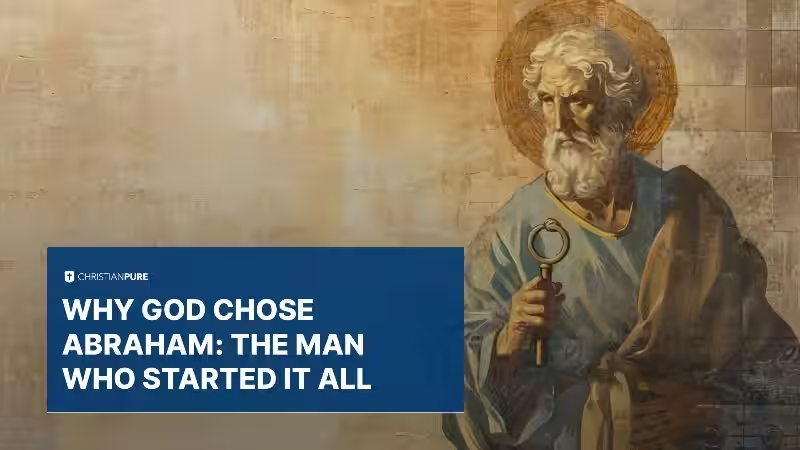
The foundational narrative of Jews, God, and history begins with Abraham. Often referred to as the “father of faith,” Abraham’s story, as told in the Book of Genesis, is pivotal. According to tradition, God called Abraham to leave his homeland and embark on a journey to a land that would be shown to him, promising to make him the father of a great nation and to bless all nations through him. This wasn’t just a geographical relocation; it was the initiation of a divine covenant, a solemn agreement between God and Abraham, and by extension, his descendants.
This covenant is the bedrock of Jewish religion and identity. It established a unique relationship, a sense of chosenness not of superiority, but of responsibility. God promised Abraham descendants as numerous as the stars in the sky, and in return, Abraham and his progeny were to uphold God’s laws and live according to His will. This fundamental agreement laid the groundwork for the development of Jewish law, ethics, and their understanding of God’s role in the world, shaping their history for millennia to come. Think of it like a special promise between two friends: one promises to always be there, and the other promises to always be honest and kind. This promise, amplified to the scale of nations and God, is the essence of the Abrahamic covenant.
From Slavery to Sinai: The Exodus and the Revelation of Law
A pivotal chapter in the history of Jews and their relationship with God is the Exodus from Egypt. This epic narrative, recounted in the Book of Exodus, details the enslavement of the Israelites, their miraculous liberation by God through Moses, and their subsequent journey through the wilderness. The Exodus is more than just a story of physical freedom; it is a profound theological event, demonstrating God’s power to intervene in history and redeem His people from oppression. This act of liberation solidified their belief in God as a liberator and a protector.
The climax of this liberation narrative is the Revelation at Mount Sinai. Here, God directly communicated His Ten Commandments and other laws to the assembled Israelites, establishing the Torah as the guiding principle for their lives. This moment was the formalization of the covenant, transforming it from a promise to a binding agreement with specific commandments. The Torah became the blueprint for Jewish religion, social justice, and daily living, influencing their history through its emphasis on justice, compassion, and holiness. The Ten Commandments, for instance, are not just rules; they are foundational ethical pronouncements that have profoundly influenced legal and moral systems worldwide, highlighting the enduring impact of this divinely revealed law on the history of Jews and beyond.
The Era of Kings and Prophets: Navigating Faith and Power
The history of Jews and their relationship with God entered a new phase with the establishment of the monarchy in ancient Israel. Figures like King David and King Solomon are central to this period, embodying both the triumphs and challenges of leading a nation under God’s watchful eye. David, remembered as a warrior and a poet, forged a unified kingdom and established Jerusalem as its capital, demonstrating a deep personal devotion to God. Solomon, renowned for his wisdom, built the First Temple, a central sanctuary for worship and a physical manifestation of God’s presence among His people.
However, this era was also characterized by the rise of the prophets. These individuals, such as Isaiah, Jeremiah, and Ezekiel, served as God’s messengers, often challenging the kings and the people when they strayed from divine law and justice. They spoke out against idolatry, social injustice, and the neglect of the poor, calling for repentance and a return to God’s path. The prophets’ messages were not always popular, but they were crucial in reminding the Jews of their covenantal obligations and the consequences of their actions, profoundly shaping their religious and ethical understanding throughout their long history. Their pronouncements serve as a powerful reminder that faith is not passive; it demands active engagement with the world and a commitment to righteousness.
The Exile and the Diaspora: Resilience in the Face of Adversity
The grandeur of the united monarchy eventually gave way to periods of division and conquest, leading to one of the most defining chapters in the history of Jews: the Babylonian Exile and the subsequent Diaspora. The destruction of the First Temple and the exile of a significant portion of the population presented an existential crisis. Yet, it was during this time of profound loss and displacement that the Jews demonstrated remarkable resilience and a deepening of their religious identity.
Stripped of their land and their central sanctuary, their faith in God became their anchor. The exiled Jews clung to their traditions, their prayers, and their scriptures, finding ways to maintain their religious practices even in foreign lands. This period fostered a stronger emphasis on prayer, study of Torah, and the communal gathering for worship, laying the groundwork for the synagogue as a central institution. The concept of the Diaspora, the scattering of Jews across the globe, became an enduring characteristic of Jewish history, forging a global community bound by shared religious heritage and a longing for redemption, all under the umbrella of their enduring belief in God.
The Rabbinic Period and the Codification of Tradition: Shaping Modern Judaism
Following the return from exile and the rebuilding of the Second Temple, Jewish history entered the Rabbinic period. This era, spanning from the destruction of the Second Temple in 70 CE to the early medieval period, was a time of immense creativity and adaptation for the Jews and their relationship with God. With the Temple destroyed, the focus shifted from sacrificial worship to study, prayer, and the interpretation of Torah. Rabbis emerged as the spiritual leaders and scholars, responsible for preserving and transmitting Jewish tradition.
This period saw the compilation of foundational texts like the Mishnah and the Talmud. These extensive bodies of work represent a monumental effort by the rabbis to interpret God’s law, apply it to new circumstances, and ensure its continuity for future generations. The Talmud, in particular, is a vast compendium of legal discussions, ethical teachings, and philosophical debates, reflecting the intellectual vibrancy of Jewish thought and its profound engagement with divine will. This codification of religious law and practice was crucial in maintaining Jewish identity and unity throughout the long centuries of Diaspora, demonstrating how faith can evolve and adapt while remaining deeply rooted in its origins.
Modernity and the Enduring Faith: Adapting to a Changing World
The contemporary history of Jews is a testament to their enduring faith and their capacity to adapt to a rapidly changing world. From the Enlightenment onwards, Jews have navigated the complexities of modernization, emancipation, and the challenges of assimilation while striving to maintain their distinct religious and cultural identity. This has led to a spectrum of Jewish movements and denominations, each approaching their relationship with God and religious observance in different ways.
Whether through Orthodox, Conservative, Reform, or Reconstructionist Judaism, the core commitment to God, Torah, and the ethical principles of their heritage remains. The establishment of the State of Israel in the 1948 marked a profound moment in Jewish history, fulfilling ancient aspirations and creating a modern center for Jewish life. Yet, the Diaspora continues to thrive, with vibrant Jewish communities around the world actively engaging with their faith, their history, and their understanding of God in the 21st century, proving that the narrative of Jews, God, and history is a living, breathing story that continues to unfold.
Frequently Asked Questions about Jews, God, History, and Religion
Who are the Jewish people?
The Jewish people are an ethnoreligious group whose origins trace back to the ancient Israelites. Their identity is shaped by a shared history, culture, and religious traditions, with Judaism being their ancestral religion.
What is the Jewish concept of God?
Judaism is a monotheistic religion, believing in one, indivisible, and incorporeal God. This God is seen as the creator of the universe, all-powerful, all-knowing, and the ultimate source of morality and justice. God is also understood as having a covenantal relationship with the Jewish people.
What are some key periods in Jewish history?
Key periods include the Patriarchal period (Abraham, Isaac, Jacob), the Exodus from Egypt and the giving of the Torah at Mount Sinai, the period of the Judges and the United Monarchy (Kings Saul, David, Solomon), the First and Second Temple periods, the Babylonian and Roman exiles, the Diaspora (dispersion of Jews throughout the world), the Enlightenment (Haskalah), and the modern era, including the Holocaust and the establishment of the State of Israel.
What are the core tenets of Judaism?
Core tenets include the belief in one God, the importance of the Torah (the first five books of the Hebrew Bible) as divine instruction, the observance of mitzvot (commandments), the concept of tikkun olam (repairing the world), and the idea of a covenant between God and the Jewish people.
What is the significance of the Torah?
The Torah (also known as the Pentateuch or the Five Books of Moses) is considered the holiest text in Judaism. It contains God’s laws and teachings revealed to Moses, providing a framework for Jewish life, ritual, ethics, and history.
What are the major branches of Judaism today?
The major branches of Judaism are Orthodox, Conservative, and Reform. Each branch differs in its interpretation and observance of Jewish law and tradition, though all share a common heritage and core beliefs.
What is the relationship between Jewish history and Jewish religion?
Jewish history and religion are deeply intertwined. Major historical events, such as the Exodus or the destruction of the Temples, are foundational to Jewish religious beliefs and practices. Conversely, religious observance and belief have shaped the course of Jewish history and preserved Jewish identity through millennia of dispersion.