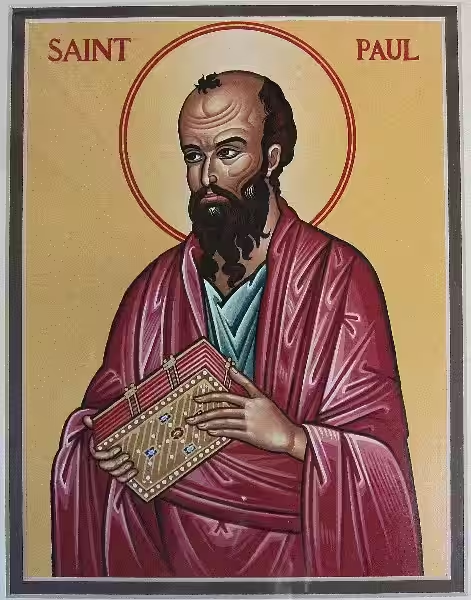
The question, “Was St. Paul an apostle?” resonates deeply within the study of Christian origins. It’s not just an academic debate; it touches upon the very foundations of how Christianity spread and evolved. Paul, or Saul of Tarsus as he was known before his dramatic conversion, is undeniably one of the most influential figures in religious history. His letters, forming a significant portion of the New Testament, have shaped theological thought for millennia. But what exactly constituted an apostle in the early Christian context, and did Paul truly fit that definition? Understanding this requires a careful examination of scripture, historical context, and the unique role he played.
The very essence of an apostle, particularly in the early church, carried specific weight. It signified a direct connection to Jesus Christ and a commission to spread his message. This wasn’t a title lightly bestowed; it implied a profound spiritual authority and a mandate to establish the nascent faith. As we delve into the life and work of Paul, we’ll explore the evidence that supports his apostleship and the lasting legacy he forged, a legacy that answers the question, “Was St. Paul an apostle?” with resounding affirmation for many.
Defining the Apostolic Role: More Than Just a Messenger
In the context of the early church, the term “apostle” (from the Greek word apostolos, meaning “one who is sent”) carried a very specific and authoritative meaning. It wasn’t simply a designation for any preacher or missionary. To be an apostle meant you had been personally chosen and commissioned by Jesus Christ himself. This direct encounter was the cornerstone of apostolic authority. Think of it like being handpicked by the CEO for a critical, high-stakes mission; your authority stems directly from that personal selection.
Key characteristics of an apostle included: witnessing the resurrected Christ, receiving direct instruction from Jesus, and being sent out to proclaim the Gospel and establish churches. This was a foundational role, essential for the transmission of Christ’s teachings and the establishment of the Christian community. The Twelve Apostles, chosen by Jesus during his earthly ministry, serve as the primary example. However, the scope of who could be an apostle, and how one qualified, is a subject of ongoing discussion, particularly when considering figures like St. Paul. This brings us back to the central inquiry: “Was St. Paul an apostle?”
The Case for Paul’s Apostleship: A Divine Encounter and Commission
The most compelling argument for St. Paul’s status as an apostle lies in his profound, life-altering encounter with the resurrected Jesus on the road to Damascus. This event, recounted multiple times in the book of Acts and alluded to in his own letters, was not just a spiritual experience; Paul himself describes it as a divine revelation and a direct commission. He didn’t seek out Jesus; Jesus sovereignly appeared to him, transforming him from a persecutor of Christians into their most ardent advocate and preacher. This mirrors the direct call experienced by the original Twelve.
Furthermore, Paul himself consistently identifies as an apostle. In the opening salutations of his epistles, a common practice, he often declares, “Paul, an apostle of Christ Jesus by the will of God” (e.g., 1 Corinthians 1:1, 2 Corinthians 1:1). This wasn’t a boastful claim but a declaration of his divinely appointed authority. He argues for his apostleship, not based on his personal charisma or popular appeal, but on the sovereign will of God and the direct commission he received from Christ. This unwavering assertion, coupled with the transformative power of his ministry, strongly supports the notion that “Was St. Paul an apostle?” is answered affirmatively by his own testimony and the undeniable fruits of his labor.
Paul’s Unique Ministry: Bridging Worlds and Expanding the Gospel
What sets Paul apart is not just his claim to apostleship, but the unprecedented scope and impact of his ministry. While the original Twelve primarily focused on ministry within Jewish communities, Paul’s apostleship was largely directed towards the Gentiles – non-Jewish people. This was a radical expansion of the Gospel message, breaking down perceived barriers and making Christianity a truly universal faith. He traveled extensively throughout the Roman Empire, establishing churches in major cities and facing immense opposition, demonstrating a courage and tenacity that are legendary.
His approach to ministry was also remarkably innovative. Paul was not just a preacher; he was a prolific writer, a theologian, and a church planter. His letters, penned to guide, correct, and encourage the fledgling Christian communities, are rich with theological insight. He wrestled with complex issues like the role of the Law, justification by faith, and unity within the church. These writings, born out of his missionary journeys and pastoral concerns, have become cornerstones of Christian doctrine, providing answers to profound questions and shaping the understanding of faith for countless generations. The question, “Was St. Paul an apostle?” is illuminated by the sheer volume and quality of his contributions.
Theological Contributions: Shaping Christian Thought for Centuries
Paul’s theological contributions are nothing short of revolutionary. He eloquently articulated core Christian doctrines, often in response to specific challenges faced by the churches he ministered to. His emphasis on justification by faith – the idea that salvation is received through faith in Jesus Christ rather than through adherence to the Law – was particularly groundbreaking. This concept, meticulously detailed in his letter to the Romans, provided a clear path to salvation for both Jews and Gentiles, fundamentally altering the trajectory of religious understanding.
He also explored the nature of the Holy Spirit, the concept of the body of Christ (the church), and the ultimate hope of resurrection. His teachings on grace – God’s unmerited favor – provided a profound understanding of God’s love and redemptive plan. These teachings weren’t abstract theological musings; they were practical, life-changing truths that empowered believers and provided a solid foundation for the burgeoning Christian movement. The depth and enduring relevance of his theological insights further solidify the answer to the question, “Was St. Paul an apostle?”
Addressing Potential Objections: The “Apostle to the Gentiles”
Some might question Paul’s apostleship by pointing to the fact that he wasn’t one of the original Twelve chosen by Jesus during his earthly ministry. This is a valid point of distinction, and it’s precisely why Paul is often referred to as the “Apostle to the Gentiles.” His calling and commission, while different in its immediate context, were no less direct or authoritative. The early church recognized the validity of his apostleship, even though he operated somewhat outside the initial circle.
The Book of Acts and Paul’s own letters depict instances where his apostleship was tested and affirmed by other leaders in the early church, such as Peter, James, and John. They recognized the divine authority that accompanied his ministry and the salvation of Gentiles that occurred through his work. This communal affirmation, alongside his personal conviction and the evidence of transformed lives, provides a robust answer to the question, “Was St. Paul an apostle?” He was, indeed, an apostle, but his unique calling expanded the understanding of what that role could entail.
The legacy of St. Paul is immeasurable. His conversion is a powerful testament to the transformative power of God’s grace. His journeys and the churches he founded laid the groundwork for Christianity’s spread throughout the known world. His writings continue to be studied, debated, and cherished by billions, providing guidance, inspiration, and theological depth to believers across diverse traditions and cultures.
Ultimately, the question, “Was St. Paul an apostle?” is answered not just by historical accounts and theological arguments, but by the undeniable impact of his life and ministry. He was a chosen instrument, a divinely appointed messenger who, through his unwavering faith and tireless efforts, played an indispensable role in shaping the course of religious history. His apostleship, though unique, was undeniably real and profoundly consequential.
Frequently Asked Questions: Was Saint Paul an Apostle?
Was Saint Paul an Apostle?
Yes, Saint Paul is considered an apostle in Christianity. While he was not one of the original twelve disciples chosen by Jesus during his earthly ministry, he is recognized as an apostle due to his fervent missionary work, his extensive writings that form a significant portion of the New Testament, and his pivotal role in spreading Christianity to the Gentile world. He is often referred to as the “Apostle to the Gentiles.”
What is the definition of an apostle in religion?
In a broad religious context, an apostle is typically a person who is sent out by a religious leader or organization to spread religious teachings, preach, and establish new communities of believers. In Christianity, the term “apostle” has a more specific meaning:
The Twelve Apostles: These were the core group of disciples personally chosen by Jesus Christ during his earthly ministry.
Broader Use: The term can also refer to others who, like Paul, were instrumental in spreading the Gospel and establishing the early Church, often through divine calling and extraordinary spiritual gifts.