The world of religious scholarship is often a fascinating journey through ancient texts, seeking to unravel their origins and understand their profound impact. Among these texts, the four Gospels of the New Testament stand as foundational pillars of Christianity, offering unique perspectives on the life and teachings of Jesus of Nazareth. While Matthew, Mark, and Luke present a more synoptic view, the Gospel of John stands apart, characterized by its theological depth and distinctive narrative style. This has led to a persistent and compelling question that echoes through centuries of study: who wrote the Gospel of John?
The identity of the author behind this influential work is not explicitly stated within the text itself, a peculiar absence that has fueled debate and speculation for millennia. Unlike some other ancient writings where an author proudly affixes their name, the Gospel of John allows its message to speak for itself, leaving the reader to ponder its source. This very mystery, however, has contributed to its enduring power and the rich tapestry of interpretations that have surrounded it, making the question of who wrote the Gospel of John central to understanding its place in religious history.
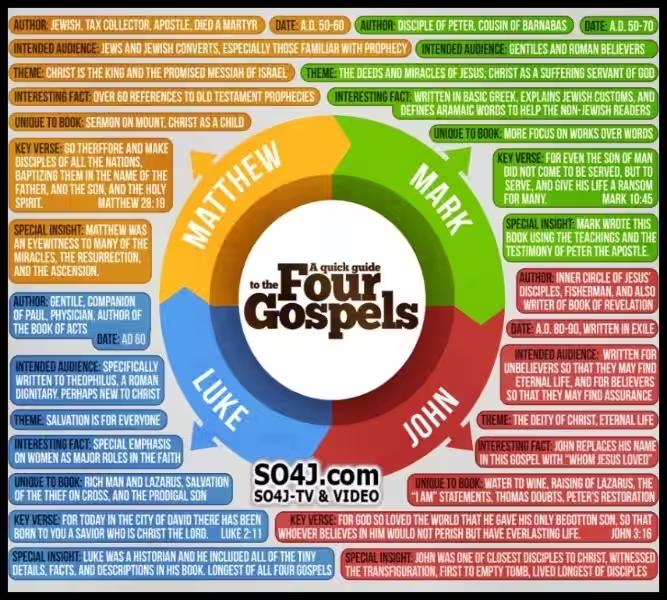
For a significant portion of Christian history, the answer to who wrote the Gospel of John has been largely settled: the Apostle John, son of Zebedee, one of Jesus’ twelve closest disciples. This tradition is primarily rooted in the Gospel’s own internal clues and the early testimonies of church fathers. The author frequently refers to himself as “the disciple whom Jesus loved,” a figure who is consistently present at pivotal moments, such as the Last Supper, Jesus’ trial, and the crucifixion, and importantly, who was the first to recognize the resurrected Christ at the Sea of Galilee. This intimate portrayal suggests an eyewitness, someone deeply familiar with Jesus’ inner circle and the events he recounts. Consider the scene at the Last Supper, where this beloved disciple leans on Jesus’ chest; this level of proximity and affection paints a vivid picture of a unique relationship, strongly pointing towards a member of Jesus’ most trusted companions.
Early Church Fathers, writing in the second and third centuries, largely affirmed this tradition. Figures like Irenaeus, a bishop of Lyons who had direct connections to the Apostle John’s disciples, explicitly attributed the Fourth Gospel to him. They saw the theological sophistication and the unique emphasis on Jesus’ divine nature as hallmarks of someone who had spent considerable time in Jesus’ presence and had a profound understanding of his mission. This collective early witness, while not absolute proof, provided a powerful foundation for the belief that who wrote the Gospel of John was indeed the Apostle John, a man who had walked with Jesus and experienced his ministry firsthand.
Beyond the external attributions, the Gospel itself offers compelling internal evidence that scholars have meticulously examined. The author demonstrates a remarkable familiarity with Jewish customs, geography, and religious practices of the era. He accurately names specific locations, describes festivals like Passover with intricate detail, and engages in theological discussions that reflect a deep understanding of Old Testament prophecy and Jewish thought. For instance, the detailed descriptions of Jesus’ journeys to Jerusalem for various feasts, and the nuanced explanations of his teachings in relation to Jewish law, suggest an author deeply immersed in that cultural and religious milieu. This level of detail is not superficial; it speaks to a lived experience and an insider’s perspective, lending credence to the idea that who wrote the Gospel of John was someone intimately connected to the Jewish world of the first century.
Furthermore, the Gospel’s unique theological vocabulary and its profound Christology—the understanding of Jesus’ divine identity—are often seen as consistent with the spiritual maturity one might expect from a long-time disciple. The opening prologue, “In the beginning was the Word, and the Word was with God, and the Word was God,” immediately elevates Jesus to a divine status that is central to the entire narrative. This sophisticated theological reflection, coupled with the personal anecdotes and intimate portrayal of Jesus, has led many to believe that the author was not just a chronicler but a devoted follower who had grappled deeply with the meaning of Jesus’ life and mission. Therefore, when we ask who wrote the Gospel of John, the internal evidence consistently points towards a figure with both intimate access and profound insight.
Scholarly Debates and Alternative Perspectives
The “Johannine Community” Hypothesis
While the traditional attribution to the Apostle John remains a strong contender, modern biblical scholarship has introduced more nuanced perspectives, particularly the “Johannine Community” hypothesis. This theory suggests that the Gospel of John, and perhaps the other Johannine writings (the letters of John and the Book of Revelation), emerged from a specific community of Jesus followers. In this view, “the disciple whom Jesus loved” might not refer to a single historical individual but rather to an idealized figure, or perhaps even the founder of this particular community. The Gospel, then, could be the product of a collective tradition, refined and shaped over time by the teachings and interpretations within this devout circle. This perspective offers an explanation for the consistent theological themes running through the Johannine literature, suggesting a shared spiritual heritage rather than a single author’s sole output.
This hypothesis proposes that the author we know, or perhaps the community as a whole, was responsible for compiling and editing existing traditions and teachings about Jesus. The Gospel, in this light, could represent the mature theological reflection of a group that had a deep, ongoing relationship with Jesus’ legacy. The question of who wrote the Gospel of John then becomes less about an individual and more about the spiritual and intellectual environment that produced such a rich and distinctive theological work. It suggests a living tradition, passed down and elaborated upon by those who continued to experience Jesus’ presence in their lives through the Spirit and his teachings.
The Role of Disciples and Scribes
Another avenue of scholarly inquiry explores the possibility that the Gospel was written by a disciple or a close follower of the Apostle John, rather than the Apostle himself. This perspective acknowledges the profound influence of John but suggests that the Gospel might have been penned by someone who meticulously recorded and organized his teachings and eyewitness accounts. This “discipular” authorship aligns with ancient literary practices where prominent teachers often had their teachings transcribed and elaborated upon by their students. Imagine a great philosopher whose lectures are meticulously recorded by their most devoted students; the resulting text, while deeply rooted in the teacher’s thought, also bears the imprint of the student’s understanding and presentation. This is a plausible model for understanding who wrote the Gospel of John.
This view allows for the possibility of the Apostle John being the primary source of information, the “beloved disciple” whose experiences form the bedrock of the narrative, but suggests that the final literary composition may have been undertaken by another hand. This scribe or disciple would have possessed the literary skill and theological acumen to present John’s testimony in a coherent and compelling manner. It helps bridge the gap between the internal evidence of an eyewitness and the potential for a polished, literary work. Thus, the question of who wrote the Gospel of John might have a complex answer, involving both the direct witness of the Apostle and the skillful hand of a devoted follower.
Theological Significance and Enduring Relevance
A Unique Christological Perspective
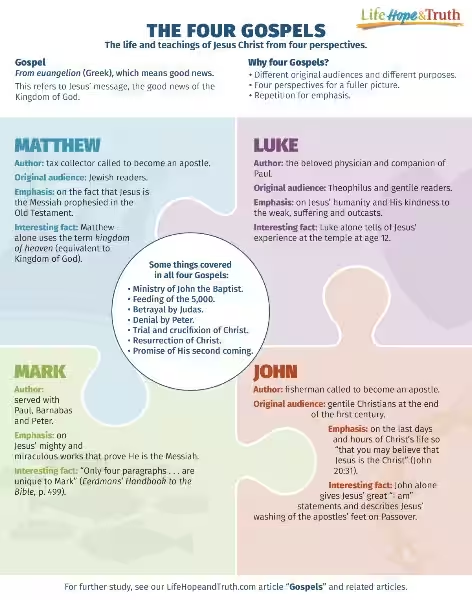
Regardless of the precise identity of its author, the Gospel of John offers a profoundly unique and influential theological perspective on Jesus. It moves beyond the earthly, human Jesus often emphasized in the Synoptic Gospels to present a Jesus who is inherently divine, the “Word of God” incarnate. The Gospel’s focus on Jesus’ “signs” (miracles) is not merely to demonstrate his power but to reveal his divine identity and his mission to bring eternal life. For example, the miracle of turning water into wine at Cana is presented not just as a display of power but as the first of Jesus’ “signs,” revealing his glory, and his disciples believed in him. This emphasis on Jesus’ divine nature and his pre-existence is a cornerstone of Christian theology, shaping centuries of belief and practice.
The profound theological explorations within John’s Gospel, such as the “I AM” statements (e.g., “I am the bread of life,” “I am the light of the world”), are powerful declarations of Jesus’ divine attributes and his role in salvation. These pronouncements are not mere metaphors; they are presented as direct claims to divinity, inviting believers to recognize Jesus as the fulfillment of God’s promises and the ultimate source of spiritual sustenance and enlightenment. The question of who wrote the Gospel of John is intrinsically linked to this theological richness, as the author’s understanding and presentation of Jesus have had an immeasurable impact on how Christians understand their faith.
A Message for All Generations
The enduring relevance of the Gospel of John lies in its universal message of love, salvation, and spiritual transformation. The emphasis on belief, on having “life in his name,” speaks directly to the human longing for meaning and connection. Jesus’ high priestly prayer in chapter 17, where he prays for his disciples and for all future believers, underscores the inclusive nature of his mission and the enduring hope he offers. This intimate glimpse into Jesus’ heart and his vision for his followers resonates deeply with people across cultures and time periods, making the Gospel a source of comfort, inspiration, and conviction.
The Gospel’s profound exploration of the relationship between God and humanity, and the role of faith in bridging that divide, continues to be a vital resource for spiritual growth and understanding. Whether one views who wrote the Gospel of John as a single apostolic figure or a community of devoted followers, the message itself remains a powerful testament to the transformative power of Jesus Christ. It invites each reader to engage with the narrative, to ponder the claims made about Jesus, and to embrace the life-giving message it proclaims, ensuring its continued significance in the religious landscape.
Frequently Asked Questions about the Gospel of John
Who wrote the Gospel of John?
The Gospel of John is traditionally attributed to John the Apostle, one of Jesus’ twelve disciples.
What is the religion of the Gospel of John?
The Gospel of John is a foundational text of Christianity. It presents Jesus as the Son of God and the Messiah, central figures in Christian belief.