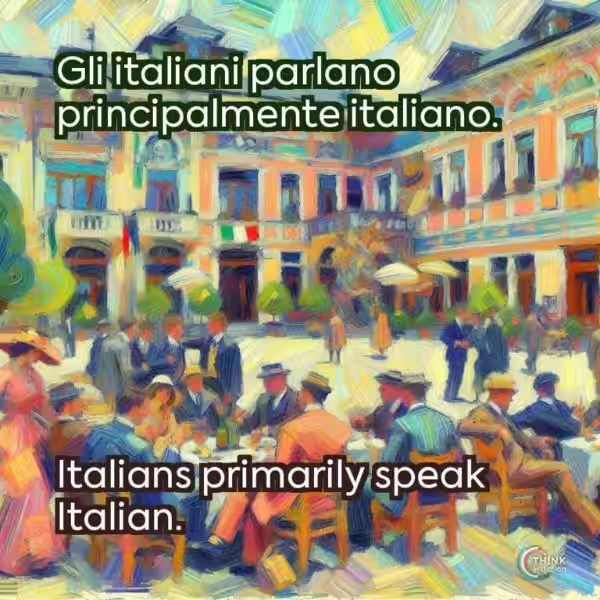
When you hear the phrase “parlano italiano”, it conjures images of vibrant piazzas, the aroma of espresso, and a rich cultural heritage. But beyond the surface, this phrase also whispers of a profound connection to faith, a heritage deeply intertwined with the very fabric of Italian life and language. Italy, a land steeped in history, is also a bedrock of religious traditions, and understanding how Italians “parlano italiano” when it comes to their beliefs offers a window into their souls and their enduring spiritual landscape.
The connection between language and religion in Italy is not merely incidental; it’s a symbiotic relationship. For centuries, the Catholic Church has been a dominant force, shaping not only art, architecture, and social customs but also the very way Italians express themselves. From the familiar Sunday greetings to the intricate theological discussions, the Italian language has served as the vessel for conveying complex spiritual ideas, fostering community, and preserving centuries of religious devotion.
The way Italians “parlano italiano” about their daily lives is often infused with religious sentiment, even if they don’t actively identify as devout. Expressions like “Mamma mia!” (My mother!) or “Dio benedica!” (God bless!) are common interjections, reflecting a cultural upbringing where faith was a constant companion. These phrases, deeply ingrained in the vernacular, serve as subtle reminders of a shared spiritual heritage that transcends individual levels of observance.
Consider the simple act of wishing someone well. Instead of a perfunctory “good luck,” an Italian might say, “In bocca al lupo!” (Into the wolf’s mouth!), often followed by “Crepi il lupo!” (May the wolf die!). This perhaps seemingly unrelated idiom, rooted in superstition and ancient beliefs, demonstrates how even secular expressions can carry the faint echoes of a worldview shaped by spiritual considerations. Similarly, the common phrase, “Se Dio vuole” (If God wills it), encapsulates a deep-seated acceptance of fate and a reliance on a higher power, a sentiment frequently heard when discussing future plans.
The nuances of how Italians “parlano italiano” in religious contexts are fascinating. Religious terminology has permeated everyday conversation to such an extent that many individuals use these words and phrases without necessarily focusing on their original sacred meaning. For instance, the word “miracolo” (miracle) is often used to describe something incredibly fortunate or unlikely, even in the absence of any overt religious connotation. A successful surgery or a surprisingly good harvest can both be termed a “miracolo.”
Furthermore, the emphasis Italians place on family and community, key tenets in many religions, is often articulated through the very way they “parlano italiano.” Expressions of gratitude, apologies, and even simple requests are often framed with a warmth and sincerity that reflects a moral compass influenced by religious teachings. The act of sharing a meal, a cornerstone of Italian culture, is often accompanied by a grace or a moment of reflection, highlighting the spiritual significance attributed to sustenance and togetherness.
Diversity Within the Italian Religious Landscape
While Catholicism has historically been the dominant faith, it’s important to recognize that the way Italians “parlano italiano” about religion also encompasses a spectrum of beliefs and practices. Modern Italy is a mosaic, with growing communities of other faiths and a significant portion of the population identifying as non-religious or secular. This diversity enriches the linguistic landscape, introducing new expressions and perspectives into the Italian discourse on spirituality.
The growing secularization in Italy has led to fascinating shifts in how people express their values and beliefs. While the traditional religious framework might be less influential for some, the underlying moral and ethical principles often remain. Thus, even when individuals don’t actively participate in religious services, the language they use to discuss right and wrong, kindness, and social justice might still carry the subtle imprint of centuries of religious influence. This demonstrates a resilience of values, even as the outward expression of faith evolves.
As Italy becomes more multicultural, the way people “parlano italiano” about their faith traditions is becoming more varied. You’ll hear about the practices of Islam, Judaism, and various Protestant denominations, each contributing its unique vocabulary and perspectives to the Italian linguistic tapestry. These interactions foster a richer understanding of religious diversity and challenge traditional notions of what it means to be Italian and spiritual.
Moreover, the rise of secularism means that many Italians “parlano italiano” about life’s big questions without resorting to religious dogma. Philosophical discussions, ethical debates, and humanist values are increasingly shaping how individuals articulate their worldview. This doesn’t negate the historical influence of religion but rather showcases the dynamic evolution of Italian thought and expression, where faith and reason often engage in dialogue.
The Enduring Power of Italian Spirituality
Ultimately, whether one is deeply religious or embraces a secular outlook, the way Italians “parlano italiano” reveals a persistent undercurrent of spirituality that has shaped their culture for millennia. The language itself acts as a conduit, carrying the weight of tradition, the comfort of community, and the enduring human quest for meaning. It’s a testament to the profound and inseparable bond between how Italians express themselves and the spiritual dimensions that have long defined their identity.
The simple act of listening to how Italians “parlano italiano” can be an education in itself. From the solemn pronouncements in ancient cathedrals to the casual conversations in a bustling market, the threads of faith are woven into the very fabric of their communication. This linguistic richness, imbued with the echoes of centuries of prayer, contemplation, and communal worship, continues to shape not only their present but also their future, ensuring that the spiritual essence of Italy will continue to resonate.