The allure of Italy, a land steeped in history and vibrant culture, has captivated travelers for centuries. Yet, beyond the sun-drenched vineyards and ancient ruins lies a profound spiritual tapestry, intricately woven with threads of faith that have traversed the very same waters that lead us from the vast, open sea to Italy. This journey, both literal and metaphorical, is a cornerstone of understanding the soul of this remarkable nation, a land where religion is not merely a belief system but a living, breathing part of everyday life.
From the earliest seafaring peoples to the pilgrims of antiquity and the modern-day adventurers setting sail, the sea to Italy route has been a conduit for more than just trade and conquest; it has been a pathway for faith. The echoes of sacred traditions, carried on the Mediterranean breeze, have shaped the very essence of Italian spirituality, influencing its art, architecture, and the deep-seated devotion of its people.
The Ancient Roots of Faith Carried Across the Seas
Long before the Roman Empire became a dominant force, the Mediterranean was a bustling highway connecting diverse cultures and their spiritual practices. The Phoenicians, Greeks, and Etruscans, all skilled mariners, brought their gods and goddesses, their rituals and myths, with them as they navigated the azure expanse leading to the Italian peninsula. These early beliefs, though often later absorbed or transformed, laid a foundational layer for the religious landscape that would eventually flourish.
Imagine the anticipation of a sailor, thousands of years ago, gazing towards the distant shores of Italy, carrying precious cargo and perhaps even sacred relics. The journey across the sea to Italy was not just about reaching a destination; it was about connecting with the divine, about seeking blessings for a safe passage, and about disseminating religious ideas. These early migrations of faith, facilitated by the sea, created a rich, hybridized spiritual environment that would prove fertile ground for greater religions to take root.
Early Christian Echoes: The Seeds of a Spiritual Revolution
When Christianity began its remarkable ascent, the Mediterranean once again became its primary artery. Apostles like Saint Paul, and countless unnamed missionaries, bravely embarked on journeys across the sea to Italy, carrying the message of Christ. Their voyages were fraught with peril, yet driven by an unshakeable conviction, spreading the nascent faith from the eastern Mediterranean to the heart of the Roman world, and eventually, across the entire Italian peninsula and beyond.
These early Christian communities, often meeting in secret, faced persecution, yet their numbers grew, fueled by a message of hope and salvation. The visual evidence of this early spread can be found in the catacombs, where simple yet powerful symbols of faith were etched into the walls, a testament to the enduring spirit of those who first brought Christianity across the sea to Italy. These were not grand cathedrals, but humble beginnings, the seeds of a spiritual revolution sown in the Roman soil.
The Vatican City: A Spiritual Epicenter Born from the Sea
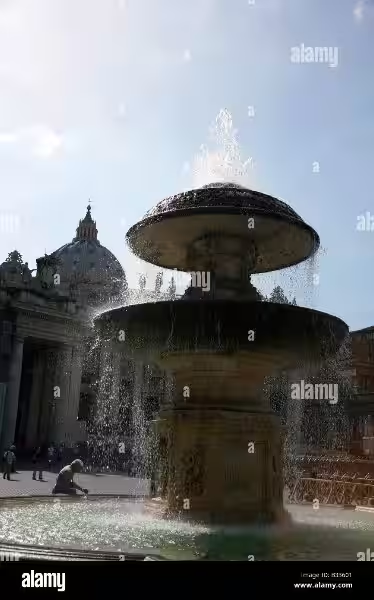
The establishment of the Vatican City, nestled within Rome, is a pivotal moment in the history of Catholicism and, by extension, Italian religion. While not directly on the coast, its very existence is inextricably linked to the historical flow of people and ideas across the Mediterranean. The papacy, as the head of the Catholic Church, gained immense influence over centuries, much of it consolidated through diplomatic and spiritual ties that traversed the very same maritime routes that brought early Christians to Rome.
The grandeur of St. Peter’s Basilica and the Vatican Museums are not just architectural marvels; they are testament to centuries of devotion, patronage, and the powerful role the Church played in shaping Italian society. The artistic masterpieces housed within, from Michelangelo’s Sistine Chapel ceiling to Raphael’s frescos, are directly inspired by biblical narratives and the teachings of the Church, a visual sermon for those who travel from the world over, often arriving by sea, to witness this sacred heartland.
Pilgrimage Routes: Following in the Footsteps of Faith
For centuries, Italy has been a paramount destination for religious pilgrims. The concept of the pilgrimage, a journey undertaken for spiritual merit, has been a powerful motivator for individuals from all corners of the globe to embark on their own voyage across the sea to Italy. Whether seeking intercession at holy sites, participating in sacred rituals, or simply yearning for a deeper connection with their faith, these journeys are a continuation of an ancient tradition.
Consider the Camino de Santiago, a famous pilgrimage route, but Italy boasts its own network of sacred paths. The Via Francigena, an ancient route spanning from Canterbury to Rome, saw countless travelers arriving by sea at various points before continuing their trek inland. This journey, mirroring the original voyages across the sea to Italy, reinforces the enduring human desire for spiritual exploration and the profound impact religious sites have on the faithful.
The Enduring Influence of Religion on Italian Culture
Religion in Italy is far more than just Sunday Mass; it’s woven into the very fabric of daily life, influencing social customs, festivals, and the arts. The deep-seated reverence for saints, the vibrant celebrations of religious holidays like Easter and Christmas, and the ubiquitous presence of churches in even the smallest villages all speak to the pervasive nature of faith.
From the passionate processions that mark patron saint days to the subtle ways religious symbolism appears in art and architecture, the influence of centuries of devotion, much of it initially arriving via the sea to Italy, is undeniable. Even for those who may not be overtly religious, the cultural heritage shaped by faith is an integral part of the Italian experience, a testament to its enduring legacy.
Art, Architecture, and the Sacred: A Visual Symphony
Italy’s artistic and architectural heritage is a breathtaking testament to the profound impact of religion. The Renaissance masters, heavily influenced by their faith, created some of the world’s most iconic religious artworks. The soaring cathedrals, with their intricate stained-glass windows and awe-inspiring domes, are not just buildings but sacred spaces designed to inspire reverence and awe, often built with materials brought by sea.
Think of the mosaics of Ravenna, shimmering with golden hues and depicting biblical scenes, a direct legacy of Byzantine influence that traveled across the Adriatic. Or consider the countless churches dotted across the landscape, each with its own unique history and artistic treasures, many of which were commissioned and supported by communities whose faith was solidified by generations of spiritual connection facilitated by the sea to Italy. These are not just historical artifacts; they are living testaments to a faith that has shaped a nation’s identity.
Modern Faith and the Evolving Spiritual Landscape
While Italy remains a predominantly Catholic nation, the spiritual landscape is evolving. Like many Western countries, it is experiencing a diversification of religious beliefs and a growing secularization. Yet, the historical weight of its religious past, carried across the sea to Italy, continues to shape its cultural identity and provide a framework for many Italians.
Even with changing demographics and societal shifts, the enduring traditions and the cultural significance of religious holidays remain strong. The rituals, the sense of community often fostered by religious institutions, and the moral frameworks derived from centuries of faith continue to resonate. The journey from the sea to Italy, once primarily a path for the dissemination of specific faiths, now represents a broader convergence of cultures and ideas, all contributing to a dynamic and multifaceted spiritual tapestry.
The Unseen Currents: How Faith Continues to Shape Italy
The impact of religion in Italy is not always overt, but it is deeply ingrained. It influences ethical considerations, the importance of family values, and a collective sense of heritage. The historical significance of the Church as a patron of arts and education has left an indelible mark on Italian society, shaping its intellectual and cultural development in ways that are still felt today.
The continued relevance of religious sites as points of pilgrimage for both domestic and international visitors demonstrates the enduring power of faith. These journeys, often beginning with a voyage across the sea to Italy, highlight a persistent human need for connection, meaning, and the spiritual solace that these sacred places offer. The echoes of ancient mariners carrying their faith to these shores continue to resonate in the hearts of modern pilgrims.
Frequently Asked Questions: Sea to Italy – Religion
What is the dominant religion in Italy?
The dominant religion in Italy is Roman Catholicism.
Is Italy a secular country?
While Roman Catholicism has a historically significant presence and influence, Italy is officially a secular state, meaning there is a separation of church and state. Freedom of religion is guaranteed by the constitution.
Are there other religious minorities in Italy?
Yes, Italy has various religious minorities, including Protestants, Orthodox Christians, Muslims, Jews, Buddhists, Hindus, and Sikhs, among others.
Can I visit religious sites in Italy?
Absolutely. Italy is home to numerous famous religious sites, including St. Peter’s Basilica in Vatican City (the heart of the Catholic Church), countless historic churches, synagogues, mosques, and temples that are open to visitors.
Is it respectful to dress a certain way when visiting religious sites?
Yes, it is generally expected to dress modestly when visiting churches and other religious sites. This typically means covering your shoulders and knees. Some sites may have specific dress codes.
Are religious holidays observed in Italy?
Major religious holidays, particularly Catholic ones like Christmas (Natale) and Easter (Pasqua), are widely observed and celebrated in Italy. Many shops and businesses may close on these days.
Is it easy to find places of worship for other religions in major cities?
In larger cities and more diverse areas, it is generally easier to find places of worship for various religious denominations. In smaller or more remote villages, the availability might be limited.
How does religion influence Italian culture?
Religion, particularly Catholicism, has deeply influenced Italian culture, art, architecture, traditions, and social customs throughout history. Many festivals and local celebrations have religious origins.
Can I participate in religious services in Italy?
Yes, visitors are often welcome to attend religious services, particularly in Catholic churches. It’s usually appropriate to observe respectfully without disturbing the service.