The Early Seeds of Faith: From Rural Roots to Seminary
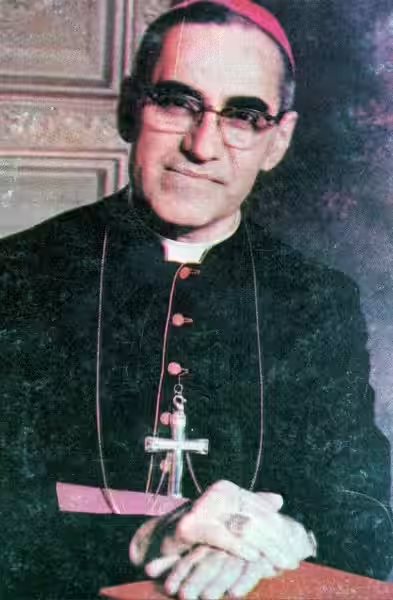
The story of Oscar Romero, the martyred archbishop of San Salvador, is a powerful testament to how deeply held religious convictions can shape a life and, in turn, influence history. Born on August 15, 1917, in Ciudad Barrios, El Salvador, Oscar Arnulfo Romero y Galdámez came from humble beginnings. His childhood was marked by a strong Catholic upbringing, a foundational element that would permeate his every decision and action. Even as a young boy, Romero displayed a profound sense of piety, often spending hours in prayer and contemplating religious life. This early inclination was not a fleeting childhood fancy but a persistent calling that would eventually lead him down the path of priesthood.
Romero’s journey into the religious life wasn’t solely a personal quest; it was also a path that offered education and a chance for a different future in a time and place with limited opportunities. He entered the seminary at a relatively young age, demonstrating an early maturity and dedication to his studies and spiritual formation. This period was crucial in shaping his understanding of Catholic social teaching, a doctrine that emphasizes the inherent dignity of every human being and the responsibility of the Church to advocate for justice and the poor. While the seeds of his later activism were being sown, his early years were characterized by a more conventional, perhaps even conservative, approach to his faith and pastoral duties.
A Shepherd’s Ascent: From Parish Priest to Archbishop
Oscar Romero’s career within the Catholic Church was a steady ascent, marked by diligent service and a growing reputation for his intellect and devotion. After his ordination in 1942, he served in various parishes, ministering to the spiritual needs of his congregants. He was known for his seriousness and his commitment to theological study, often delving into complex doctrines and their practical implications. His early ministry, while faithful, didn’t yet betray the prophetic voice that would later define him. He was seen as a capable and orthodox clergyman, someone who could be trusted with increasing responsibilities.
His appointment as Auxiliary Bishop of San Salvador in 1970, and then as Archbishop in 1977, marked a significant turning point, both for Romero and for El Salvador. The country at this time was experiencing escalating political turmoil, widespread poverty, and a brutal military regime that suppressed dissent. This was a period when the Church’s role in society was becoming increasingly complex, and the lines between spiritual guidance and social justice were blurring out of necessity. The suffering of the Salvadoran people, palpable and pervasive, would soon begin to weigh heavily on the new archbishop’s conscience, challenging his previous, more measured approach to his pastoral responsibilities.
The Awakening of a Prophet: Embracing the Cry of the Poor
The transition from a more reserved bishop to a vocal champion of the oppressed was not instantaneous but a gradual awakening, spurred by the escalating violence and injustice he witnessed. As Archbishop, Romero was initially perceived as a moderate, perhaps even a conservative choice by the government. However, the stark realities of El Salvador – the disappearances, the torture, the economic exploitation – could no longer be ignored by a man deeply committed to his faith. He began to hear the cries of the poor and marginalized echoing in his sermons and his conscience, compelling him to speak out.
Romero’s sermons, broadcast weekly on radio, became a powerful platform for dissent and a source of hope for a beleaguered populace. He didn’t shy away from criticizing the government’s human rights abuses, even when it put him in grave danger. He spoke of “the preferential option for the poor,” a core tenet of liberation theology, arguing that the Church must stand with those most vulnerable and exploited. This was a radical departure for many, and it transformed his public image from a quiet churchman to a courageous voice of conscience, challenging the powerful and offering solace to the suffering.
The Power of the Word: Sermons that Challenged an Empire
Oscar Romero’s sermons were not mere religious pronouncements; they were acts of prophetic witness in a time of profound crisis. He used the pulpit to illuminate the deeply intertwined nature of faith and justice, arguing that true Christianity demanded a commitment to alleviating suffering and fighting oppression. His words, delivered with conviction and empathy, resonated deeply with ordinary Salvadorans, offering them a sense of dignity and validation in their struggles.
He masterfully weaved biblical narratives with the contemporary struggles of his flock, drawing parallels between the ancient prophets who spoke truth to power and his own mission. For instance, he might speak of Moses leading his people out of slavery to illustrate the need for liberation from economic and political bondage. His radio broadcasts became a lifeline, reaching even the most remote villages and becoming a crucial source of information and moral guidance. These sermons were not abstract theological discourse; they were concrete calls to action and reflections on the human cost of injustice, making his message incredibly relatable and urgent.
A Church in the Trenches: The Embodiment of Pastoral Care
Romero’s commitment extended beyond his sermons; he actively sought to embody the pastoral care he preached. He visited prisons, met with the families of victims, and provided spiritual and material support to those displaced by the violence. He understood that faith was not to be confined to the sanctuary but must be lived out in the messy reality of human suffering. This hands-on approach solidified his image as a shepherd truly walking among his flock, sharing their burdens.
He became a symbol of hope and resistance for many, a figure who dared to challenge the established order in the name of his faith. His actions demonstrated that the Catholic Church, in its purest form, is a force for liberation and a champion of the downtrodden. He was not afraid to confront the powerful, using his position to advocate for peace and reconciliation, even when met with threats and hostility. This unwavering dedication to his people cemented his legacy as a true servant of God and humanity.
The Ultimate Sacrifice: Martyrdom for the Faith
Oscar Romero’s unwavering stance against injustice and his powerful advocacy for the poor ultimately sealed his fate. The threats against him escalated as his influence grew and his words continued to challenge the military regime. Despite warnings and pleas for his safety, he refused to be silenced, believing that his voice was essential for the oppressed. He saw his potential death not as an end, but as a final act of witness to the principles he held dear.
On March 24, 1980, while celebrating Mass in a small chapel in San Salvador, Archbishop Oscar Romero was assassinated. A single shot to the heart ended his earthly life, but it did not extinguish the flame of his legacy. His death sent shockwaves around the world, drawing international attention to the brutal realities of El Salvador and igniting a wave of grief and outrage. He became a martyr for his faith, a testament to the power of conviction and the ultimate price of speaking truth to power. His martyrdom solidified his status as a beacon of hope and a saintly figure for many, inspiring generations to come to live out their faith with courage and compassion.
A Lasting Legacy: Inspiration for a World in Need
The assassination of Oscar Romero did not silence his message; instead, it amplified it. His life and death became a powerful symbol of resistance against oppression and a call to live out faith through action. He is remembered not just as a religious figure, but as a human rights advocate who embodied the core tenets of his faith in the face of extreme adversity. His legacy continues to inspire individuals and movements around the globe who strive for justice, peace, and the dignity of all people.
The Catholic Church officially recognized his sainthood in 2018, an affirmation of the profound impact he had and the enduring power of his witness. Saint Oscar Romero’s biography, intertwined with his deep commitment to religion, serves as a timeless reminder that faith, when lived authentically, can be a transformative force, capable of challenging injustice and offering hope to the most vulnerable. His story is a profound lesson in the intersection of religion and social responsibility, proving that a life dedicated to God is often a life dedicated to humanity.
Frequently Asked Questions about Oscar Romero
Who was Oscar Romero?
Oscar Romero was a Roman Catholic archbishop in El Salvador who became a prominent voice for the poor and oppressed during the country’s civil war. He was assassinated in 1980 while celebrating Mass.
What was Oscar Romero’s religion?
Oscar Romero was a Roman Catholic. He served as the Archbishop of San Salvador and was deeply committed to his faith and its teachings on social justice.
When was Oscar Romero born and when did he die?
Oscar Romero was born on August 15, 1917, and died on March 24, 1980.
What is Oscar Romero known for?
He is known for his courageous advocacy for human rights and his outspoken criticism of government repression and violence against the poor in El Salvador. His sermons often called for peace and justice.
Was Oscar Romero canonized?
Yes, Oscar Romero was canonized as a saint by the Catholic Church on October 14, 2018. He is known as Saint Oscar Romero.
What was Oscar Romero’s role in the church hierarchy?
He rose through the ranks of the Catholic Church, serving as a priest, bishop, and eventually as the Archbishop of San Salvador, the highest position for a bishop in a diocese.
What were some of the key issues Oscar Romero addressed?
Romero addressed issues such as poverty, inequality, political repression, torture, disappearances, and the violence of the civil war. He consistently spoke out against these injustices.
What is the significance of Oscar Romero’s assassination?
His assassination was a pivotal moment that highlighted the deep divisions and brutality of the Salvadoran civil war and brought international attention to the human rights abuses occurring in the country.
Where can I learn more about Oscar Romero?
Information about Oscar Romero can be found in biographies, historical accounts of El Salvador, documentaries, and official Vatican resources.