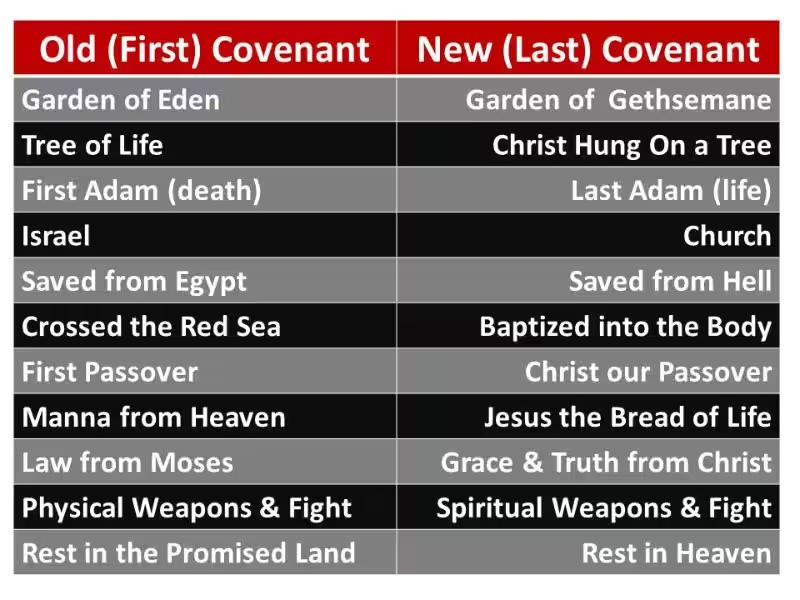
Religion, at its core, is a quest for meaning, a framework for understanding our place in the universe, and a guide for living a righteous life. Throughout history, humanity has grappled with these profound questions, and in the Abrahamic faiths, two distinct yet interconnected covenants have shaped its spiritual landscape: the Old Covenant and the New Covenant. While both represent divine agreements with humanity, they offer vastly different pathways to relationship with the divine, each with its own unique set of principles, promises, and implications. Understanding the distinctions between the old covenant versus the new covenant is not merely an academic exercise; it’s a journey that can illuminate the very heart of faith, offering profound insights into God’s character and His enduring love for humanity.
The Old Covenant, primarily established through Moses at Mount Sinai, was a pivotal moment in the history of ancient Israel. It was a legalistic agreement, a detailed set of laws and commandments given by God to His chosen people. This covenant was characterized by its emphasis on obedience, sacrifice, and ritual. The Ten Commandments, the intricate system of sacrifices, and the elaborate rules governing daily life were all designed to set Israel apart as a holy nation, reflecting God’s own holiness. The covenant was a conditional agreement, meaning that blessings were promised for obedience, and consequences for disobedience.
Think of it like a master builder laying out a meticulous blueprint. The Old Covenant provided the detailed instructions, the specific materials, and the exact procedures for constructing a righteous life and a functioning community. The people were expected to follow these instructions precisely, and their adherence was the measure of their relationship with God. This covenant was crucial for establishing a moral code and revealing God’s justice, but it also highlighted humanity’s inherent inability to perfectly keep its stipulations. The constant need for atonement through animal sacrifices underscored a fundamental problem: the unbridgeable gap between human sinfulness and divine perfection.
The Ten Commandments: A Moral Compass
At the heart of the Old Covenant were the Ten Commandments, a foundational set of ethical and societal principles. These weren’t just abstract rules; they were practical guidelines for living in community and honoring God. Commandments like “You shall have no other gods before me” and “You shall not murder” provided a framework for monotheism and basic human decency. They served as a clear standard of righteousness, a benchmark against which Israel’s faithfulness could be measured.
These commandments were also a powerful testament to God’s expectations for His people. They revealed the seriousness of sin and the need for a divine solution that went beyond human effort. For instance, the commandment against coveting, while seemingly internal, exposed the deep-seated desires that could lead to outward transgressions. The exhaustive list of laws, from dietary restrictions to ceremonial purity, demonstrates the holistic nature of the Old Covenant, seeking to regulate every aspect of life. However, the immense burden of upholding such a comprehensive legal system often proved overwhelming for the Israelites, leading to a perpetual cycle of failure and reliance on priestly mediation.
Sacrifices and Atonement: A Temporary Solution
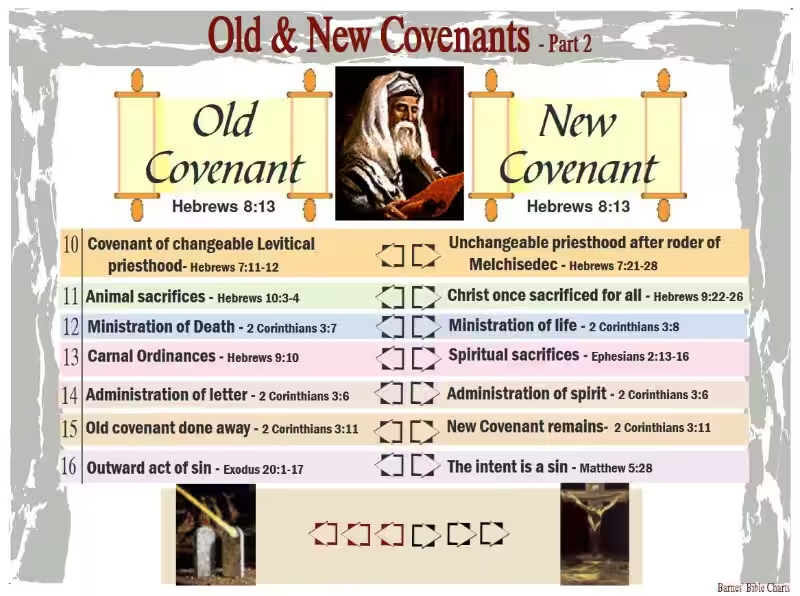
A defining feature of the Old Covenant was the system of animal sacrifices. These sacrifices were not arbitrary; they were divinely ordained rituals designed to temporarily atone for sin. The blood of innocent animals was shed to cover the transgressions of the people, a poignant symbol of the consequences of sin. The more grievous the sin, the more elaborate the sacrifice; this highlighted the gravity of offending a holy God. The entire sacrificial system was a constant reminder that sin required a blood payment.
However, the Old Covenant sacrifices were inherently limited. They were a temporary measure, a placeholder for something greater. The book of Hebrews in the New Testament poignantly explains that “it is impossible for the blood of bulls and goats to take away sins” (Hebrews 10:4). These sacrifices could cover sin and restore ritual purity, but they couldn’t permanently cleanse the heart or eradicate the inclination to sin. This inherent limitation created a persistent yearning for a more perfect and enduring atonement, a desire that would ultimately be fulfilled in the New Covenant.
The Dawn of the New Covenant
The New Covenant, prophesied by prophets like Jeremiah and ultimately inaugurated by Jesus Christ, represents a profound shift in God’s relationship with humanity. It is a covenant not of outward law, but of inward transformation. Unlike the Old Covenant, which was based on human obedience to external commands, the New Covenant is founded on divine grace and the transformative power of the Holy Spirit. Jesus’ sacrifice on the cross is the central cornerstone of this new agreement, offering a perfect and eternal atonement for the sins of all who believe.
Imagine the Old Covenant blueprint being replaced by a living, breathing organism. The New Covenant is not a rigid set of rules, but a dynamic relationship empowered by love and marked by the indwelling presence of God. It’s a covenant that changes us from the inside out, enabling us to fulfill God’s will not out of compulsion, but out of a transformed heart. This covenant is unconditional in its offer of salvation through faith in Christ, yet it demands a wholehearted response of love and devotion.
Jesus Christ: The Mediator of a Better Covenant
Jesus Christ is the living embodiment of the New Covenant. He is the perfect High Priest and the ultimate sacrifice for sin. His death on the cross was not just another sacrifice; it was the once-for-all atonement that permanently dealt with sin’s penalty and power. The Old Covenant required constant mediation by Levitical priests and repeated sacrifices. The New Covenant, however, finds its mediation solely in Jesus, who intercedes for us eternally.
His sacrifice fulfilled the prophecies of the Old Testament and ushered in a completely new way of relating to God. The New Testament writers consistently emphasize that through Christ, we have access to God’s presence in a way that was previously impossible. This is the essence of a better covenant, one built on more glorious promises and a more profound reconciliation between God and humanity. The personal relationship forged through Christ’s sacrifice is the hallmark of this new era.
The Indwelling Holy Spirit: Power for Transformation
A defining characteristic of the New Covenant is the indwelling of the Holy Spirit. Unlike the Old Covenant, where God’s presence was often localized or temporary, the New Covenant promises that the Spirit will dwell within believers, empowering them to live righteous lives. This is not about the ability to perfectly keep external laws, but about the divine enablement to love God, to love others, and to overcome the power of sin. The Holy Spirit acts as our internal guide, comforter, and source of strength.
This inward transformation is what distinguishes the New Covenant from the old. Instead of striving to obey a set of external rules, believers are empowered by the Spirit to live according to God’s will, which is written on their hearts. This leads to a genuine desire for holiness and a deepening intimacy with God. A believer struggling with anger, for example, under the Old Covenant might have focused on suppressing outward outbursts. Under the New Covenant, the Holy Spirit, through prayer and reliance on God, works to transform the root of the anger, fostering patience and forgiveness.
The Practical Implications: Living Under the New Covenant
Understanding the old covenant versus the new covenant has profound practical implications for how we live our faith today. It shifts our focus from performance-based righteousness to grace-empowered transformation. Under the Old Covenant, the emphasis was on what you did to earn God’s favor. Under the New Covenant, the emphasis is on who you are in Christ, transformed by His love and empowered by His Spirit. This doesn’t negate morality; rather, it reorients it.
Living under the New Covenant means embracing freedom from the condemnation of the law while embracing the responsibility to live a life that honors God. It’s about reliance on God’s strength, not our own. This translates into a faith that is less about meticulous adherence to a list of rules and more about a heart surrendered to God’s leading, a life characterized by love, joy, peace, patience, kindness, goodness, faithfulness, gentleness, and self-control – the fruits of the Spirit.
Freedom from Condemnation, Not Freedom from Responsibility
The New Covenant offers liberation from the condemnation that the Old Covenant law inevitably brought. Because Jesus’ sacrifice fully paid the debt for our sins, believers are no longer under the sentence of death for their failures. This is the incredible freedom of the gospel. However, this freedom is not an excuse for licentious living. Instead, it is a freedom to live in obedience out of love, not out of fear of punishment.
The New Testament is replete with exhortations to live a life worthy of our calling. For example, the Apostle Paul writes in Romans 6:1-2, “What shall we say, then? Shall we go on sinning so that grace may increase? By no means! We died to sin; how can we live in it any longer?” This highlights the paradoxical nature of the New Covenant: complete freedom from condemnation coupled with a deep responsibility to live a life that reflects God’s character. The Old Covenant demanded obedience to prevent punishment; the New Covenant inspires obedience as a grateful response to grace.
A Relationship of Love, Not Just Obligation
The old covenant versus the new covenant ultimately represents a profound shift in the nature of our relationship with God. The Old Covenant was largely about obligation and adherence to external mandates. While love was certainly a component, the framework was heavily legalistic. The New Covenant, however, is fundamentally a covenant of love. Jesus’ command to “love one another as I have loved you” (John 13:34) becomes the central operating principle.
This love is not a humanistic ideal; it is the divine love that flows from God through the Holy Spirit. It’s a love that seeks the best for others, demonstrates compassion, and extends forgiveness. This transforms our interactions with fellow believers and with the world. Instead of approaching faith as a duty, we approach it as a joyful participation in God’s redemptive work, motivated by a deep and abiding love for the One who first loved us. The Old Covenant’s emphasis on outward appearances gives way to the New Covenant’s focus on the inward condition of the heart, transforming our very being from the inside out.
Frequently Asked Questions: The Old Covenant Versus the New Covenant
What is the Old Covenant?
The Old Covenant, primarily established through Moses on Mount Sinai, is a set of laws, commandments, and rituals given to the ancient Israelites. It involved a conditional relationship between God and His people, where obedience to the Law was the basis for their blessings and favor. Key elements included the Ten Commandments, sacrificial systems, and the Levitical priesthood.
What is the New Covenant?
The New Covenant is a concept introduced by Jesus Christ, fulfilling and superseding the Old Covenant. It is characterized by a direct relationship with God through faith in Jesus’ sacrifice, which atoned for sins. The New Covenant emphasizes internal transformation, forgiveness of sins, and the indwelling of the Holy Spirit, rather than adherence to external laws.
What are the main differences between the Old and New Covenants?
The primary differences lie in their foundation, mediators, and scope:
* Foundation: The Old Covenant was based on adherence to the Law; the New Covenant is based on grace through faith in Jesus Christ.
* Mediator: The Old Covenant was mediated by Moses; the New Covenant is mediated by Jesus Christ.
* Scope: The Old Covenant was primarily for the nation of Israel; the New Covenant is offered to all who believe, Jew and Gentile alike.
* Sacrifice: The Old Covenant required continuous animal sacrifices; the New Covenant is sealed by Jesus’ one-time, perfect sacrifice.
* Law: The Old Covenant focused on external laws; the New Covenant emphasizes an internal law written on the heart by the Holy Spirit.
How does the Old Covenant relate to the New Covenant?
The New Covenant does not abolish the Old Covenant but rather fulfills it. Jesus is seen as the perfect High Priest and the ultimate sacrifice that the Old Covenant foreshadowed. The moral principles of the Old Covenant are upheld in the New Covenant, but they are understood and lived out through the power of the Holy Spirit and the transformative love of Christ.
Does the New Covenant mean the Old Testament is no longer relevant?
The Old Testament remains relevant as it provides the historical and theological foundation for understanding God’s plan of salvation and the person of Jesus Christ. It reveals God’s character, His faithfulness, and the consequences of sin, which necessitate the grace offered in the New Covenant.
What is the role of religion within these covenants?
In the context of the Old Covenant, religion was largely defined by the observance of Mosaic Law, rituals, and Temple worship. In the New Covenant, “religion” is understood as a personal relationship with God through Jesus Christ, characterized by faith, love, and the guidance of the Holy Spirit, rather than a rigid adherence to external religious practices.