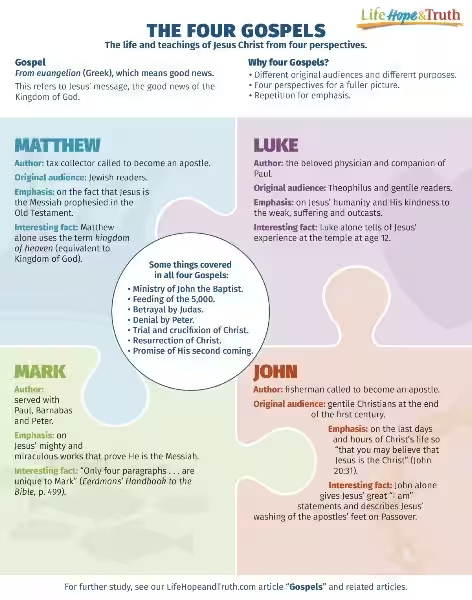
The New Testament presents us with a captivating collection of four distinct accounts of Jesus Christ’s life, teachings, death, and resurrection. Often referred to as the Synoptic Gospels (Matthew, Mark, and Luke) and John, these narratives, while sharing a common core of events, offer differing perspectives, emphases, and even unique details. Understanding these differences isn’t about finding contradictions, but rather appreciating the richness and multifaceted nature of the Christian message. It’s akin to looking at a magnificent sculpture from four different angles; each view reveals something new and essential about the whole.
These Gospels are not mere historical records in the modern sense. They are proclamations of faith, written for specific audiences with particular theological aims. The authors, drawing from different sources and traditions, crafted their narratives to persuade, instruct, and inspire their readers. Their unique approaches allow us to engage with Jesus in a way that speaks to different facets of our own spiritual journeys.
Why Four Perspectives? The Divine Strategy of Diverse Voices
Imagine a pivotal moment in history, like a groundbreaking scientific discovery. Different scientists, with varying backgrounds and expertise, might report on it, each highlighting different aspects they find most significant. Similarly, the divine inspiration behind the Gospels seems to have orchestrated a symphony of voices, each contributing a unique melody to the overarching narrative of salvation. This diversity ensures that no single perspective can exhaust the profound mystery of Christ.
The primary reason for having four Gospels is to provide a comprehensive and nuanced portrait of Jesus. Each evangelist, guided by the Holy Spirit, selected and arranged material to emphasize particular truths about Jesus’ identity and mission. This wasn’t about accidental omission or error, but a deliberate choice to illuminate different facets of the divine through human experience. For instance, one Gospel might focus on Jesus’ role as a fulfillment of Old Testament prophecy, while another emphasizes his divine nature and cosmic significance.
Matthew: The King and Teacher for a Jewish Audience
Matthew, often considered the “Gospel of the Kingdom,” was likely written for a predominantly Jewish Christian audience. His primary goal was to demonstrate that Jesus is the Messiah, the promised King who fulfills the prophecies of the Old Testament. He meticulously connects Jesus’ life and ministry to Jewish scripture, often quoting passages and explicitly stating, “This was to fulfill what was spoken by the prophet…” This approach would have been crucial for convincing Jewish readers that Jesus was indeed the one they had been waiting for.
Matthew’s Gospel is structured in five major teaching blocks, mirroring the five books of the Torah (the Pentateuch). This highlights Jesus as a new Moses, a supreme teacher delivering God’s law and kingdom principles. We find here the Sermon on the Mount, the parables of the Kingdom, and Jesus’ instructions to his disciples. His inclusion of Jesus’ genealogy tracing back to Abraham and David is a powerful declaration of his royal lineage, solidifying his claim to the Davidic throne.
Mark’s Gospel, the shortest and arguably the most action-packed, presents Jesus as the powerful, active Servant of God. It is characterized by its fast pace, vivid imagery, and emphasis on Jesus’ deeds rather than lengthy discourses. Mark often uses the word “immediately” (or a similar Greek term) to convey a sense of unstoppable momentum in Jesus’ ministry. This Gospel was likely written for a Gentile audience, perhaps in Rome, who would have been impressed by Jesus’ authority and power over sickness, demons, and even nature.
Mark’s portrayal of Jesus is one of bold action and decisive intervention. He shows Jesus performing miracles with a sense of urgency, often telling those he heals to keep his identity a secret. This “messianic secret” theme is a unique characteristic of Mark, perhaps serving to emphasize Jesus’ humility and the true nature of his kingdom, which is not one of earthly power and conquest. The stark depiction of Jesus’ suffering and crucifixion also underscores his role as a suffering servant, who gives his life as a ransom for many.
Luke: The Compassionate Savior for All Nations
Luke, a physician and historian, crafts a Gospel that emphasizes Jesus as the compassionate Savior of all humanity, particularly the marginalized and outcast. His prologue suggests that he relied on eyewitness accounts and meticulously investigated the events. Luke’s Gospel is notable for its emphasis on prayer, the Holy Spirit, and the universal scope of Jesus’ mission, reaching out to Samaritans, Gentiles, and the poor. He carefully orders his narrative, presenting a chronological and detailed account of Jesus’ life from birth to ascension.
A key difference in Luke is his inclusion of numerous stories and parables not found in the other Gospels. These often highlight Jesus’ concern for the poor, the sick, and those considered sinners. Think of the parables of the Good Samaritan, the Prodigal Son, and the Lost Coin – all beautifully illustrating God’s unconditional love and desire for reconciliation. Luke’s focus on women’s significant roles in Jesus’ ministry is also a distinctive feature, showcasing their presence and devotion.
John: The Divine Son Making the Invisible Visible
John’s Gospel stands apart from the Synoptics in its theological depth and unique narrative style. It is less concerned with chronological order and more focused on revealing the divine identity of Jesus. John begins with a profound theological statement: “In the beginning was the Word, and the Word was with God, and the Word was God.” He presents Jesus as the “I AM” statements, declarations that powerfully assert his divine nature, directly linking him to God himself.
John’s Gospel is filled with long discourses and symbolic “signs” (miracles) that are interpreted to reveal Jesus’ true identity. Unlike the Synoptics, John doesn’t include the institution of the Lord’s Supper or Jesus’ agony in Gethsemane. Instead, he focuses on Jesus’ farewell discourses to his disciples, filled with profound teachings about the Father, the Spirit, and the intimate relationship believers have with God. John’s aim is clear: to lead his readers to believe that Jesus is the Christ, the Son of God, and that by believing they may have life in his name.
Beyond the Synoptics: The Distinctive Voice of John
While Matthew, Mark, and Luke share a significant amount of material and are called “Synoptic” (meaning “seeing together”), John’s Gospel offers a complementary, rather than contradictory, perspective. He provides a deeper theological understanding of Jesus, exploring his pre-existence and his divine relationship with the Father. John’s accounts of Jesus’ interactions, such as the conversation with Nicodemus and the woman at the well, reveal Jesus’ transformative power in a unique and profound way.
One of the most striking differences is John’s presentation of Jesus’ miracles as “signs.” These aren’t just acts of power; they are divine demonstrations pointing to who Jesus is. For instance, the miracle of feeding the five thousand in John is followed by Jesus’ discourse on being the “Bread of Life,” a profound metaphor for his spiritual sustenance. This symbolic and interpretative approach is a hallmark of John’s writing, inviting readers to move beyond the physical to grasp the spiritual reality.
Unifying Threads: The Shared Heartbeat of the Gospels
Despite their distinct styles and specific emphases, the four Gospels are united by a common core of essential truths. All four proclaim Jesus as the Son of God, the Messiah, who came to save humanity. They all recount his crucifixion and resurrection, the central events of Christian faith. The love of God, the call to repentance, and the promise of eternal life are themes that resonate powerfully across all four narratives.
Ultimately, the differences between the Gospels serve to enrich our understanding of Jesus. They offer a holistic picture, allowing us to see him as King, Servant, Savior, and Divine Son. By engaging with each Gospel in its unique context and with its specific message, we can deepen our faith and grow in our knowledge of this central figure of history. The four Gospels are not a jigsaw puzzle with missing pieces, but a masterpiece of divine artistry, inviting us to explore its multifaceted beauty.
Frequently Asked Questions about the Gospels and Religion
This section addresses common questions about the four Gospels and their relationship to religion.
What are the four Gospels?
The four Gospels are Matthew, Mark, Luke, and John. They are the first four books of the New Testament of the Christian Bible and tell the story of the life, ministry, death, and resurrection of Jesus Christ.
What is the main difference between the four Gospels?
While all four Gospels share the central narrative of Jesus’ life, they differ in their perspective, audience, and emphasis. Matthew is often seen as presenting Jesus as the Jewish Messiah, while Mark is characterized by its fast-paced narrative. Luke emphasizes Jesus’ compassion for the outcasts and his universal message. John’s Gospel offers a more theological and symbolic account, focusing on Jesus’ divine nature and his relationship with God the Father.
Are the Gospels contradictory?
While there are apparent differences in details and order of events, most scholars do not consider the Gospels to be contradictory. These differences are often attributed to the authors’ distinct purposes, audiences, and the theological perspectives they aimed to convey. They are seen as complementary accounts that offer a fuller picture of Jesus.
What is religion?
Religion is a set of beliefs, practices, and values that relate to the sacred or divine. It often involves a belief in a higher power or powers, ethical codes, rituals, and a community of adherents. Religions provide frameworks for understanding the meaning of life, morality, and the human condition.
How do the Gospels relate to religion?
The Gospels are foundational texts for Christianity, one of the world’s major religions. They are central to Christian belief and practice, providing the narrative of Jesus Christ, who is considered the Son of God and the central figure of Christian faith. Christians look to the Gospels for teachings, examples of behavior, and the message of salvation.
Are the Gospels historical documents?
The Gospels are considered to have historical value, providing accounts of Jesus’ life and teachings. However, they are also theological documents written from specific faith perspectives. While historians use them to understand the context and events of the 1st century, their primary purpose is to convey a religious message and foster faith.
Can people of other religions read and benefit from the Gospels?
Yes, individuals of any religious background can read and study the Gospels. They offer insights into the life and teachings of a significant historical and religious figure, as well as explore themes of love, compassion, forgiveness, and human struggle that can resonate with people of diverse beliefs.