In the hallowed halls of religious study and discussion, where faith, history, and philosophy intertwine, the precise presentation of sources is not merely a matter of academic rigor; it can be a testament to the reverence for tradition and the integrity of belief. When we engage with sacred texts, theological arguments, or historical accounts of religious practice, accurately attributing the words and ideas of others is paramount. This is where the formal quotation format becomes an indispensable tool, ensuring that our own contributions stand on a foundation of verifiable knowledge and respectful engagement with the wisdom of those who came before us.
Think of it like constructing a sacred edifice. Just as each stone must be carefully placed and mortared to ensure structural integrity, each quoted passage must be accurately presented and properly cited. Without this meticulous attention to detail, the entire edifice of our understanding could crumble, leading to misinterpretations, the dilution of meaning, and a failure to honor the intellectual and spiritual labor of our predecessors. This article will explore the significance of formal quotation formats within religious contexts, offering practical guidance and relatable examples to illuminate its importance.
Religious texts, whether they are the divinely inspired scriptures of a faith or the profound theological treatises that have shaped its doctrines, are often held in the highest esteem. The sanctity of the original text is a cornerstone of many religious traditions. When we quote from these sources, our primary obligation is to represent their words faithfully. A formal quotation format, with its emphasis on exact wording, punctuation, and capitalization, helps to preserve this sanctity. It acts as a shield against unintentional alteration, ensuring that the spiritual and intellectual weight of the original is not diminished by our own transcription.
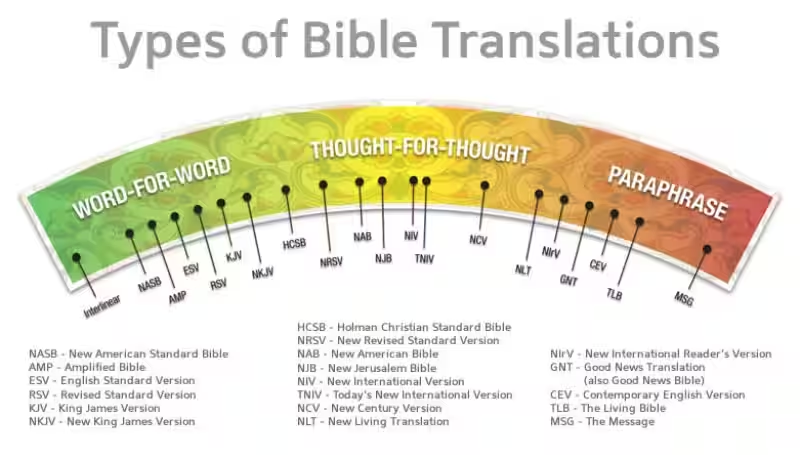
Consider the difference between quoting a verse from the Bible verbatim, including its specific phrasing and archaic language, and paraphrasing it loosely. The verbatim quote, properly formatted, allows the reader to engage directly with the text as it has been preserved through centuries. For instance, a formal quotation might look like this: As the Apostle Paul wrote in his letter to the Ephesians, “For by grace you have been saved through faith. And this is not your own doing; it is the gift of God” (Ephesians 2:8-9, ESV). This precision prevents our own contemporary understanding from inadvertently coloring or distorting the original message, which is crucial when discussing foundational theological concepts.
Establishing Credibility and Trust within the Faith Community
Within any religious community, credibility and trust are built on a foundation of honesty and intellectual integrity. When engaging in discussions, sermons, or academic papers related to faith, citing sources formally demonstrates that you have done your due diligence. It shows that your claims are supported by scholarly or theological precedent, rather than being mere personal opinions. This is particularly important when exploring complex theological debates or historical interpretations, where a clear lineage of thought needs to be traced.
Imagine a scholar presenting research on the evolution of a particular religious ritual. If they make claims about the origins of the ritual, but fail to cite the historical texts or anthropological studies that inform their conclusions, their arguments will lack persuasive power. A formal quotation format, however, would allow them to say: According to the historical analysis by Dr. Anya Sharma, “These ceremonial gestures, first documented in the third century, indicate a significant shift in priestly roles” (Sharma 2018, 45). This not only supports their argument but also directs interested readers to the original research, fostering a culture of transparency and shared learning within the faith community.
At its core, a formal quotation format is about accuracy and detail. It’s not just about putting quotation marks around borrowed words. It involves several key elements that ensure clarity and proper attribution. These include:
Exact wording: Every word, capitalization, and punctuation mark from the original source must be replicated.
Proper punctuation: Quotation marks are essential. For longer quotes (typically over 40 words), a block quote format is used, indented and without quotation marks.
Clear attribution: The author and the source of the quote must be clearly indicated.
Page or verse numbers: For religious texts or scholarly works, specific location information (e.g., chapter and verse, page number) is vital for readers to find the original source.
For example, if you’re quoting from the Upanishads, the precision matters. A formal quote might look like this: The Brihadaranyaka Upanishad states, “From untruth lead me to truth! From darkness lead me to light! From death lead me to immortality!” (Brihadaranyaka Upanishad 1.3.28, trans. Eknath Easwaran). This level of detail allows someone familiar with the text to immediately locate the passage and understand its context, ensuring that the philosophical nuance is not lost in translation or transmission.
In-Text Citations and Bibliographic Entries
Formal quotation format involves two primary components: in-text citations and bibliographic entries. In-text citations are brief references placed directly after the quotation in the body of your text. They typically include the author’s last name and the year of publication, and often a page or verse number. Bibliographic entries, on the other hand, are comprehensive details of all the sources you’ve cited, compiled in a list at the end of your work (often called a bibliography or works cited page).
A common in-text citation for a book might be (Smith 2021, 78), indicating that the information comes from page 78 of a work by Smith published in 2021. For religious scriptures, it would be more like (Quran 4:15), referencing chapter 4, verse 15 of the Quran. The corresponding bibliographic entry for the Smith book would provide the full title, publisher, and publication location, while for the Quran, it might specify the translation used, e.g., “Quran. Translated by M.A.S. Abdel Haleem. Oxford University Press, 2004.” This two-tiered system ensures that readers can easily find the source of any information presented.
Applying Formal Quotation Formats in Diverse Religious Contexts
Sacred Scriptures: The Foundation of Faith
When discussing or interpreting sacred scriptures, the adherence to formal quotation formats is paramount. These texts are the foundation of faith for billions, and any deviation from their original wording, however slight, can lead to profound theological misunderstandings. Different academic disciplines and religious traditions might favor specific citation styles (e.g., Chicago Manual of Style for theological studies, MLA for comparative religion), but the core principles of accuracy remain universal.
For example, when a minister quotes from the Book of Psalms during a sermon, they might say: “The Psalmist declares, ‘The Lord is my shepherd; I shall not want'” (Psalm 23:1, KJV). This simple in-text citation, including the book, chapter, verse, and the specific translation (King James Version), provides the congregation with the exact reference. For scholarly work, a more detailed citation might be required in a footnote or endnote, but the principle of unwavering fidelity to the text is the same.
Theological Debates and Scholarly Analysis
The landscape of theological debates and scholarly analysis is built upon the careful examination and citation of previous arguments and texts. When scholars engage with the works of great theologians like Augustine, Aquinas, or Rumi, they must precisely represent their ideas to contribute meaningfully to the ongoing dialogue. This is where formal quotation becomes a tool for intellectual honesty and respect for the thinkers whose shoulders we stand upon.
Imagine a scholar writing about the concept of tawhid (oneness of God) in Islamic theology. They might quote a passage from Al-Ghazali. A formal in-text citation would look something like: Al-Ghazali argues that, “True knowledge of God is not attained through mere intellectual assent but through a profound spiritual realization” (Al-Ghazali, The Revival of the Religious Sciences, Book I, Part 3, 87). This allows readers to trace the philosopher’s argument and understand how it informs contemporary discussions, ensuring that complex philosophical concepts are debated with precision.
Historical Accounts and Ethnographic Studies of Religion
When examining the historical accounts and ethnographic studies of religion, formal quotation is equally critical. These sources often provide firsthand or meticulously researched insights into the practices, beliefs, and social structures of religious communities. Accurately quoting these accounts allows us to reconstruct past realities and understand the diversity of religious expression without imposing our own biases.
Consider an anthropologist studying a specific pilgrimage in India. They might interview a devotee who recounts their experience. A formal quotation would capture the devotee’s words precisely: “The feeling of divine presence was overwhelming; it was as if the deity themselves touched my soul,” explained one pilgrim during our interview on the Ganges riverbank (Gupta, field notes, 2022). This preserves the authenticity of the lived experience, allowing for nuanced interpretation and ensuring that the voice of the individual is not lost or misrepresented in the academic analysis.
Conclusion: Honoring the Word Through Accurate Citation
In the realm of religion, where words carry immense spiritual and historical weight, the formal quotation format is more than just a stylistic convention; it is an ethical imperative. It is a practice that safeguards the integrity of sacred texts, upholds the credibility of scholars and practitioners, and fosters a deeper, more honest engagement with the multifaceted world of faith. By meticulously attending to the details of quotation – from the exact wording to the precise attribution – we demonstrate a profound respect for the source material and for the ongoing conversation of religious thought and experience.
Embracing formal quotation formats allows us to build upon the wisdom of the past with clarity and integrity. It ensures that when we speak of faith, history, and theology, our contributions are not only informative but also grounded in truth and respect. Whether you are a student, a theologian, a clergy member, or simply a curious individual exploring the depths of religious tradition, mastering and applying these principles will significantly enhance the quality and impact of your discourse, ultimately honoring the sacred word in all its forms.
Frequently Asked Questions: Formal Quotation Format
What is a formal quotation?
A formal quotation is a written document that details the cost of goods or services that a supplier is offering to a potential buyer. It’s a legally binding document once accepted by the buyer, outlining the exact price, terms, and conditions of the proposed transaction.
What essential elements should a formal quotation include?
A formal quotation should typically include your company’s contact information, the recipient’s contact information, a unique quotation number, the date of issue, a clear description of the goods or services, unit prices, quantities, total price, payment terms, validity period, and any relevant terms and conditions.
How should I format the description of goods or services?
The description should be clear, concise, and specific. Include product names, model numbers, specifications, and any relevant details that leave no room for ambiguity. For services, describe the scope of work, deliverables, and any included or excluded items.
What are typical payment terms?
Payment terms specify when and how payment is expected. Common terms include “Net 30” (payment due within 30 days of invoice), “20% upfront, 80% upon completion,” or “Payment upon delivery.” Clearly state your preferred terms.
The validity period is the timeframe during which the quoted price remains firm. This is crucial to protect both parties from price fluctuations. A typical validity period can range from 30 to 90 days, depending on the industry and the nature of the quote.
Should I include taxes and shipping costs?
Yes, it is essential to clearly state whether taxes and shipping costs are included in the quoted price or if they will be added separately. Transparency here prevents misunderstandings and disputes later.
What are “terms and conditions”?
These are the contractual clauses that govern the agreement. They can cover aspects like delivery schedules, warranty information, cancellation policies, liability, and dispute resolution. It’s important to have these clearly defined.
Is a quotation legally binding?
A formal quotation becomes a legally binding document once it is formally accepted by the buyer, usually by signing it or issuing a purchase order based on its terms. Until acceptance, it’s considered a proposal.
How do I ensure my quotation is “formal”?
Formality is achieved through clear structure, professional language, inclusion of all necessary details, and often, the use of company letterhead or a designated quotation template. It should convey professionalism and seriousness.
Frequently Asked Questions: Religion
What is religion?
Religion is a complex system of beliefs, practices, and moral codes that often center on the worship of a god or gods, or on the pursuit of spiritual enlightenment. It typically involves a set of rituals, sacred texts, and a community of adherents.
What are the main purposes of religion?
Religions often serve to provide meaning and purpose to life, offer explanations for the unknown, guide moral behavior, foster community and social cohesion, and provide comfort and hope in the face of suffering and death.
What are the major world religions?
The major world religions, based on the number of adherents, include Christianity, Islam, Hinduism, Buddhism, and Judaism. Other significant religions and spiritual traditions exist globally.
What is the difference between a monotheistic and a polytheistic religion?
Monotheistic religions believe in the existence of one God, while polytheistic religions believe in the existence of multiple gods.
What is the role of sacred texts in religion?
Sacred texts, such as the Bible, Quran, or Vedas, are considered divinely inspired or authoritative writings that contain teachings, stories, laws, and guidance for believers. They are central to understanding and practicing a religion.
What are common religious practices?
Common religious practices include prayer, meditation, worship services, rituals, ceremonies, fasting, pilgrimage, and acts of charity. These practices vary significantly between different religions.
How does religion influence culture and society?
Religion has profoundly influenced art, music, architecture, law, ethics, social customs, and political structures throughout history and continues to shape societies worldwide.
What is the concept of “faith” in religion?
Faith, in a religious context, generally refers to a belief in and commitment to the divine, the supernatural, or religious doctrines, often without empirical proof. It involves trust and conviction.
What are some common ethical teachings found in religions?
Many religions share ethical teachings that emphasize love, compassion, forgiveness, honesty, justice, and the importance of treating others with respect and dignity.
How do different religions view the afterlife?
Views on the afterlife vary widely, with concepts such as heaven, hell, reincarnation, nirvana, or spiritual union with the divine being prevalent in different religious traditions.