The amber hues and rich, complex aroma of Latvian balsam are more than just a sensory delight; they are an embodiment of a nation’s soul, deeply intertwined with its spiritual landscape. This potent elixir, crafted through generations of meticulous distillation, offers a tangible connection to Latvia’s history, its resilience, and its enduring faith. For many, a glass of Latvian balsam isn’t merely a drink; it’s a ritual, a moment of reflection, and a taste of something profoundly sacred.
Understanding the significance of Latvian balsam requires delving into the very heart of Latvian culture. It’s a story woven with ancient pagan beliefs, the influence of Christian missionaries, and the quiet strength of a people who have navigated centuries of change. The ingredients themselves, often including herbs and roots revered for their medicinal and spiritual properties, hint at a connection to the earth and its inherent energies, a concept central to many spiritual traditions.
The Mystical Roots of Latvian Balsam and its Spiritual Resonance
The origins of Latvian balsam are shrouded in a mist as thick as the Latvian forests themselves. While the modern iteration might be attributed to a 1724 recipe for Albert Wolfgang, the practice of infusing spirits with herbs and botanicals for medicinal and potentially spiritual purposes predates this by centuries. Ancient Latvian folklore speaks of shamans and healers who would prepare potent concoctions from the bounty of the land, believing these brews could commune with spirits, ward off evil, and bring good fortune. Think of it like creating a sacred tea, but with a kick, meant to not only heal the body but also to soothe and guide the spirit.
The very act of creating Latvian balsam, with its careful selection of herbs like mint, wormwood, and St. John’s wort, echoes ancient rituals. These plants were not chosen for their flavor alone, but for their perceived energetic properties and symbolic meanings. Mint, for instance, was often associated with clarity and mental purification, while St. John’s wort held protective qualities. The slow infusion process, allowing the essence of these botanicals to meld, can be seen as a metaphor for the spiritual maturation and deepening of faith that occurs over time. It’s a slow, deliberate transformation, much like the journey of the soul.
The key to the unique character and perceived spiritual benefits of Latvian balsam lies in its carefully guarded recipe, which features a blend of over two dozen herbs and natural ingredients. Each component is thought to contribute not just to the taste but also to the overall ‘spirit’ of the balsam. For instance, the bitter notes from wormwood are sometimes linked to purification and detoxification, both physically and spiritually. Valerian root, known for its calming properties, could be seen as aiding in meditation and inner peace.
These ingredients are not just random additions; they are believed to be nature’s gifts, carefully collected and prepared with respect. Many of these herbs have been used in traditional healing practices across Europe for centuries, their efficacy often attributed to a combination of their chemical compounds and a deeper, almost mystical understanding of their connection to the natural world. The process of combining these elements can be viewed as a form of herbal alchemy, transforming simple plants into a potent elixir that nourishes the body and spirit.
Latvian Balsam in the Context of Religious Practice and Belief
The relationship between Latvian balsam and religion is multifaceted, evolving through different historical periods and religious influences. During times when Latvia was under the sway of various empires and their dominant religions, particularly Christianity, the balsam found its place within existing spiritual frameworks. It was sometimes incorporated into sacraments or used in monastic settings for its perceived medicinal properties and its ability to induce a state conducive to prayer and contemplation. Imagine monks in centuries past, sipping on a small measure of Latvian balsam before their evening prayers, seeking to sharpen their focus and deepen their devotion.
While not a direct sacrament in the way wine is used in Christian communion, Latvian balsam has historically been associated with celebratory religious festivals and personal moments of spiritual significance. It could be shared during family gatherings after attending church services, or offered as a gesture of hospitality to visiting clergy. In a nation where Lutheranism has historically been prominent, the balsam’s rich, earthy notes might have resonated with a spiritual appreciation for the natural world and its divine creation. It offered a tangible, comforting link to the land that sustained them, a land they often saw as a reflection of God’s handiwork.
From Pagan Rituals to Christian Adaptation: A Spiritual Evolution
The pre-Christian era in Latvia was rich with animistic beliefs and nature worship. Herbs and potent drinks were central to rituals designed to appease deities, communicate with ancestral spirits, and ensure a good harvest. It’s plausible that early forms of infused spirits, precursors to Latvian balsam, played a role in these ancient ceremonies. The very act of imbibing something carefully crafted from the earth could have been seen as a way to absorb the energy and blessings of the natural world.
When Christianity arrived, it didn’t always erase these deeply ingrained traditions. Instead, there was often a syncretic blending. Christian missionaries themselves, trained in monastic traditions that valued herbalism, may have recognized the potential of these local concoctions. The balsam, with its complex character, could have been reinterpreted within a Christian context – perhaps as a symbol of divine complexity and the multifaceted nature of faith. It offered a way for the populace to continue a familiar practice, albeit with a new spiritual overlay, bridging the gap between old and new beliefs.
Modern Interpretations: Latvian Balsam as a Spiritual Anchor in a Secular World
In contemporary Latvia, a nation that has experienced significant secularization, the connection to Latvian balsam may have shifted from overt religious practice to a more cultural and personal spirituality. For many, the act of enjoying Latvian balsam is now tied to national pride, heritage, and a sense of belonging. It’s a way to connect with their roots, to honor the traditions passed down through generations, even if they no longer actively participate in formal religious services.
The act of sharing a small glass of Latvian balsam can still evoke a sense of communion and shared experience, reminiscent of its historical role in communal gatherings. It can be a moment of quiet contemplation, a pause in the hustle of modern life to appreciate the simple yet profound pleasures that connect us to our past and to each other. The rich, lingering taste becomes a reminder of endurance, resilience, and the enduring spirit of the Latvian people, a spirit that has weathered many storms and found solace in the enduring traditions that are as much a part of their identity as the land itself.
Frequently Asked Questions about Latvian Balsam
What is Latvian Balsam?
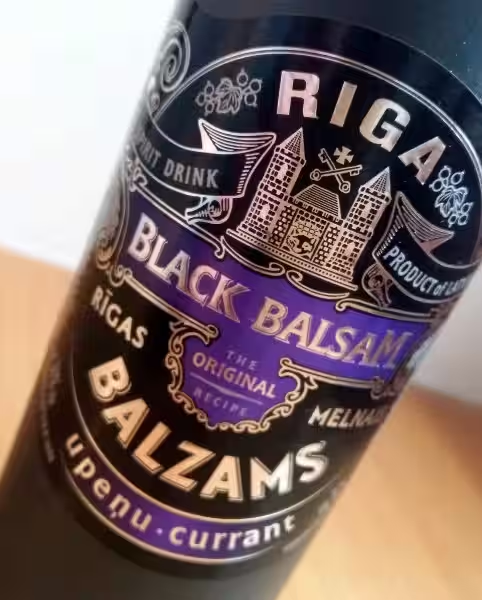
Latvian Balsam is a traditional herbal liqueur originating from Latvia. It is known for its complex flavor profile, often described as a blend of herbs, spices, and a hint of bitterness.
What are the main ingredients in Latvian Balsam?
The exact recipe is a closely guarded secret, but it typically includes a combination of natural ingredients such as various herbs, spices, roots, and berries. Common components are believed to be peppermint, ginger, wormwood, and other botanicals.
Latvian Balsam can be enjoyed in several ways. It is often consumed neat at room temperature, or chilled. It can also be added to hot drinks like tea or coffee, or used as an ingredient in cocktails.
Is Latvian Balsam medicinal?
Historically, herbal bitters like Latvian Balsam were believed to have medicinal properties, often used to aid digestion or as a general tonic. However, it is primarily consumed today as an alcoholic beverage and should not be considered a substitute for medical treatment.
What is the origin of Latvian Balsam?
Latvian Balsam has a long history, with its origins tracing back to the 18th century in Riga, Latvia. It was initially developed by pharmacists and has been produced by the same company for centuries.
Where can I buy Latvian Balsam?
Latvian Balsam is available in many liquor stores and specialty beverage shops, particularly in regions with a significant Latvian diaspora or an interest in traditional liqueurs. It can also be purchased online from various retailers.
What does Latvian Balsam taste like?
The taste of Latvian Balsam is complex and multifaceted. It is characterized by its robust herbal notes, a noticeable bitterness, and a warming sensation. It can have hints of spices, flowers, and even dark chocolate depending on the specific variant.
What are some popular ways to use Latvian Balsam in cocktails?
Latvian Balsam can add a unique depth to cocktails. It pairs well with spirits like vodka, gin, and rum. It can be used in Old Fashioned variations, hot toddies, or simply mixed with soda water and a citrus garnish.
Are there different types of Latvian Balsam?
While the classic Black Balsam is the most well-known, there might be variations or limited editions produced over time. However, the core identity remains consistent.
Is Latvian Balsam suitable for vegetarians or vegans?
Latvian Balsam is generally considered suitable for vegetarians and vegans as it is made from plant-based ingredients. However, it’s always a good idea to check the specific product labeling for any potential allergens or clarifying agents if you have strict dietary requirements.