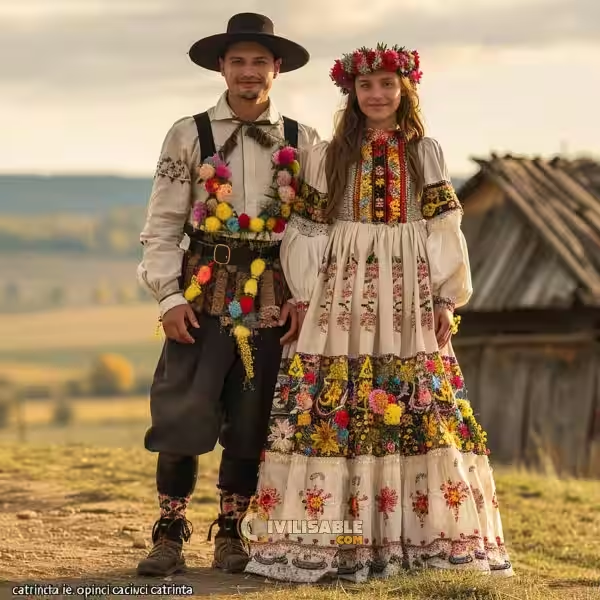
When we think of the Romani people, often a vibrant image comes to mind: flowing skirts, colorful scarves, and a life lived on the move. While these visual elements are undeniably part of their rich cultural heritage, the significance of Romani clothes extends far beyond mere aesthetics. They are deeply interwoven with the spiritual and religious beliefs that have guided the Romani for centuries, acting as a visual language that speaks of identity, respect, and connection to the divine. Understanding the interplay between Romani clothes and their faith offers a profound glimpse into a culture that has navigated the world with resilience and unwavering conviction.
The connection between Romani clothes and religion isn’t always overt or dogmatic in the same way it might be in some established faiths. Instead, it’s a more nuanced, lived expression, a constant reminder of their spiritual path and their place within the universe. This article will explore how these garments serve as more than just adornment; they are vessels carrying ancestral wisdom, markers of social order, and tangible representations of deeply held beliefs. We’ll delve into how different aspects of their faith find expression in the very fabric they wear, from the choices of color and pattern to the way garments are worn and cared for, all while keeping the rich tradition of Romani clothes at the forefront.
The Symbolic Language of Color and Pattern in Romani Attire
The kaleidoscope of colors and intricate patterns found in Romani clothes is not arbitrary. Each hue can carry a spectrum of meanings, often tied to the Romani understanding of the world and their spiritual beliefs. For instance, bright reds are frequently associated with vitality, passion, and sometimes protection, warding off negative energies. Deep blues might evoke a sense of peace, spirituality, and connection to the celestial realm, a nod to a higher power. Conversely, certain colors might be avoided for specific occasions or by particular individuals based on spiritual considerations, highlighting a conscious and deliberate approach to dressing.
Beyond individual colors, the combination and placement of patterns can also hold symbolic weight. Geometric designs, often seen on scarves or embroidered onto bodices, can represent the interconnectedness of all things, a fundamental concept in many spiritual philosophies. Stories or blessings might even be subtly woven into the fabric through specific motifs, passed down through generations who understood their sacred significance. This is particularly evident in the elaborate embroidery found on traditional Romani dresses for special ceremonies, where each stitch can be a prayer or a wish for prosperity and divine favor. The very act of creating these garments becomes a spiritual practice, imbuing the Romani clothes with a profound personal and communal meaning.
Dressing with Respect: Modesty and Spiritual Purity
A cornerstone of many Romani spiritual traditions is the emphasis on modesty and respect, which is directly reflected in the way Romani clothes are worn. This often translates into a preference for covering the body, particularly for women, as a sign of reverence for oneself and for those around them. The concept of ‘moulo’ or ritual impurity, a significant aspect of Romani social and spiritual life, also influences clothing choices. Certain body parts are considered more susceptible to impurity, and this understanding dictates how garments are designed and worn to maintain a sense of spiritual cleanliness.
For example, a woman might wear multiple layers, with longer skirts and higher necklines, not out of obligation to external rules, but as a personal expression of her spiritual integrity and her understanding of purity. The Romani dress itself, with its flowing silhouette and often generous fabric, naturally lends itself to this practice. The careful layering of garments can symbolize the different facets of one’s spiritual journey, with each layer offering protection and signifying a deeper connection to the divine. Even seemingly simple Romani skirts can be designed with specific lengths and fullness to adhere to these deeply ingrained spiritual principles, demonstrating that Romani clothes are intrinsically linked to their moral and spiritual compass.
The Role of Romani Clothes in Ritual and Celebration
Religious festivals and important life events, such as weddings or christenings, are occasions where the spiritual significance of Romani clothes truly comes to the fore. These are not just opportunities for communal gathering but also for the reaffirmation of faith and cultural identity. The most exquisite and elaborately decorated Romani attire is often reserved for these moments, serving as a visual testament to the joy and sanctity of the occasion. The choice of fabrics, the richness of the embroidery, and the vibrant colors all contribute to the celebratory atmosphere and the spiritual gravitas of the event.
Consider a Romani wedding: the bride’s traditional Romani dress might be adorned with gold or silver threads, symbolizing prosperity and a blessed union, often blessed by elders who imbue the garment with their prayers for the couple’s future. Similarly, for religious holidays, specific Romani clothing might be worn, perhaps incorporating symbols or colors associated with that particular observance. These garments become more than just clothing; they are sacred vestments, imbued with the collective prayers and aspirations of the community, worn with pride and a deep sense of spiritual connection. The care and preservation of these special Romani clothes further underscore their importance, often passed down as heirlooms, carrying the spiritual legacy of ancestors.
The Journey of Romani Clothes: From Practicality to Spiritual Adornment
Historically, the nomadic lifestyle of many Romani communities meant that Romani clothes had to be both durable and adaptable. Yet, even within this practicality, there was always an underlying spiritual dimension. The emphasis was on clothing that could withstand the elements while still allowing for a dignified and spiritually resonant presentation. This inherent duality between the practical needs of daily life and the spiritual aspirations of the people has shaped the evolution of Romani clothes over centuries.
The development of specific garments for different purposes – everyday wear versus ceremonial attire – reflects this evolution. While daily Romani outfits might prioritize comfort and resilience, special occasion wear showcases the artistic and spiritual dedication of the wearer. The vibrant fabrics, the intricate beadwork, and the careful tailoring all speak to a profound respect for tradition and a desire to honor the divine through their personal presentation. This journey, from purely functional garments to deeply spiritual adornments, highlights how Romani clothes are a dynamic and living expression of their enduring faith and cultural identity. They are a constant, tangible reminder of who they are, where they come from, and the spiritual path they continue to walk.
Frequently Asked Questions About Romani Clothing and Religion
What are common traditional Romani clothing items?
Traditional Romani clothing often features vibrant colors, elaborate embroidery, and flowing fabrics. Skirts, particularly full, layered skirts, are common for women. Men might wear loose shirts, vests, and trousers. Jewelry, such as large earrings and necklaces, is also a significant part of traditional attire. Specific styles can vary greatly depending on the Romani community and its region of origin.
No, there is no single, unified Romani religion. Romani people practice a diverse range of faiths, often influenced by the dominant religions of the countries where they have settled. This includes Christianity (both Catholic and Orthodox), Islam, and in some cases, Hinduism (due to their historical origins in India). Many Romani communities also maintain unique spiritual beliefs and traditions alongside their adopted faiths.
Do Romani people have specific religious practices related to clothing?
Religious practices related to clothing can vary significantly among Romani communities. Some may have specific rules or customs concerning modesty, head coverings, or the wearing of religious symbols. For example, in some Muslim Romani communities, women may observe hijab. In Christian communities, certain attire might be preferred or required for religious services or ceremonies. However, these practices are not universal and are determined by the specific religious affiliation and cultural norms of each group.
How important is clothing in Romani culture?
Clothing has historically played a significant role in Romani culture, often serving as a marker of identity, social status, and belonging to a particular group. The vibrant colors and intricate designs can be expressions of creativity and tradition. While modernization has influenced clothing choices, many Romani communities still cherish and maintain their traditional attire for special occasions, cultural events, and as a symbol of their heritage.
Are Romani religious beliefs influenced by their nomadic history?
The nomadic history of the Romani people has undoubtedly shaped their religious and spiritual outlook. It may have fostered a sense of adaptability and a connection to the natural world. While specific religious doctrines are often adopted from settled societies, underlying spiritual beliefs might reflect a worldview that values freedom, resilience, and a strong sense of community, which can be seen as influenced by generations of movement and migration.