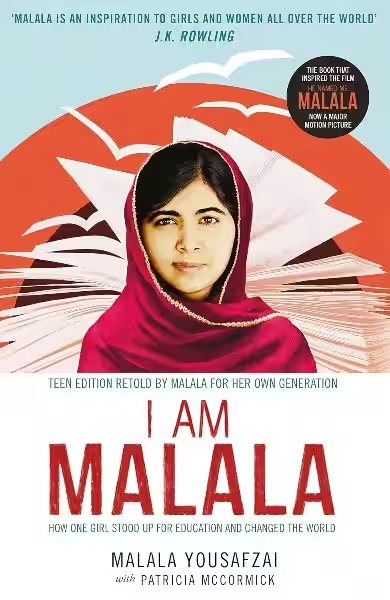
The name Malala Yousafzai resonates globally, a beacon of resilience and a testament to the indomitable spirit of a young woman who dared to dream of education for all. For many, the phrase “I am Malala Yousafzai” isn’t just a declaration; it’s an embrace of her ideals, a recognition of the profound impact one voice can have on the world. Her story, deeply intertwined with her religious upbringing and faith, offers invaluable lessons on courage, the pursuit of knowledge, and the meaningful intersection of spirituality and activism.
Malala’s journey began in the Swat Valley of Pakistan, a region rich in tradition and deeply rooted in Islam. Her father, a teacher himself, instilled in her a love for learning and a strong sense of moral responsibility. This nurturing environment, steeped in the principles of her faith, provided the fertile ground for her unwavering conviction to grow. It was within this framework of religious and familial values that she first understood the importance of education as a pathway to empowerment and a fundamental human right, a belief that would ultimately define her destiny.
Malala’s early life was shaped by the rhythms of her community and the teachings of Islam. The emphasis on kindness, compassion, and justice, central tenets of her faith, were not just abstract concepts but lived realities. These principles were woven into the fabric of her daily life, influencing her interactions and her understanding of the world around her. She learned from the Quran, from the elders, and from the examples of strong women within her family and community, all of whom demonstrated the strength that faith could provide.
Her father, Ziauddin Yousafzai, played a pivotal role in shaping her worldview. He believed that education was a gift from God, a means to unlock human potential and foster a more just society. This belief was not merely personal; it was deeply informed by his understanding of Islamic teachings that valorize knowledge and learning. For Malala, this translated into a profound understanding that seeking and sharing knowledge was not just a personal endeavor but a spiritual imperative, a way to serve humanity and uphold divine principles.
Education as a Sacred Endeavor
In Malala’s Swat Valley, the Taliban’s rise brought an oppressive regime that sought to stifle education, particularly for girls. Their interpretation of religion was one of exclusion and subjugation, a stark contrast to the inclusive and empowering messages Malala had absorbed. This is where her personal understanding of faith, deeply personal and rooted in compassion, clashed with a distorted ideology. The ban on girls’ education was a direct assault on the very principles she held dear, a violation of what she understood to be just and righteous.
For Malala, the fight for education became a sacred duty. She saw it as her religious obligation to advocate for the right of every girl to learn, to grow, and to reach her full potential. This conviction was not born out of defiance for its own sake, but from an unshakeable belief that denying education was a profound injustice, a sin against both humanity and the divine. The phrase “I am Malala Yousafzai” came to symbolize this unflinching commitment to a cause she believed was divinely inspired.
The Courage of Conviction: Facing Adversity with Faith
The act of speaking out against the Taliban came at a tremendous personal cost for Malala. Her vocal advocacy for girls’ education earned her the ire of extremist elements, placing her in grave danger. Yet, her faith provided her with an inner strength that allowed her to persevere. She understood that her actions, though dangerous, were aligned with her deepest moral and spiritual convictions, a testament to the power of faith in the face of fear.
The assassination attempt on her life, a brutal act meant to silence her, instead amplified her voice. While physically wounded, her spirit remained unbroken. Her survival and subsequent recovery were seen by many as a miracle, further solidifying her belief in a higher purpose. This experience, though harrowing, only deepened her resolve. The world rallied behind her, recognizing that the girl who said “I am Malala Yousafzai” represented a universal struggle for human dignity, a struggle that transcended borders and backgrounds.
Speaking Truth to Power, Guided by Inner Strength
Malala’s message of education for all, rooted in her faith, resonated with people from diverse backgrounds. She consistently emphasized that her actions were not politically motivated but were driven by a desire for justice and equality, principles that are universally recognized and often underpinned by religious or ethical frameworks. Her ability to articulate her vision with such clarity and grace, even after enduring such trauma, highlights the profound influence of her faith in shaping her character and her unwavering resolve.
She became a global advocate, traveling the world, meeting with leaders, and speaking at international forums. Her speeches were often imbued with the wisdom and compassion she had learned, reminding audiences that true strength lies not in violence but in understanding and empowerment. The simple yet powerful declaration, “I am Malala Yousafzai,” became a rallying cry for those who believed in the transformative power of education and the importance of standing up for what is right, regardless of the personal risk.
Malala’s Legacy: Faith as a Foundation for Global Change
The impact of Malala Yousafzai extends far beyond her personal story. She has inspired a generation to believe in their own capacity for change and to recognize the interconnectedness of global issues. Her work with the Malala Fund continues to champion education for girls worldwide, creating tangible change and empowering countless young lives. Her journey demonstrates how deeply held religious beliefs, when interpreted through a lens of love and justice, can be a powerful force for positive transformation.
Her enduring message is a call to action for all of us. It encourages us to examine our own beliefs, to find the courage to stand for what is right, and to recognize that even the smallest voice, when fueled by conviction and faith, can echo across the globe. When we hear “I am Malala Yousafzai,” we are reminded of the potential within each of us to make a difference, to build a more compassionate and equitable world, one act of courage and one shared lesson at a time. Her life is a living testament to the fact that faith, when coupled with action, can indeed change the world.
Frequently Asked Questions: Malala Yousafzai and Religion
What is Malala Yousafzai’s religion?
Malala Yousafzai is a Muslim.
Does Malala Yousafzai’s faith influence her activism?
Yes, her faith, particularly the Islamic principles of peace, justice, and the pursuit of knowledge, informs her belief in the importance of education for all, especially girls.
Has Malala Yousafzai spoken about her religious beliefs?
Yes, she has spoken about her faith and how it inspires her to advocate for human rights and education. She often emphasizes the peaceful and compassionate aspects of Islam.