Life is a tapestry woven with decisions, big and small. From the everyday choices of what to say or do, to the monumental crossroads that shape our destinies, we are constantly navigating a complex landscape of “right” and “wrong.” For centuries, religious traditions have offered frameworks for understanding these moral dilemmas, and at the heart of this exploration stand moral theologians. These learned individuals, steeped in the wisdom of their faiths, act as guides, helping us to interpret sacred texts, understand divine principles, and ultimately, to live lives that are both meaningful and ethically sound.
For many, the concept of religion provides a fundamental bedrock for their moral compass. It offers a sense of purpose, a connection to something larger than oneself, and a set of values that shape personal conduct. However, the application of these religious principles to the ever-evolving complexities of modern life can be challenging. This is where the insights of moral theologians become invaluable. They don’t just present abstract rules; they engage in rigorous study and thoughtful reflection to help us understand the why behind religious teachings and how they can be applied with compassion and wisdom in our contemporary world.
Understanding the Role of Moral Theologians in Religious Ethics
At their core, moral theologians are scholars dedicated to the systematic study of morality within a religious context. They delve into the foundational texts of their respective faiths – be it the Bible, the Quran, the Torah, or other sacred scriptures – seeking to uncover the divine will and its implications for human behavior. This isn’t simply about memorizing commandments; it’s about wrestling with nuanced interpretations, understanding historical contexts, and discerning timeless truths from culturally specific expressions of faith. Their work helps to illuminate the path of righteousness, offering clarity in times of doubt and guidance in moments of moral crisis.
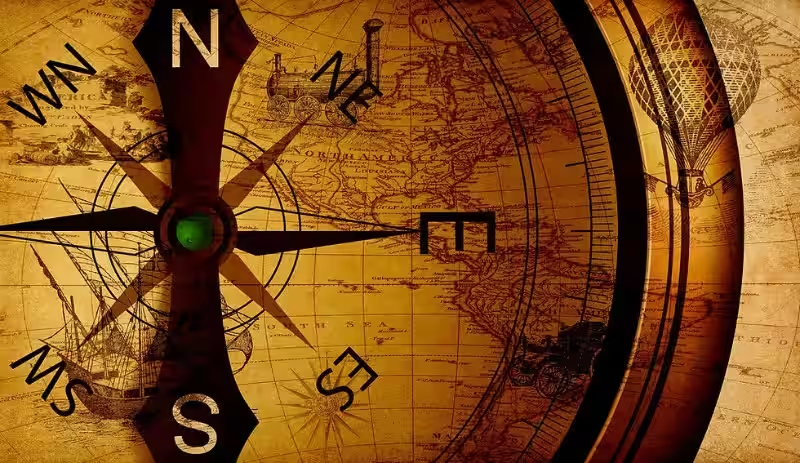
Think of a moral theologian as a seasoned navigator charting a course through often uncharted ethical waters. They possess a deep understanding of the “map” – the religious tradition – and the “stars” – the underlying principles of divine love, justice, and mercy. When a ship (an individual or community) encounters a storm (a moral dilemma), they can consult the navigator to understand the best route, considering the prevailing winds (societal pressures) and the destination (a life lived in accordance with one’s faith). Their objective is not to dictate, but to educate and empower, providing the tools and insights necessary for individuals to make informed and virtuous choices.
The Foundations of Religious Moral Frameworks
Every major religion offers a rich tapestry of moral teachings, often rooted in the idea of a divinely ordained order. Moral theologians are the custodians and interpreters of these frameworks, ensuring their continued relevance and accessibility. They examine concepts like virtue ethics, which emphasizes the cultivation of good character traits, and deontology, which focuses on duties and rules, all within the context of a particular faith’s worldview. For example, a Christian moral theologian might explore the Beatitudes as a foundational guide to a Christ-like life, while an Islamic moral theologian might delve into the ethical injunctions found in the Hadith to understand principles of justice and compassion.
These foundations are not static pronouncements from a distant past. Moral theologians understand that religious ethics must engage with the evolving realities of human experience. They grapple with questions that were unimaginable to earlier generations, such as the ethics of artificial intelligence, environmental stewardship, or the complexities of global economic disparities. Their task is to bridge the gap between ancient wisdom and contemporary challenges, demonstrating how enduring religious principles can offer profound insights and practical guidance for the moral issues we face today. This involves careful study of scripture, tradition, reason, and experience, weaving them together into a coherent ethical vision.
Moral Theologians as Interpreters and Guides
The pronouncements of moral theologians are not meant to be rigid dogma, but rather reasoned interpretations that invite dialogue and personal reflection. They engage in the painstaking work of hermeneutics, the art and science of interpretation, to understand the deepest meanings embedded within religious texts and traditions. This often involves considering different scholarly perspectives, historical developments, and the lived experiences of believers. For instance, when grappling with passages that seem to address specific historical circumstances, moral theologians help us discern the underlying ethical principles that transcend those particular contexts.
Ultimately, the goal of moral theologians is to equip individuals with the capacity for moral reasoning and discernment. They don’t provide easy answers, but rather foster the skills needed to ask the right questions. They encourage a deeper engagement with one’s faith, promoting a conscience that is both informed and sensitive. Through their writings, teachings, and pastoral work, they help to cultivate a community of believers who are not just following rules, but actively striving to live lives that reflect the highest ethical aspirations of their religion, acting with integrity, empathy, and a commitment to the common good.
The Practical Application of Religious Morality in Everyday Life
The abstract principles discussed by moral theologians find their true expression in the everyday choices we make. Religion provides a framework, but it is through our actions that this framework becomes a living reality. Whether it’s the daily practice of honesty in our dealings, the generosity shown to those in need, or the forgiveness extended to those who have wronged us, these are the tangible manifestations of a life guided by religious morality. The challenge lies in consistently translating these ideals into our often messy and complicated lives.
Consider the seemingly simple act of telling the truth. For many faiths, this is a fundamental tenet. However, in practice, we might encounter situations where a white lie seems harmless, or where harsh truths could cause unnecessary pain. This is where the nuanced guidance of moral theologians can be particularly helpful. They can help us understand the spirit behind the commandment, emphasizing not just the avoidance of falsehood, but the promotion of trust and authentic relationships, while also acknowledging the complexities of compassion and discretion.
Navigating Ethical Dilemmas with Faith
Life is replete with ethical dilemmas, from the personal to the professional. A moral theologian might explore the ethical implications of controversial medical procedures, the responsibilities of wealth, or the moral obligations of citizenship. They help believers to analyze these situations through the lens of their faith, drawing upon established religious principles and their own reasoned interpretations. For example, when faced with a conflict between loyalty to a friend and the obligation to report unethical behavior, a moral theologian would encourage a prayerful consideration of justice, solidarity, and the integrity of the community.
The insights of moral theologians are not confined to academic discourse. They often inform the pronouncements of religious leaders, shape the curriculum of religious education, and provide guidance for individuals seeking to live more ethically. Their work helps to ensure that religious teachings remain a vibrant and relevant force for good in the world, offering a moral compass that can help us navigate the often turbulent waters of modern existence. This involves a commitment to discernment, careful study, and a prayerful reliance on divine wisdom.
Cultivating a Virtuous Life: The Role of Practice and Community
A key aspect of religious morality emphasizes the cultivation of virtues. Moral theologians often highlight the importance of developing character traits like patience, humility, kindness, and courage. These are not innate qualities for most; they are cultivated through consistent practice and immersion in a supportive community. Religion provides the ideals, but the community of faith offers the environment and encouragement for their development. This might involve participating in acts of service, engaging in regular prayer and reflection, and learning from the examples of virtuous individuals within the tradition.
The guidance of moral theologians extends to understanding the role of community in fostering virtuous living. They recognize that moral development is not a solitary pursuit. Shared rituals, communal worship, and mutual accountability within a faith community can provide a powerful impetus for ethical growth. By learning from and supporting one another, believers can collectively strive to embody the ethical teachings of their religion, creating a ripple effect of positive change in the wider world. This commitment to shared values and mutual support is a cornerstone of living a morally rich and fulfilling religious life.
Frequently Asked Questions about Moral Theologians
What is a moral theologian?
A moral theologian is an academic scholar who studies and teaches about ethical principles and moral theology within a specific religious tradition. They analyze religious texts, traditions, and philosophical reasoning to understand and articulate moral teachings and their application to human behavior and societal issues.
What kind of questions do moral theologians address?
Moral theologians address a wide range of questions concerning right and wrong, good and evil, virtue and vice, justice, and the nature of moral obligation. These can include personal ethical dilemmas, social justice issues, bioethical concerns, and the interpretation of religious moral codes.
What is the relationship between moral theology and philosophy?
Moral theology draws heavily on philosophical ethics for its methods of reasoning, argumentation, and conceptualization. While philosophy explores ethics from a purely rational standpoint, moral theology grounds its ethical inquiries within the framework of a specific religious faith, often incorporating revelation, scripture, and tradition.
How does religion inform moral theology?
Religion provides the foundational beliefs, values, and divine commands that inform moral theology. Religious texts (like the Bible, Quran, Torah, or Vedas), historical traditions, and the teachings of religious authorities are primary sources for understanding the moral framework within which a moral theologian operates.
What are some common areas of study for moral theologians?
Common areas include the nature of sin and virtue, the application of religious laws, the development of conscience, the ethics of sexuality, the principles of social justice, medical ethics, environmental ethics, and issues related to war and peace, all from a religious perspective.
Do all religions have moral theologians?
While the specific terminology might vary, most religious traditions have individuals or groups within their scholarly ranks who dedicate themselves to the study and interpretation of their faith’s ethical teachings. These individuals perform a role analogous to that of a moral theologian in larger, more formalized contexts.
How do moral theologians differ from religious leaders or clergy?
While there can be overlap, moral theologians are primarily scholars and educators, often working within academic institutions. Religious leaders and clergy focus more on pastoral care, preaching, and the direct application of religious teachings to their congregations, though they may also engage in theological reflection.