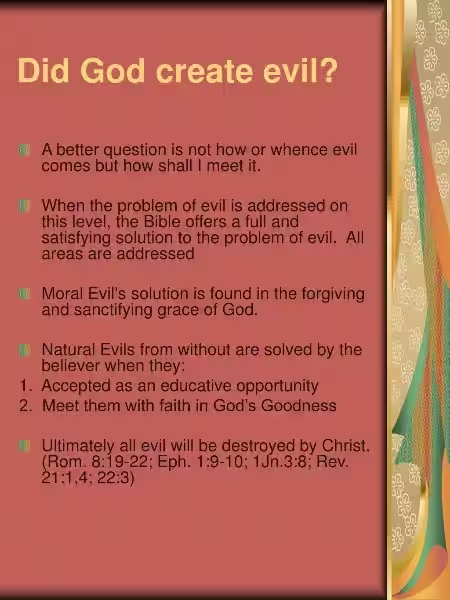
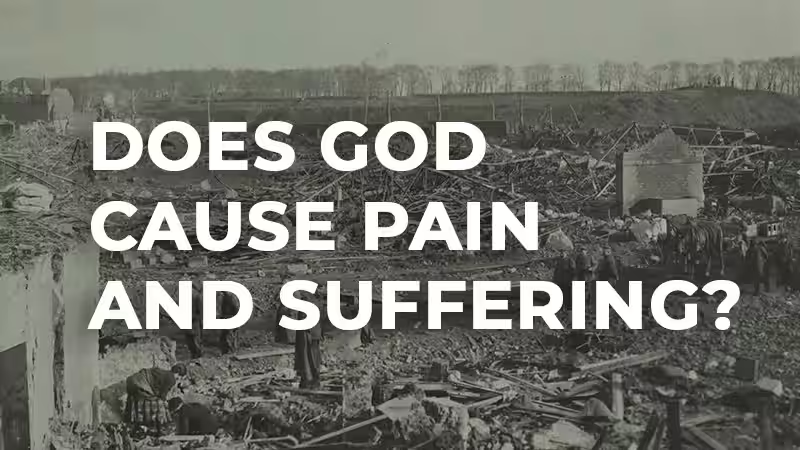
The question of whether God made evil is one of the most persistent and deeply felt inquiries within religious thought. It’s a paradox that has troubled theologians, philosophers, and everyday believers for millennia. If God is all-powerful, all-knowing, and perfectly good, how can evil exist in the world? This isn’t just an abstract theological debate; it touches the very core of our human experience, influencing how we understand suffering, injustice, and our own moral compass. We see acts of unimaginable cruelty alongside moments of profound kindness, and the source of this duality often leads us back to the fundamental question: did God make evil?
This exploration delves into various religious perspectives, aiming to offer clarity and understanding to those grappling with this profound mystery. We’ll navigate different interpretations, from the idea of evil as a privation of good to the concept of free will, and consider how these concepts shape our understanding of a benevolent Creator. The aim is to provide a useful, relatable, and informative journey through this complex theological landscape, equipping you with new ways to think about this age-old dilemma.
The existence of suffering, pain, and moral corruption presents a significant challenge to the traditional understanding of a supremely good and powerful God. If a deity created everything and is responsible for its nature, then the existence of evil seems to imply that this deity, in some way, is either the author of or at least complicit in its creation. This “problem of evil” is not confined to any single religion; it’s a universal human struggle that arises whenever people contemplate the divine and the realities of their existence. Think about a sudden, devastating natural disaster, or the horrific acts of violence that sometimes plague our news cycles. These events make us question: did God make evil by allowing such things to occur?
Many people find themselves wrestling with this question during personal tragedies. When a loved one suffers from a debilitating illness, or when innocent lives are lost, the easy answer of “God has a plan” can feel hollow and insufficient. This is where the concept of did God make evil becomes intensely personal. It forces us to reconcile our faith with the often harsh realities of life. The very act of questioning, of seeking understanding, is a testament to our inherent desire for a just and loving universe, and it’s this desire that fuels the ongoing theological dialogue.
Evil as a Privation of Good: The Augustinian View
One of the most influential and enduring perspectives on the nature of evil comes from Saint Augustine. He proposed that evil is not a creation in itself, but rather a lack or absence of good. This is often referred to as the “privatio boni” doctrine. Imagine a room that is completely dark. The darkness isn’t a substance that God created; it’s simply the absence of light. Similarly, Augustine argued, evil arises when there is a deficiency in the good that God originally created. God created the world with inherent goodness, and evil is what happens when that goodness is diminished or distorted.
This perspective helps to alleviate the direct accusation that did God make evil as a positive entity. Instead, it suggests that evil is a consequence of a deviation from the divine norm. For instance, consider a beautiful, well-tuned instrument. If it’s played incorrectly, or if certain strings are broken, the resulting sound is discordant and unpleasant. The instrument itself isn’t evil, but the flawed performance or damage leads to an absence of its intended harmonious sound. In this analogy, the lack of proper playing or the broken strings represent the absence of good, leading to what we perceive as “bad” music.
The Role of Free Will: A Human Choice
Another significant theological concept that addresses the question of did God make evil is the notion of free will. Many religious traditions emphasize that God endowed humanity with the capacity for genuine choice. This means that humans are not mere robots programmed to do good; they have the ability to choose between right and wrong, between obedience to God and disobedience. When individuals choose to act in ways that cause harm, suffering, or injustice, they are exercising their free will. Therefore, the evil that results from these choices is attributed to human agency, not directly to God’s design.
This idea is crucial because it allows for a morally responsible universe. If God predetermined every action, then praise for good deeds and blame for evil deeds would be meaningless. However, by granting free will, God allows for the possibility of genuine love and virtue, which are only meaningful if they are freely chosen. Consider a parent who allows their child to choose their own friends. While the parent hopes for good influences, they understand that the child might make poor choices. The parent doesn’t make the bad friendship happen, but they allow the child the freedom to explore and learn. In this context, did God make evil by creating beings with the capacity to choose, even if those choices lead to suffering?
Divine Sovereignty vs. Human Agency: A Delicate Balance
Reconciling God’s absolute power and knowledge (divine sovereignty) with the human capacity for free choice and the reality of evil is one of the most intricate theological puzzles. If God knows everything that will happen, including every evil act, and is powerful enough to prevent it, then why doesn’t He? This leads back to the persistent question: did God make evil? Some interpretations suggest that God’s sovereignty operates in a way that allows for human freedom within His ultimate plan. It doesn’t mean God causes evil, but rather that He permits it for reasons that might be beyond our current comprehension.
This delicate balance is often illustrated by the concept of a skilled chess player. The player knows all the possible moves and can anticipate their opponent’s strategy. However, they don’t force their opponent to make specific moves. They allow for the opponent’s choices, while still guiding the game towards their own victory. Similarly, some theologians propose that God allows for the unfolding of human choices, even the sinful ones, within the grander narrative of His divine purpose. The challenge remains in understanding how this allowance does not equate to God making evil.
Theological Interpretations of God’s Relationship with Evil
Throughout history, various religious traditions have offered different lenses through which to view God’s relationship with evil. In some Eastern religions, the concept of karma plays a significant role, suggesting that individuals create their own suffering through their actions in this life and past lives, rather than God directly creating evil. In Abrahamic religions, the narrative often centers on a God who is fundamentally good, but who allows for the existence of evil as a consequence of free will, disobedience, or as a means to a greater, albeit mysterious, end. The core question of did God make evil continues to be debated with nuanced interpretations.
Ultimately, understanding God’s relationship with evil often involves embracing a degree of mystery. We might not have all the answers, and our human minds may be incapable of fully grasping the divine perspective. However, these varying interpretations offer frameworks for making sense of suffering and for maintaining faith in a loving Creator. For example, when faced with a challenging situation, one might consider if it’s a direct act of divine malice (unlikely in most theological frameworks), a consequence of human choices, or part of a larger, incomprehensible plan. This mental exercise helps in processing difficult experiences, even if it doesn’t provide a definitive answer to did God make evil.
Finding Meaning in a World with Evil
The existence of evil doesn’t necessarily negate the possibility of a benevolent God. Instead, it can be seen as a profound call to humanity. If evil is not a direct creation of God, then the responsibility to combat it and to promote good falls upon us. This perspective shifts the focus from questioning God’s intent to understanding our own role in the moral fabric of the world. The question did God make evil then becomes less about divine responsibility and more about our human response to the challenges presented by its existence.
In many faiths, overcoming adversity and acting with compassion in the face of suffering are seen as pathways to spiritual growth. The presence of evil can serve as a stark contrast that highlights the beauty and importance of good. It’s through experiencing hardship that we can truly appreciate moments of joy and kindness. This doesn’t excuse the suffering, but it can offer a way to find meaning and purpose even when confronted with the darkest aspects of existence. The resilience of the human spirit, the acts of selfless love in the midst of tragedy, and the persistent striving for justice all speak to a profound capacity for good, even in a world where evil is undeniably present.
Living with the Mystery and Embracing Hope
Ultimately, for many, the question of did God make evil remains a profound mystery, one that cannot be fully resolved by logic or human understanding alone. While various theological frameworks offer explanations, the deep, emotional experience of suffering often transcends intellectual answers. However, within these mysteries, a powerful sense of hope can be found. The belief in a loving and just God, even amidst suffering, can provide solace and a reason to persevere.
This journey through the question of did God make evil is not about finding a simple yes or no answer. It’s about engaging with complex ideas, understanding different perspectives, and ultimately, finding a way to live a meaningful and ethical life. It encourages introspection, compassion, and a commitment to being a force for good in the world. By focusing on our own actions and the positive impact we can have, we can contribute to a world where the presence of evil is challenged by the overwhelming power of love, kindness, and divine grace.
Frequently Asked Questions: God and the Problem of Evil
Does God create evil?
Different religions and theological perspectives offer varying answers to this question.
Monotheistic Religions (Judaism, Christianity, Islam): In many traditional interpretations of these religions, God is seen as inherently good and the creator of all things, including the universe and its laws. Evil is often understood not as something God creates in the same way He creates goodness, but rather as a consequence of:
Free Will: God grants humanity and possibly other spiritual beings free will. Evil arises when these beings choose to act against God’s will or moral laws.
The Absence of Good: Some philosophies view evil as a privation or absence of good, rather than an independent force or substance created by God.
Spiritual Warfare/Satanic Influence: In some traditions, evil is attributed to the actions of fallen angels or demonic forces that oppose God.
God’s Permissive Will: While not directly creating evil, God may permit it to exist for reasons that are beyond human comprehension, often to allow for greater good to ultimately prevail or to test faith.
Dualistic Religions (e.g., Zoroastrianism): Some religions posit the existence of two opposing primordial forces, one good and one evil, both of whom may have a role in creation or existence. In such systems, God (or the supreme good entity) does not create evil, but it exists as an independent, opposing principle.
Pantheistic/Panentheistic Views: In philosophies where God is identical with the universe (pantheism) or where God is in all things and all things are in God (panentheism), the concept of evil can be more complex. Evil might be seen as an emergent property of the complex universe, or a necessary part of the totality of God’s being, even if it appears negative from a human perspective.
Ultimately, the question of whether God “makes” evil often hinges on definitions of “God,” “evil,” and “make” within specific religious or philosophical frameworks. Most mainstream monotheistic traditions maintain that God is good and does not directly author evil, but rather that evil arises from other sources, often involving the choices of created beings or as part of a larger divine plan.