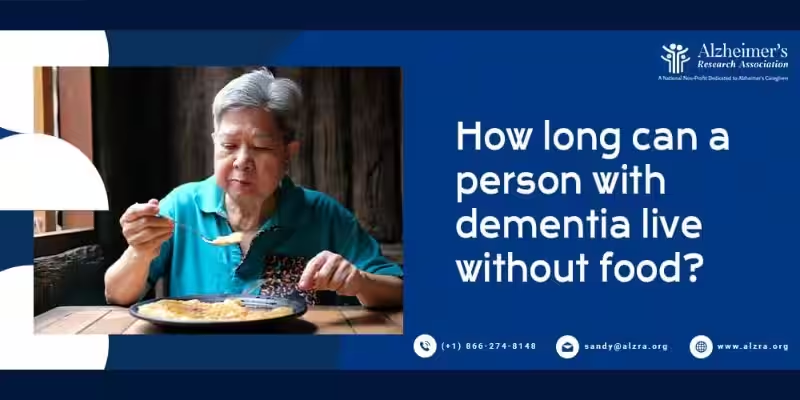
The question of how long an elderly person can survive without food is a deeply unsettling one, touching upon our most primal fears and our profound sense of compassion. It’s a scenario that no family wishes to face, yet understanding the factors involved, including the often overlooked influence of religion, can provide a measure of preparedness and a deeper appreciation for the human spirit’s resilience. This isn’t a morbid curiosity, but rather a quest for knowledge that can empower caregivers, comfort those in faith, and illuminate the complex interplay of biology, psychology, and spirituality.
When we talk about survival without sustenance, we’re venturing into a territory where the body’s reserves are the sole arbiters of time. It’s a stark reminder that food is not merely a source of pleasure or social connection; it is the fundamental fuel that powers every cell, every thought, and every beat of our hearts. For an elderly individual, the equation becomes even more intricate, as their bodies may already be operating with a diminished capacity, making them more vulnerable to the rigors of prolonged fasting.
Understanding the Biological Clock: How Long Can an Elderly Person Survive Without Food?
The stark reality is that how long an elderly person can survive without food is not a fixed number, but a spectrum influenced by a multitude of biological factors. The human body, especially in later years, possesses a remarkable ability to adapt, but this adaptation has its limits. We are not designed for extended periods without nourishment, and the consequences can be swift and severe.
Several key elements dictate this timeline. Firstly, the individual’s overall health and pre-existing medical conditions are paramount. An elderly person with chronic illnesses like diabetes, heart disease, or kidney issues will have significantly fewer reserves than a relatively healthy centenarian. Think of it like a car: one with a brand-new engine will perform differently under strain than one with thousands of miles and worn parts. Hydration also plays an equally critical, if not more critical, role. While a person can survive longer without food than without water, dehydration can accelerate decline rapidly, often within days.
Furthermore, the body’s stored energy reserves, primarily in the form of fat and muscle, are crucial. Individuals with higher body fat percentages might theoretically be able to sustain themselves for longer periods as their bodies tap into these stores for energy. However, this is a dangerous and unsustainable process. Muscle mass also provides protein, which the body will eventually break down for essential functions, leading to severe weakness and organ damage. Even in the absence of food, the body continues to expend energy on basic functions like breathing and maintaining body temperature, further depleting reserves.
The Spiritual Anchor: Religion’s Role in Enduring Hardship
Beyond the purely biological, the role of religion in how an elderly person copes with or endures a period without food is profound and often underestimated. Faith can provide a powerful psychological buffer, offering solace, hope, and a sense of purpose even in the face of extreme physical deprivation. For many, their religious beliefs offer a framework for understanding suffering and a promise of a greater peace beyond earthly trials.
Religious practices often emphasize prayer, meditation, and communal support. These activities can shift focus away from physical discomfort and towards spiritual connection. A devout individual might find strength in believing that their suffering is part of a divine plan or that they are being tested. This mental fortitude can be a surprisingly potent factor in prolonging perceived well-being and resilience, even when the body is weakening. Furthermore, religious communities often rally around their members in times of crisis, providing not only emotional support but also practical assistance, which can indirectly influence survival by ensuring the person is not entirely alone or forgotten.
The concept of divine providence is a cornerstone for many faiths. This belief in God’s care and guidance can instill a deep sense of peace and acceptance, reducing the panic and despair that would otherwise exacerbate the physical stress of starvation. For an elderly person, who may already be grappling with the realities of aging and mortality, their faith can offer a comforting perspective on life’s ultimate journey. This doesn’t negate the biological realities, but it can profoundly alter the experience of those realities, making the seemingly unbearable more manageable.
Factors Influencing Survival Time: A Deeper Dive
When we consider how long an elderly person can survive without food, it’s vital to dissect the contributing factors more thoroughly. It’s a complex equation with many variables, and each plays a significant role in determining the outcome.
One of the most critical factors is the rate of metabolism. A slower metabolism means the body burns fewer calories at rest, potentially extending survival time without food. However, as we age, metabolism naturally tends to slow down. This can be a double-edged sword: while it conserves energy, it also means the body is less efficient at processing nutrients when they are available, and the decline can be more pronounced when they are absent. Age itself is a significant factor; a spry 70-year-old will likely have different survival capabilities than a frail 90-year-old.
The environment also plays a role. Extreme temperatures can force the body to expend more energy to maintain its core temperature, accelerating the depletion of reserves. A calm, comfortable environment can help conserve energy. Think of a hibernating animal; its survival depends on minimizing energy expenditure in cold conditions. Similarly, for an elderly person without food, minimizing unnecessary physical or emotional exertion is key to conserving precious energy.
The Psychological and Spiritual Dimensions of Fasting
The psychological and spiritual dimensions of prolonged fasting, particularly within a religious context, are as significant as the physical ones. While the body is undeniably weakening, the mind can remain remarkably strong, fueled by faith and a sense of purpose.
For individuals who voluntarily undertake fasting for religious reasons, such as during Ramadan or Lent, there is often a conscious choice and a clear spiritual objective. This controlled deprivation is vastly different from involuntary starvation. The mental preparation, the communal observance, and the belief in spiritual rewards can provide a powerful framework that helps individuals endure physical discomfort. They are not simply suffering; they are participating in a ritual with meaning. This intentionality can foster a sense of control and resilience that is absent in situations of forced deprivation.
In contrast, an elderly person facing involuntary starvation due to neglect or unforeseen circumstances experiences a different kind of suffering. Here, the absence of spiritual comfort can amplify feelings of abandonment and despair. However, even in such dire situations, the flicker of faith can remain a source of solace. A simple prayer whispered in the dark, a cherished religious text read aloud, or the memory of a comforting sermon can offer a lifeline to spiritual peace, helping them to face their physical decline with a greater sense of dignity.
When Faith Meets Biology: A Delicate Interplay
The question of how long an elderly person can survive without food ultimately highlights the intricate interplay between our biological needs and our spiritual capacities. While science can offer estimations based on physiological processes, it cannot fully account for the profound impact of faith on an individual’s resilience and their perception of suffering.
It is crucial to remember that survival without food is a medical emergency. While faith can provide immense psychological strength, it cannot override the body’s fundamental need for nutrition and hydration. In any situation where an elderly person is unable to access food, seeking immediate medical attention is paramount. This is not a contradiction to faith, but rather a practical application of care and a recognition of the body’s vulnerability.
Ultimately, understanding the factors that influence an elderly person’s survival without food, coupled with an appreciation for the powerful role religion can play in providing strength and solace, offers a more comprehensive and compassionate perspective. It reminds us of the human capacity for endurance, the importance of community, and the enduring power of hope, regardless of the challenges faced.
Frequently Asked Questions: Elderly Survival Without Food & Religion
How long can an elderly person survive without food?
The duration an elderly person can survive without food varies significantly based on several factors, including their general health, pre-existing medical conditions, hydration levels, body fat reserves, and even their environment. On average, a healthy adult can survive for a few weeks without food, provided they have access to water. However, for elderly individuals, especially those with compromised health or underlying conditions, this timeframe can be considerably shorter. Dehydration is often a more immediate threat than starvation. In cases of severe malnutrition or illness, survival without any food could be a matter of days rather than weeks. It’s crucial to understand that any prolonged period without adequate nutrition for an elderly person is a critical medical emergency and requires immediate professional intervention.
How does religion view the act of surviving without food?
Many religions have traditions and narratives that involve fasting or abstaining from food for spiritual or religious purposes. These practices are often undertaken with intent, prayer, and within specific religious frameworks. For example, in Christianity, fasting is practiced during Lent; in Islam, fasting is a pillar of Ramadan; and in Judaism, fasting is observed on Yom Kippur. These religious abstentions are typically for a defined period and are seen as acts of devotion, self-discipline, or atonement, often accompanied by spiritual reflection and prayer.
When survival without food is involuntary or due to dire circumstances (like famine or extreme poverty), religious perspectives often emphasize compassion, charity, and the responsibility of the community to care for the vulnerable. Many faiths stress the importance of feeding the hungry and providing relief to those in need. While some religions may view enduring hardship, including starvation, as a test of faith or a path to spiritual growth, this is generally within a context of prayer and hope for divine intervention or relief, rather than a desired or accepted state of prolonged suffering. The act of starving oneself involuntarily would typically be viewed with great concern and sorrow, prompting religious calls for aid and support.