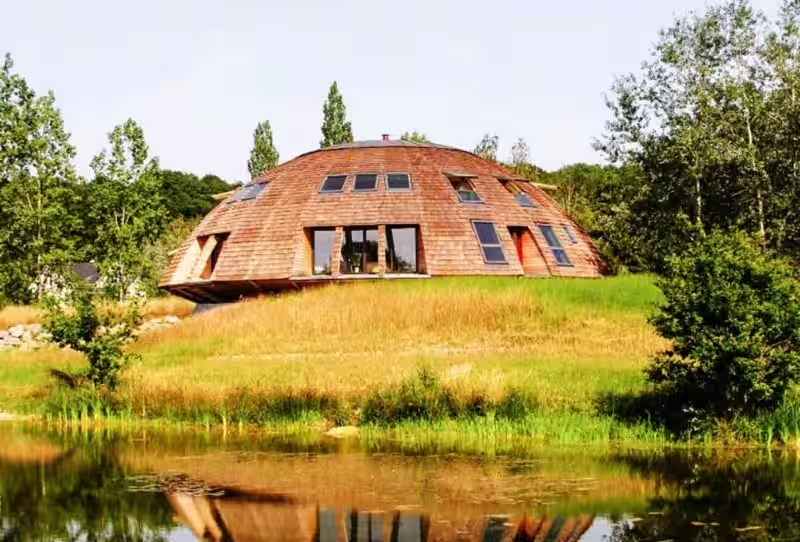
In a world increasingly grappling with environmental anxieties and a yearning for deeper meaning, the concept of “ark living” is emerging not just as a practical approach to survival, but as a profound spiritual endeavor. Far from being a relic of ancient flood narratives, ark living, in its modern interpretation, is about embracing a lifestyle that is sustainable, self-sufficient, and deeply connected to faith. It’s a conscious choice to build a sanctuary – a personal or communal ark – that shelters not only its inhabitants but also a reverence for the Earth and a commitment to spiritual principles.
This isn’t about hoarding supplies or isolating oneself from society in a doomsday scenario. Instead, it’s about cultivating a resilient and faithful existence that anticipates challenges with grace and wisdom. Ark living, intertwined with religion, offers a pathway to navigate the complexities of modern life by anchoring ourselves in timeless values and a profound understanding of our interconnectedness with the divine and the natural world. It’s a call to action, for those who feel a spiritual imperative to live in harmony with creation and to foster a sense of purposeful stewardship.
Theological Roots of Ark Living: Faith in the Face of the Flood
The most prominent example of ark living in religious tradition is, of course, Noah’s Ark. This biblical narrative, found in the Book of Genesis, isn’t just a story of survival; it’s a powerful allegory for faith, obedience, and divine preservation. Noah was instructed by God to build an ark, a massive vessel designed to protect his family and representatives of all living creatures from a catastrophic flood. This story highlights the importance of listening to divine guidance, even when the instructions seem daunting or incomprehensible, and the ultimate triumph of righteousness and preservation.
The act of building the ark itself required immense faith and dedication. Noah worked for an extended period, likely facing skepticism and ridicule from his contemporaries. Yet, he persevered, driven by his unwavering belief in God’s promise and his commitment to following divine commands. This dedication to a long-term, faith-driven project, even amidst uncertainty, is a foundational element of ark living. It teaches us that true faith often involves patient action and a steadfast commitment to principles, even when the immediate rewards are not apparent.
The narrative of Noah’s Ark offers several profound lessons applicable to contemporary ark living. Firstly, it emphasizes the importance of preparation and foresight. Noah didn’t wait for the floodwaters to rise; he began building his sanctuary well in advance. This translates to modern ark living through practices like stockpiling essential resources, developing skills in self-sufficiency, and creating resilient living spaces that can withstand various environmental and societal shifts. It’s about being proactive rather than reactive, guided by a spiritual understanding of potential challenges.
Secondly, the ark was a space of preservation and diversity. Noah was tasked with saving not just his family but also pairs of every living creature. This underscores a religious imperative for conservation and biodiversity. Modern ark living, therefore, extends beyond human survival to encompass a deep respect for all of God’s creation. This can manifest in practices like organic gardening, supporting local ecosystems, and advocating for environmental protection, recognizing that our well-being is inextricably linked to the health of the planet.
Ark Living as a Spiritual Discipline: Cultivating Inner and Outer Resilience
Beyond the practicalities, ark living, when viewed through a religious lens, becomes a potent spiritual discipline. It challenges us to cultivate inner resilience – a steadfast faith and a calm spirit that can weather personal storms and anxieties, much like the ark weathered the literal deluge. This inner strength is nurtured through prayer, meditation, scripture study, and communal worship, all of which help to ground individuals in their faith and provide a sense of peace amidst uncertainty.
Furthermore, ark living fosters outer resilience through the development of practical skills and a commitment to self-sufficiency. This can involve learning to grow your own food, manage your own water and energy resources, and build or repair your own shelter. These activities, when undertaken with a spiritual mindset, become acts of devotion, a tangible expression of faith in action. They remind us of our inherent capabilities and our responsibility to care for ourselves and our environment, as stewards appointed by a higher power.
Practical Expressions of Religious Ark Living
The practical expressions of religious ark living are as diverse as the faiths themselves, but they often revolve around core principles of stewardship, community, and mindful consumption. For Christians, this might involve creating “Christian Permaculture” gardens, where biblical principles of creation care are integrated into sustainable food production. For Jews, it could mean embracing the concept of “Tikkun Olam” (repairing the world) through eco-conscious living and supporting community initiatives that address environmental justice. For Muslims, the emphasis on “Khalifah” (stewardship) can lead to practices like conserving water, a precious resource in many Islamic traditions, and fostering a sense of responsibility for the Earth.
Some individuals and communities are actively building eco-villages or intentional communities that embody ark living principles. These communities often prioritize renewable energy sources, sustainable building materials, and local food systems. They function as modern-day arks, providing a supportive environment for like-minded individuals to live out their faith through practical action, fostering a sense of shared purpose and mutual support. They are living demonstrations of how faith can inspire a holistic approach to life that benefits both people and the planet.
Thematic Elements of Ark Living in Diverse Faith Traditions
While the Noah’s Ark story is central to Abrahamic religions, the underlying themes of ark living – preparation, preservation, faith, and divine providence – resonate across a wide spectrum of spiritual and religious traditions. Many indigenous cultures, for instance, have deep-rooted spiritual connections to the land and a profound understanding of cycles of nature, often incorporating practices that ensure the sustainability of their communities and environments for future generations. These practices, honed over centuries, are essentially forms of ark living, designed to protect and sustain life.
Even in philosophical traditions that may not overtly center on divine intervention, the concept of building a resilient and purposeful existence holds significant weight. The pursuit of wisdom, ethical living, and mindful detachment from fleeting worldly concerns can be seen as constructing an inner ark, a sanctuary of the soul. The emphasis on interconnectedness and collective well-being, found in many Eastern philosophies and New Age spiritualities, also aligns with the core tenets of ark living – recognizing that our survival and flourishing are dependent on the health of the whole.
Building Your Personal Ark: A Journey of Faith and Practice
Embarking on the path of ark living is not about grand gestures or immediate perfection; it’s a gradual but intentional journey. It begins with a spiritual awakening to the interconnectedness of all things and a desire to live in greater harmony with divine principles and the natural world. This might involve a deep dive into your own faith traditions to uncover scriptural guidance on stewardship and sustainability or exploring the wisdom of different spiritual paths.
The practical steps can be as simple as reducing your waste, learning to compost, or starting a small herb garden. As your understanding and commitment grow, you might explore more significant changes, such as investing in renewable energy, learning to preserve food, or participating in community-based sustainability projects. The key is to approach these changes with a spirit of gratitude, mindfulness, and unwavering faith, recognizing that each step, no matter how small, contributes to building a more resilient and spiritually fulfilling life – your personal ark.
Ark Living is a lifestyle concept that emphasizes sustainable, self-sufficient, and community-oriented living, often with a focus on preparedness and resilience. It draws inspiration from the idea of an “ark” as a sanctuary and a means of survival.
What are the core principles of Ark Living?
Core principles typically include: self-sufficiency in food and energy, sustainable resource management, strong community bonds and mutual support, preparedness for various emergencies, and a deep connection with nature.
Is Ark Living a religion?
No, Ark Living is not a religion. It is a lifestyle choice and a set of practices. While some individuals who practice Ark Living may have personal spiritual beliefs, the concept itself is secular in nature.
Are there any religious doctrines associated with Ark Living?
There are no mandatory religious doctrines associated with Ark Living. Adherents come from diverse religious and non-religious backgrounds. Any exploration of spirituality within an Ark Living context is personal and individual.
Can people of different faiths participate in Ark Living?
Yes, absolutely. Ark Living is inclusive and welcomes individuals from all religious, spiritual, and non-religious backgrounds. The focus is on shared practical goals and community building, not on religious dogma.
Does Ark Living involve worship or religious rituals?
Ark Living does not inherently involve specific worship practices or religious rituals. If individuals within an Ark Living community choose to incorporate their own personal or communal religious practices, that is a matter of their own discretion and agreement.
How does religion relate to the preparedness aspect of Ark Living?
For some individuals, their religious faith may inform or motivate their desire for preparedness and self-sufficiency. They might see it as a responsibility or a way to care for their community. However, this is a personal interpretation and not a requirement of Ark Living.