For centuries, the Bible has served as a cornerstone of faith, a source of wisdom, and a guide for millions. Its profound impact on history, culture, and individual lives is undeniable. Yet, as with any ancient text, the journey of understanding its original message can be complex. The sheer number of available Bible translations can feel overwhelming, leaving many wondering: which translation best preserves the power and accuracy of the original languages? This article aims to demystify this crucial aspect of biblical study, guiding you through the top 5 most accurate Bible translations and empowering you to connect with scripture on a deeper, more meaningful level.
Choosing a Bible translation isn’t merely about picking a book off a shelf; it’s about selecting a vessel to carry the timeless truths of God’s Word. The nuances of Hebrew and Greek, the original languages of the Bible, are incredibly rich and can be lost in translation. Understanding the different approaches translators take is key to finding a version that resonates with your spiritual journey and provides the most faithful representation of the original text. We’ll explore why accuracy matters and how certain translations stand out.
The Quest for Faithful Representation: Why Bible Translation Accuracy Matters
Imagine trying to convey a complex scientific theory or a nuanced legal document through a game of telephone. The core idea might survive, but the precise details, the intended emphasis, and the subtle implications could become distorted. The Bible, with its intricate theological concepts, historical accounts, and poetic expressions, is no different. The goal of a most accurate Bible translation is to minimize this distortion, ensuring the reader receives the closest possible understanding of what the original authors intended to communicate thousands of years ago.
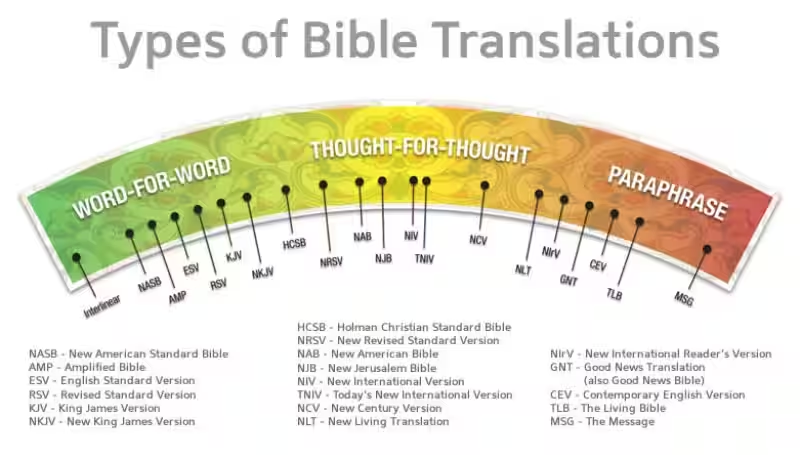
Different translation philosophies exist, each with its strengths and weaknesses. Some strive for a word-for-word equivalence, meticulously translating each Greek or Hebrew word into its English counterpart. This approach often results in translations that are highly literal but can sometimes feel archaic or difficult to read. Others opt for a thought-for-thought or dynamic equivalence approach, prioritizing the meaning and impact of a phrase over a literal word-for-word rendering. This can make the text more accessible and relatable but might introduce a degree of interpretation. Understanding these distinctions is vital when evaluating the top 5 most accurate Bible translations.
Exploring the Elite: The Top 5 Most Accurate Bible Translations in Detail
When we talk about accuracy in Bible translation, we often refer to translations that prioritize formal equivalence, aiming to mirror the grammatical structure and vocabulary of the source texts as closely as possible. While no translation is perfect, and scholarly debate is ongoing, certain versions consistently rise to the top in terms of their commitment to preserving the original languages. Let’s delve into some of the most highly regarded options that are often cited among the top 5 most accurate Bible translations.
It’s important to remember that “accuracy” can be perceived differently by various readers. Some may value the precise rendering of every word, while others might prioritize clarity and flow. The following translations represent a spectrum of approaches, all with a strong emphasis on fidelity to the original Hebrew, Aramaic, and Greek. Many scholars and theologians consider these to be among the top 5 most accurate Bible translations available today.
Often lauded for its unwavering commitment to literal accuracy, the New American Standard Bible (NASB) is a benchmark for those seeking a word-for-word translation. This version meticulously translates each Hebrew and Greek word into its closest English equivalent, striving to maintain the grammatical structure and vocabulary of the original texts. For instance, where the original text uses a specific verb tense or grammatical construction, the NASB endeavors to replicate that precisely in English, even if it results in a more formal or less fluid reading experience.
The NASB’s strength lies in its scholarly rigor and faithfulness to the source material. This makes it an invaluable tool for in-depth study, allowing readers to examine the subtle nuances of the original languages without significant interpretive layers. While its prose might be less accessible for casual reading compared to some other translations, its precision makes it a favorite among pastors, theologians, and serious students of the Bible who want to get as close as possible to the original wording. It’s a prime example of a translation that consistently ranks among the top 5 most accurate Bible translations for its literal approach.
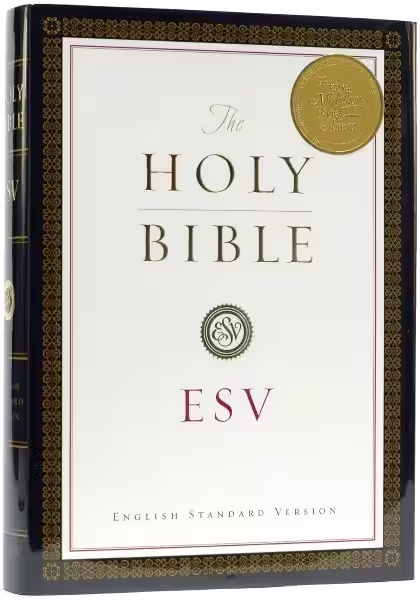
2. The English Standard Version (ESV)
The English Standard Version (ESV) strikes a remarkable balance between literal accuracy and readability. While it leans heavily towards a word-for-word translation philosophy, it also incorporates more modern English usage, making it more accessible than some other literal translations. The ESV translation committee aimed to create a translation that was both theologically sound and idiomatically English, capturing the meaning and spirit of the original texts while remaining clear and engaging for contemporary readers. Think of it as a highly accurate map that is also easy to follow.
The ESV is a popular choice for its versatility, serving well for personal devotion, public reading, and in-depth study. Its translators paid close attention to the literary qualities of the original languages, preserving the poetic beauty of the Psalms or the rhetorical force of Paul’s epistles. This commitment to both accuracy and eloquence is why the ESV is frequently recognized as one of the top 5 most accurate Bible translations, offering a robust understanding of scripture without sacrificing clarity.
3. The New King James Version (NKJV)
Building upon the legacy of the King James Version (KJV), the New King James Version (NKJV) seeks to update its language while retaining its revered accuracy. The NKJV translators used the same original language texts as the KJV but updated the archaic language and syntax to be understandable to modern readers. This means you get the traditional phrasing and theological weight that many have cherished for centuries, but without the stumbling blocks of Elizabethan English. It aims for a balance between formal equivalence and contemporary language. For example, instead of “thee” and “thou,” it uses “you,” and archaic verb endings like “-eth” are replaced with modern equivalents.
The NKJV is a beloved choice for individuals who appreciate the traditional feel and theological depth of the KJV but desire greater readability. It maintains a strong commitment to accuracy, translating carefully from the same Greek and Hebrew manuscripts that informed earlier versions. This dedication to preserving the essence of a trusted translation while enhancing its accessibility is a key reason why the NKJV is often considered among the top 5 most accurate Bible translations, bridging the gap between historical reverence and modern comprehension.
The Recovery Version (RV) is a unique translation that stands out for its extensive footnotes and cross-references, designed to illuminate the deeper spiritual meaning and theological implications of the text. While it also aims for accuracy in its rendering of the original languages, its primary distinctive feature is its interpretive commentary, which is deeply rooted in the theological perspective of Witness Lee and Watchman Nee. This version isn’t just about translating words; it’s about providing a rich tapestry of understanding for the reader.
The RV’s approach is to be both accurate in translation and rich in spiritual insight. The footnotes offer explanations of biblical terms, historical context, and theological concepts, essentially providing a guided tour through the text. This makes it an exceptionally useful resource for those who want to go beyond the surface meaning and explore the profound spiritual truths conveyed by the scriptures. Its combined emphasis on faithful translation and comprehensive study aids solidifies its place as a strong contender for the top 5 most accurate Bible translations for those seeking a deeply annotated experience.
5. The New Revised Standard Version (NRSV)
The New Revised Standard Version (NRSV) is renowned for its scholarly consensus in translation and its inclusive language. This version is the result of a broad committee of biblical scholars from various denominations and backgrounds, ensuring a high degree of academic rigor and theological balance. The NRSV prioritizes formal equivalence but also employs a thought-for-thought approach when necessary to convey the meaning accurately in modern English. For instance, it carefully considers how to render gendered language in the original texts to be both faithful and relevant to contemporary readers.
The NRSV is widely used in academic settings and by individuals who value its commitment to theological neutrality and its sensitive handling of language. It aims to be an accurate and accessible translation for a broad audience, reflecting the latest linguistic scholarship. Its dedication to clarity, accuracy, and faithfulness to the original languages, coupled with its inclusive approach, makes it a significant and often-cited option among the top 5 most accurate Bible translations for a comprehensive understanding of scripture.
Beyond the List: Finding Your Personal Connection
While these top 5 most accurate Bible translations represent excellent choices for serious study and a faithful understanding of scripture, the “best” translation is ultimately the one that helps you connect most meaningfully with God’s Word. Consider trying out a few of these versions. Read the same passage in different translations and see which one resonates most with your spirit and intellect. Perhaps you’ll find yourself drawn to the literal precision of the NASB for deep dives, while the ESV might be your go-to for daily reading. Or maybe the interpretive richness of the Recovery Version or the balanced scholarship of the NRSV will speak most directly to you.
Ultimately, the Holy Spirit is the ultimate interpreter of Scripture, and He can use any faithful translation to illuminate God’s truth. The key is to engage with the text prayerfully and consistently. Having a reliable translation is a powerful tool, but it’s the heart of the reader and the guidance of the Spirit that truly unlocks the transformative power of the Bible. May your journey through these sacred texts be one of profound discovery and deepening faith, guided by the accuracy and beauty of God’s enduring Word.
Frequently Asked Questions: Top 5 Most Accurate Bible Translations
What makes a Bible translation “accurate”?
Accuracy in Bible translation refers to how closely a new version reflects the meaning and nuances of the original Hebrew, Aramaic, and Greek texts. This involves careful consideration of vocabulary, grammar, and historical context. Different translation philosophies exist, such as word-for-word (formal equivalence) and thought-for-thought (dynamic equivalence), each aiming for accuracy in its own way.
What are the top 5 most accurate Bible translations?
Determining the absolute “top 5” is subjective and depends on the criteria used for accuracy and the user’s preference for translation style. However, based on scholarly consensus and widespread use for their fidelity to the original languages, the following are frequently cited as highly accurate:
1. New American Standard Bible (NASB)
The NASB is known for its commitment to a literal, word-for-word translation approach, aiming to preserve the grammatical structure and vocabulary of the original texts as much as possible. This can make it more challenging for casual reading but highly valued for in-depth study.
2. English Standard Version (ESV)
The ESV is a modern translation that balances word-for-word accuracy with readability. It builds upon the tradition of the Revised Standard Version (RSV) and is highly regarded by many scholars for its faithfulness to the original languages while remaining accessible to a broad audience.
3. New King James Version (NKJV)
The NKJV is a revision of the King James Version (KJV) that updates the language while striving to maintain the essentially literal translation style of its predecessor. It aims to be accurate to the original texts while using more modern English than the KJV.
4. Holman Christian Standard Bible (HCSB) / Christian Standard Bible (CSB)
Both the HCSB and its successor, the CSB, are known for their “optimal equivalence” approach, blending word-for-word accuracy with clarity and readability. They aim to be faithful to the original languages and convey the message in a way that is understandable to contemporary readers.
5. New Revised Standard Version (NRSV)
The NRSV is a revision of the RSV and is widely respected for its scholarly accuracy and scholarly consensus. It uses a gender-inclusive language where appropriate to reflect the original intent and is favored in academic and ecumenical settings.
How do I choose the best translation for me?
The best translation for you depends on your purpose. If you are doing in-depth theological study, a more literal translation like the NASB or ESV might be preferred. If you are looking for readability and clear understanding of the message, a translation like the CSB or NKJV might be more suitable. Many people find it beneficial to compare verses across different translations to gain a richer understanding.
Are there other accurate translations not on this list?
Yes, there are many other excellent and accurate Bible translations available. This list represents some of the most frequently cited for their fidelity to the original languages and their widespread use in study and devotion. Other translations like the New International Version (NIV), while often categorized as more dynamic equivalence, are also considered accurate in conveying the message by many.