The journey of faith is deeply personal, yet for many, it finds its expression and community within the walls of a church. Behind the hymns, sermons, and shared meals, a vital, though often unseen, framework operates: church governance. This isn’t just an administrative detail; it’s the very structure that allows a religious community to function, to fulfill its mission, and to navigate the complexities of both spiritual and temporal matters. Understanding church governance is key to appreciating the dynamics of faith communities, from the smallest house church to the grandest cathedral, offering insights into how religion is organized, led, and sustained across diverse traditions.
For many, the term “church governance” might conjure images of distant councils or hierarchical pronouncements, feeling removed from their everyday spiritual experience. However, the reality is far more nuanced and has a direct impact on the lifeblood of any religious congregation. It’s the system that dictates how decisions are made, how resources are managed, and how leadership is established and held accountable. This framework, deeply intertwined with a religion’s theology and historical development, shapes the very fabric of communal worship and outreach.
The Foundation of Order: Why Church Governance Matters
The need for order and structure within any community, especially one dedicated to shared beliefs and practices, is paramount. Church governance provides this essential scaffolding, ensuring that a religious body can effectively pursue its spiritual and practical objectives. Without clear guidelines, even the most well-intentioned congregations can falter, leading to confusion, conflict, or a stagnation of their mission. It’s about building a sturdy vessel to carry the passengers of faith safely through the storms of life and towards their eternal destination.
Think of a family. While love and shared values are the foundation, clear roles, responsibilities, and decision-making processes are what allow a family to thrive. Similarly, church governance establishes these vital elements for a faith community. It addresses fundamental questions such as: Who is responsible for preaching? How are new leaders chosen? What is the process for managing the church’s finances? How are disputes resolved? The answers to these questions, rooted in specific theological interpretations and historical precedents, define the unique character and operational style of each religion and its constituent churches.
Diverse Models of Authority: Examining Different Governance Structures
The landscape of church governance is as varied as the denominations it serves. Different religion traditions have developed distinct models, each reflecting their theological underpinnings and historical trajectories. These variations are not arbitrary; they are deeply connected to how each tradition understands the nature of God, the role of the church, and the authority vested in its leadership and members. Exploring these models offers a fascinating glimpse into the rich tapestry of organized faith.
We can broadly categorize these structures into a few key types, though many variations and hybrid models exist:
Episcopal Governance: This model, often associated with denominations like Methodism, Anglicanism, and Catholicism, is characterized by a hierarchical structure headed by bishops. Bishops hold significant authority, overseeing a geographical region of churches and ordaining clergy. This system emphasizes a clear chain of command and a unified doctrinal approach, ensuring consistency across a broad spectrum of congregations. A simple analogy might be a national government with a president and regional governors.
Presbyterian Governance: Found in denominations like the Presbyterian Church, this system relies on a representative form of governance. Authority is vested in elected elders who serve on congregational, regional (presbytery), and national (synod or assembly) levels. Decisions are made through a series of councils or “courts,” where representatives from various churches meet to discuss and vote on matters. This model aims to balance congregational autonomy with denominational oversight, ensuring that local churches are part of a larger, interconnected body. Imagine a town council where elected representatives from different neighborhoods come together to make decisions for the entire town.
Congregational Governance: In this model, each local congregation operates with a high degree of autonomy. Decisions are typically made by the congregation as a whole or by elected boards and committees within that local church. While these churches may associate with broader denominational bodies for fellowship and mission, they retain the right to govern their internal affairs independently. This is often seen in Baptist, Congregationalist, and many independent or non-denominational churches. This is akin to a cooperative, where individual members have significant say in how the organization is run.
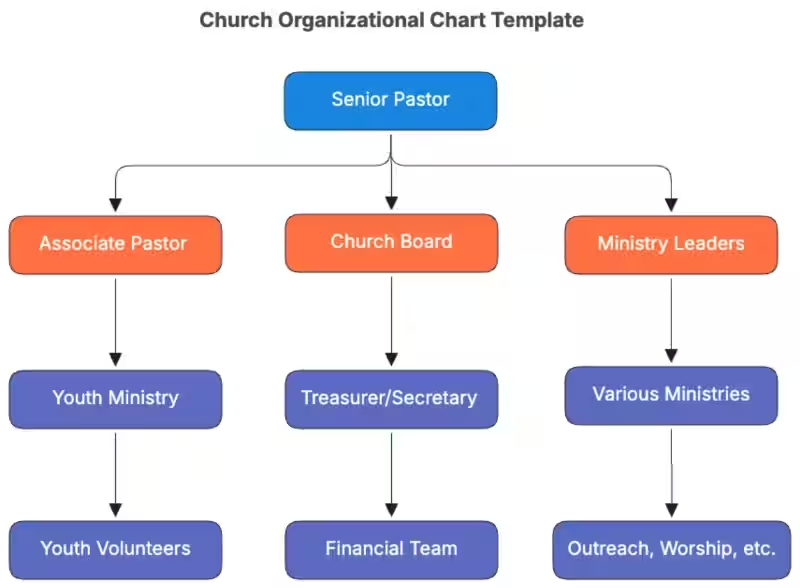
Hybrid Models: Many churches today employ systems that blend elements of these traditional structures. For instance, a church might have an elected council of elders but also recognize the importance of a senior pastor’s spiritual leadership. The specific blend often reflects a pragmatic approach to leadership and decision-making that best serves the needs of the particular congregation and its theological convictions within its broader religion.
The Role of Clergy and Laity: A Delicate Balance
A crucial aspect of church governance is the relationship between clergy (ordained ministers, pastors, priests) and the laity (non-ordained members of the congregation). How this balance is struck profoundly impacts the spiritual health and operational effectiveness of a church. Different governance models assign varying degrees of authority and responsibility to each group, reflecting differing theological views on the “priesthood of all believers” and the unique calling of ordained ministry.
In episcopal systems, the hierarchy places significant emphasis on the ordained clergy, particularly bishops, as spiritual leaders and administrators. While lay participation is encouraged in various committees and ministries, ultimate authority often rests with the episcopate. Conversely, congregational models tend to empower the laity more directly, with congregational meetings and elected boards playing a more prominent role in decision-making. Presbyterian systems seek a middle ground, with elected elders (both clergy and lay) forming governing bodies. Regardless of the model, fostering a healthy dialogue and mutual respect between clergy and laity is essential for vibrant church governance.
Practical Applications: Decision-Making, Finances, and Ministry
Beyond the theoretical frameworks, church governance has tangible, day-to-day implications for every member of a religious community. It’s the engine that drives the church’s mission, from organizing outreach programs to maintaining its physical facilities. Understanding these practical applications can demystify the process and highlight the importance of engaged participation.
Making Decisions: From Worship Services to Building Projects
The process of decision-making within a church can range from routine matters, like scheduling events or selecting sermon themes, to more significant ones, such as approving budgets, calling new staff, or undertaking major building renovations. In an episcopal system, many of these decisions might be initiated or approved by a bishop or denominational leadership. In a presbyterian system, decisions would typically be made at the presbytery or synod level, with input from local church representatives. For congregational churches, these decisions are often brought before the entire membership for discussion and vote, or are handled by an elected church council. A relatable example: Imagine deciding on a new curriculum for a church’s religious education program. In one model, the denominational office might provide approved materials. In another, a local church committee, perhaps including parents and teachers, would research and select the best fit.
Financial Stewardship: Accountability and Transparency
Managing church finances is a critical function of church governance. This involves budgeting, fundraising, accounting, and ensuring that funds are used ethically and effectively to support the church’s mission and ministries. Religion often emphasizes generosity and good stewardship, making financial accountability a cornerstone of good governance. Transparency is key; members need to have confidence that their financial contributions are being managed responsibly. This might involve regular financial reports presented to the congregation, independent audits, or oversight from finance committees. The specific mechanisms for financial oversight vary greatly depending on the governance model, but the underlying principle of responsible stewardship remains universal across most religion traditions.
The Future of Church Governance: Adapting to a Changing World
As society evolves, so too does the context in which church governance operates. Modern churches are increasingly grappling with issues of inclusivity, social justice, and adapting to technological advancements. Effective church governance in the 21st century necessitates a willingness to adapt, to listen, and to innovate while remaining true to core theological principles.
Inclusivity and Diversity: Expanding the Table
Many contemporary religion communities are re-examining their governance structures to ensure they are more inclusive and representative of the diverse populations they serve. This can involve actively seeking to include women, people of color, LGBTQ+ individuals, and people with disabilities in leadership roles and decision-making processes. This evolution in church governance reflects a growing understanding that all members, regardless of background, have unique gifts and perspectives to offer. It’s about ensuring that the church’s leadership mirrors the diversity of God’s creation and that the “table” of decision-making is open to all.
Technology and Communication: New Avenues for Engagement
The digital age has opened up new avenues for church governance and communication. Online platforms can facilitate congregational meetings, provide access to important documents, and enhance communication between leaders and members. Some churches are even exploring new forms of digital democracy for certain decision-making processes. However, this also presents challenges, such as ensuring equitable access to technology and maintaining meaningful in-person community. The integration of technology requires thoughtful consideration to enhance, rather than replace, the core relational aspects of religion and community.
Ultimately, church governance is not merely an abstract organizational principle; it is the living embodiment of a faith community’s values, its commitment to order, and its capacity to serve God and humanity. By understanding its diverse forms and practical implications, we gain a deeper appreciation for the intricate workings of religion and the dedicated efforts of those who strive to lead and sustain these vital spiritual homes.
Frequently Asked Questions on Church Governance and Religion
What is church governance?
Church governance refers to the system by which a church or religious denomination is organized and administered. It outlines the structure of authority, decision-making processes, and the roles and responsibilities of its leaders and members.
What are the common models of church governance?
Common models include:
* Congregational: Authority rests with the local congregation.
* Presbyterian: Authority is shared among elders elected by the congregation.
* Episcopal: Authority is vested in bishops, who oversee a diocese.
* Hierarchical: A clear chain of command with ultimate authority at the top (e.g., the Pope in Catholicism).
How is religion defined?
Religion is a system of beliefs, practices, and often rituals that relates humanity to an order of existence that is supernatural, transcendental, or spiritual. It typically involves a community of believers, moral codes, and a worldview often centered around a deity or deities, or a similar ultimate reality.
What is the role of religion in society?
Religion can play a significant role in society by providing moral guidance, fostering community, offering social services, influencing cultural norms and values, and sometimes shaping political landscapes.
How does church governance relate to religious practice?
Church governance structures often influence how religious doctrines are interpreted and applied, how congregational life is organized, and how decisions are made regarding worship, mission, and community engagement. The specific model of governance can impact the degree of autonomy local congregations have and the uniformity of practice across a denomination.