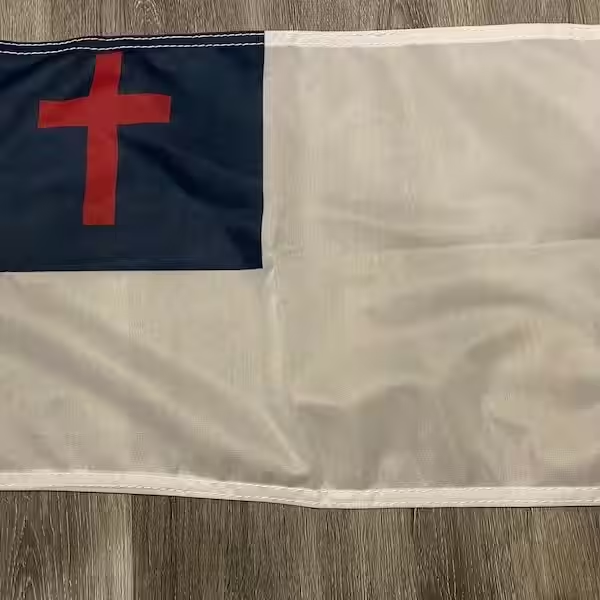
In the tapestry of religious symbolism, certain icons resonate with a profound and enduring power, transcending mere visual representation to embody deep theological truths and evoke powerful emotional responses. Among these, the Christ the King banner stands as a particularly potent emblem. More than just a piece of fabric adorned with an image, it is a declaration, a rallying point, and a constant reminder of Christ’s ultimate sovereignty and reign. Its rich history, diverse applications, and the spiritual depth it conveys make the Christ the King banner a subject worthy of exploration for anyone seeking to deepen their understanding of Christian faith and its expression.
The visual representation on a Christ the King banner typically depicts Jesus Christ, often in regal attire, sometimes crowned, and frequently holding symbols of his kingship – a scepter, a globe, or a cross. The very act of displaying such a banner is an act of worship and affirmation, a public testament to the belief that Jesus is not just a historical figure or a moral teacher, but the divinely appointed King of kings and Lord of lords. This belief has profound implications for how Christians understand their own lives, their communities, and the world at large. The Christ the King banner serves as a constant, visual anchor to this central tenet of Christian theology.
Historical Roots and Evolution of the Christ the King Banner
The concept of Christ’s kingship is deeply embedded in scripture, with prophecies foretelling a Davidic king who would reign eternally. This theological understanding gained formal prominence within the Catholic Church through the institution of the Feast of Christ the King, established by Pope Pius XI in 1925. The social and political upheaval of the early 20th century, marked by rising secularism and totalitarian regimes, prompted the Church to emphasize Christ’s supreme authority not only over individuals but also over societies and nations. The Christ the King banner became a visible manifestation of this renewed focus, appearing in liturgical processions, church decorations, and at ecumenical gatherings.
Over time, the design and usage of the Christ the King banner have evolved. While traditional depictions remain popular, contemporary interpretations also emerge, reflecting diverse artistic styles and cultural contexts. Regardless of the specific artistic rendering, the core message remains consistent: the acknowledgment of Christ’s absolute dominion. You might see a Christ the King banner carried aloft in a solemn religious parade, its vibrant colors catching the sunlight, or a more stylized version adorning the altar of a parish church during the Feast of Christ the King. Each iteration, however humble or grand, carries the weight of centuries of devotion and theological contemplation.
The imagery on a Christ the King banner is rich with symbolic meaning. The crown, when present, is not merely an earthly adornment but signifies Christ’s divine authority and his victory over sin and death. The scepter represents his power to rule and govern, while the globe or orb he might hold symbolizes his dominion over all creation. Often, Christ is depicted with a benevolent expression, conveying his justice tempered with mercy. The colors used also carry significance; gold often denotes royalty and divine glory, while purple has historically been associated with kingship and majesty.
Beyond the specific visual elements, the very act of displaying a Christ the King banner invites contemplation on several key aspects of Christian faith. It reminds believers of their allegiance to Christ as their supreme leader, guiding their actions and shaping their worldview. It serves as a beacon of hope in times of adversity, assuring them that ultimate victory belongs to Christ and his kingdom. For communities, the Christ the King banner can foster a sense of unity and shared purpose, reinforcing their collective identity as followers of Christ. This visual reminder encourages individuals to live out their faith not just in private devotion but in public witness.
The Christ the King Banner in Liturgical and Public Expression
The primary context for the Christ the King banner is often within the Church’s liturgical life. During the Feast of Christ the King, which concludes the liturgical year, processions featuring the Christ the King banner are common, symbolizing Christ’s triumphant reign. It might be carried by a designated member of the congregation, leading the faithful into or out of the sanctuary, underscoring the belief that Christ is the center of their worship and the sovereign of their lives. The banner’s presence elevates the solemnity of the occasion and visually reinforces the theological themes being celebrated.
Beyond the confines of the church building, the Christ the King banner can also play a role in public demonstrations of faith. In religious festivals, pilgrimages, or marches, carrying a Christ the King banner serves as a public declaration of Christian identity and commitment. This public witnessing can be an encouragement to fellow believers and a message of faith to the wider community. The banner acts as a mobile altar, bringing the proclamation of Christ’s kingship into the public square, inviting reflection and drawing attention to the enduring relevance of Christian values in the modern world. It’s a tangible expression of a spiritual reality that impacts every facet of life.
Personal and Communal Impact of the Christ the King Banner
For many individuals, the Christ the King banner is more than just a religious artifact; it is a source of personal inspiration and a tangible reminder of their spiritual journey. Seeing a Christ the King banner can evoke feelings of peace, strength, and renewed commitment to their faith. It acts as a visual sermon, prompting introspection on their own lives and their relationship with Christ. For someone facing personal struggles, the image of Christ as King can offer solace and the assurance that they are not alone, but are under his loving and sovereign care.
On a communal level, the Christ the King banner fosters a sense of belonging and shared identity among believers. It visually unites a congregation or a group as they rally around the common belief in Christ’s supreme authority. This shared symbol can strengthen bonds of fellowship and encourage collective action in living out Christian principles. Imagine a youth group or a religious order, each member proudly carrying a section of a larger Christ the King banner, symbolizing their unified purpose and dedication to serving Christ together. This shared endeavor reinforces their commitment and builds a powerful sense of community dedicated to a common King.
Modern Relevance and Enduring Appeal of Christ the King Imagery
In an era often characterized by shifting values and competing ideologies, the message conveyed by the Christ the King banner remains remarkably relevant. It offers a stable, unchanging truth in a world that frequently feels in flux. The concept of an eternal, benevolent King provides a grounding force for believers, offering clarity and purpose. The banner serves as a constant reminder that despite the challenges and uncertainties of life, there is an ultimate authority and a kingdom that will endure.
The enduring appeal of Christ the King imagery lies in its comprehensive nature. It speaks to Christ’s authority not just in the spiritual realm but also in the practical affairs of human life. It calls for justice, compassion, and service – principles that are essential for building a better world. Whether displayed in a grand cathedral or a simple home, a Christ the King banner continues to be a powerful symbol, inspiring faith, fostering hope, and calling believers to live as subjects of a loving and righteous King. Its timeless message resonates deeply, offering a spiritual anchor in the complexities of the 21st century, and reminding us of the ultimate hope that lies in Christ’s reign.
Frequently Asked Questions: Christ the King Banner
What is the religious significance of a Christ the King banner?
A Christ the King banner signifies the sovereignty and reign of Jesus Christ over all creation. It’s a visual representation of His divine authority, kingship, and ultimate victory over sin and death. The banner is often used during liturgical seasons like the Feast of Christ the King, processions, and in places of worship to proclaim Christ’s lordship.
What are common symbols found on a Christ the King banner?
Common symbols include a cross (representing Christ’s sacrifice and resurrection), a crown (signifying His kingship), a lamb (representing Christ as the Lamb of God who takes away the sins of the world), a shepherd’s crook (symbolizing His role as the Good Shepherd), and sometimes a royal scepter or orb. The colors used can also have religious meaning, such as purple or gold for royalty and white for purity and victory.
Where are Christ the King banners typically used?
These banners are commonly displayed in Catholic churches, particularly during the Feast of Christ the King (the last Sunday of Ordinary Time in the liturgical year). They are also used in religious processions, at Christian conferences, youth rallies, and in areas dedicated to Christ’s reign, such as shrines or chapels.
Can a Christ the King banner be used in non-religious contexts?
While the primary meaning of a Christ the King banner is deeply religious, its imagery of kingship and authority might be adapted in certain symbolic or metaphorical ways in non-religious contexts, though this is uncommon and can dilute its intended theological message. Its core purpose remains within a Christian framework.
What message does a Christ the King banner convey to believers?
To believers, the banner serves as a powerful reminder and affirmation of their faith in Jesus Christ as their Lord and King. It strengthens their hope in His ultimate triumph and encourages them to live lives that reflect His teachings and reign in their hearts and actions. It’s a declaration of allegiance to Christ above all earthly rulers and powers.