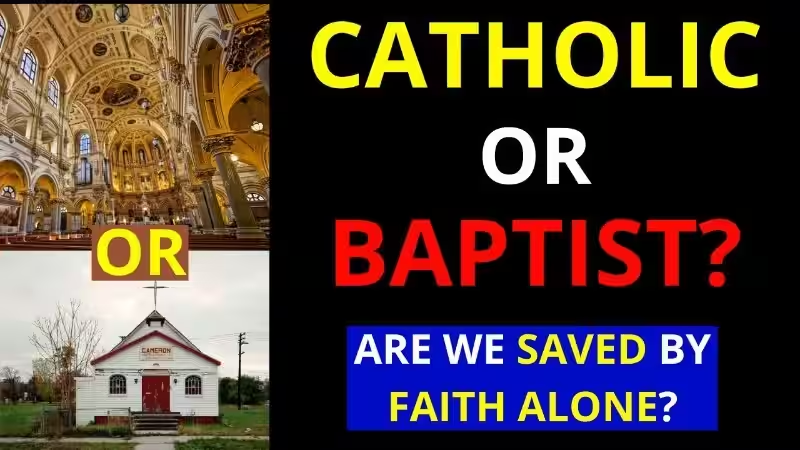
In the vast tapestry of Christian belief, two prominent threads, Catholicism and Baptism, weave distinct patterns of faith, practice, and understanding. For many, these traditions represent deeply personal expressions of devotion, shaped by centuries of history, theological development, and unique spiritual journeys. While both traditions share a foundational belief in Jesus Christ as Lord and Savior, the Catholic Baptist differences are significant and touch upon core aspects of religious life, from how salvation is understood to the very nature of the church itself.
Exploring these divergences isn’t about declaring one right and the other wrong; rather, it’s about gaining a richer appreciation for the diverse ways Christians engage with their faith. Whether you’re a curious inquirer, a member of one tradition seeking to understand another, or simply someone fascinated by the nuances of religious expression, this exploration aims to illuminate the key distinctions that define these two vibrant branches of Christianity. We will delve into the heart of their beliefs, offering relatable examples and clear explanations to make these Catholic Baptist differences accessible and informative.
The Foundation of Authority: Scripture vs. Tradition and Magisterium
One of the most fundamental Catholic Baptist differences lies in where ultimate religious authority resides. For Baptists, the bedrock of faith and practice is Sola Scriptura, a Latin phrase meaning “Scripture alone.” This principle asserts that the Bible is the sole infallible source of Christian doctrine and practice. Every belief, every ethical guideline, and every aspect of church governance must be able to be traced back directly to a biblical text.
Catholics, while deeply revering the Bible, also place significant weight on Sacred Tradition and the Magisterium. Tradition refers to the teachings and practices passed down from the apostles through the centuries, interpreted and preserved by the Church. The Magisterium, embodied by the Pope and the bishops in communion with him, is seen as the authoritative teaching office of the Church, entrusted with the task of authentically interpreting both Scripture and Tradition. This means that while a Baptist minister might preach solely from the Bible, a Catholic priest or bishop would draw from Scripture, the teachings of the Church Fathers, and pronouncements of councils and popes.
For example, consider the concept of Mary, the mother of Jesus. Baptists generally hold Mary in high regard as a faithful woman chosen by God, but their understanding of her role is primarily derived from the biblical narratives. They might emphasize her humility and obedience as depicted in the Gospels. Catholics, however, also hold Marian dogmas such as the Immaculate Conception (Mary being conceived without original sin) and the Assumption (Mary being taken body and soul into heaven). These doctrines are understood to be revealed truths, though their explicit Scriptural basis is a point of theological discussion and a significant area of Catholic Baptist difference.
The Path to Salvation: Faith and Works, Sacraments and Grace
The question of how one attains salvation is another crucial area where Catholic Baptist differences become apparent. Baptists strongly emphasize salvation by grace through faith alone, often referred to as Sola Gratia and Sola Fide. This means that salvation is a free gift from God, received solely through personal faith in Jesus Christ’s atoning sacrifice on the cross. While good works are seen as a natural and important outgrowth of genuine faith, they are not considered a requirement for salvation; rather, they are evidence of a transformed life.
Catholics also believe that salvation is a gift of God’s grace and that faith is essential. However, they view salvation as a process that involves God’s grace working in and through the believer, often mediated through sacraments. Sacraments, such as Baptism, Confirmation, the Eucharist, and Reconciliation (confession), are seen as outward signs instituted by Christ that confer God’s grace. Therefore, while faith is paramount, participation in the sacramental life of the Church is considered vital for spiritual growth and the ongoing process of salvation.
Think about entering a beautiful garden. For a Baptist, stepping into the garden is like accepting Christ through faith – the act of entering itself secures your place. The beauty and nourishment you find within are the results of that decision and God’s ongoing work. For a Catholic, stepping into the garden (through baptism) is the beginning, and the sacraments are like the pathways, the watering system, and the sunlight that help the plants (the faithful) to grow and flourish, leading to the full enjoyment of the garden’s bounty. This difference in emphasis on the role of sacraments is a significant Catholic Baptist difference.
The Nature of the Church and its Leadership
The very definition and structure of the Church also present notable Catholic Baptist differences. Baptists typically understand the Church as a local assembly of baptized believers who voluntarily associate for worship, fellowship, and mission. There is a strong emphasis on congregational autonomy, meaning each local church governs itself and is not subject to external denominational hierarchy. Leadership roles, such as pastors and deacons, are generally elected by the congregation.
The Catholic Church, in contrast, views itself as a universal, visible institution founded by Jesus Christ, with a hierarchical structure that includes the Pope, bishops, priests, and deacons. This structure is understood to be divinely ordained, tracing back to the apostles through an unbroken line known as apostolic succession. The Church is seen as the “Body of Christ” on earth, and its teachings and pronouncements are considered authoritative for all its members.
Imagine a group of friends deciding to form a book club. For Baptists, each book club is its own independent entity, choosing its own books and meeting times. If one book club decides to merge with another, it’s a voluntary merger of equals. In the Catholic view, it’s more like a national library system. The central library has overarching policies, and local branches, while having some local control, operate under the guidance and direction of the larger system, with a clear line of authority. This distinction in ecclesiology, or the doctrine of the Church, is a profound Catholic Baptist difference.
Worship and Sacramental Practices
The outward expressions of faith, particularly in worship and sacramental practices, reveal further Catholic Baptist differences. Baptist worship services are often characterized by their simplicity and focus on preaching and congregational singing. While there may be elements like prayer, scripture reading, and occasional observance of ordinances like Believer’s Baptism and the Lord’s Supper (often referred to as communion), these are generally seen as symbolic acts rather than channels of immediate divine grace. The emphasis is on personal experience and intellectual engagement with the Word.
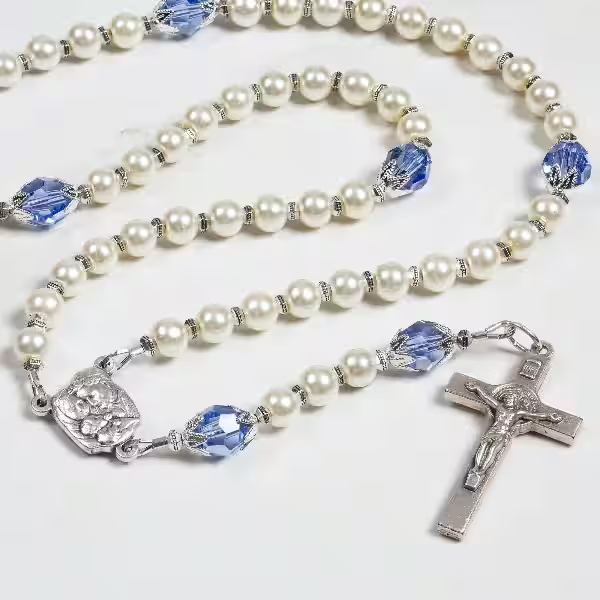
Catholic worship, centered around the Mass, is a more liturgical and sacramental experience. The Mass is considered the central act of worship, where the sacrifice of Christ is made present and believers partake in the Eucharist. The Eucharist is believed to be the actual Body and Blood of Christ (transubstantiation). The liturgy is rich with symbolism, ritual, and tradition, involving specific prayers, readings, and actions that are performed in a structured order. Baptism in the Catholic tradition is typically performed on infants, initiating them into the Church and conferring initial grace.
Consider the difference between attending a poetry reading and attending a grand opera. The poetry reading might be very moving and intellectually stimulating, with the poet sharing their heartfelt words. The opera, on the other hand, is a highly orchestrated event with elaborate sets, costumes, music, and a prescribed narrative, all designed to create a profound, immersive emotional and spiritual experience. This analogy helps to illustrate the differing approaches to worship and the role of sacraments in Catholic Baptist differences.
Understanding of Ministry and Priesthood
The understanding of ministry and the role of ordained leaders also highlights Catholic Baptist differences. In Baptist churches, the concept of the “priesthood of all believers” is central. While pastors and ministers are recognized for their leadership and teaching roles, they are not seen as having a unique mediatorial function between God and the people. All believers, according to this understanding, have direct access to God through prayer and the Holy Spirit.
The Catholic Church, however, maintains a distinction between the common priesthood of all the faithful and the ordained priesthood. Priests are ordained through the sacrament of Holy Orders, setting them apart for specific ministries, including presiding over the Eucharist, administering sacraments, and offering sacrifices on behalf of the people. This sacramental priesthood is seen as a continuation of Christ’s priestly ministry and plays a distinct role within the Church’s structure.
Imagine a community garden. In a Baptist understanding, every member of the community has a shared responsibility to tend to the garden, with some taking on leadership roles to organize tasks. In a Catholic understanding, in addition to the communal tending, there are also specialized gardeners (priests) who have received specific training and ordination to manage the most sacred aspects of the garden, like cultivating rare plants or overseeing the harvest for special feasts. This contrast in the understanding of ministerial roles is a significant Catholic Baptist difference.
Conclusion: Respectful Dialogue and Shared Hope
The Catholic Baptist differences are not merely minor variations; they represent distinct theological frameworks and historical trajectories that shape the lived experience of faith for millions. From the ultimate source of authority to the path of salvation, the structure of the Church, and the practice of worship, these distinctions invite careful consideration and respectful dialogue.
While the differences are undeniable, it is crucial to remember the profound common ground that unites Catholics and Baptists: a shared belief in the divinity of Jesus Christ, his atoning sacrifice for humanity, and the hope of eternal life through faith in him. Understanding these Catholic Baptist differences can foster greater appreciation for the diversity within Christianity and encourage bridge-building through mutual respect and a shared commitment to the Gospel message. This journey of understanding is an ongoing one, enriching our own faith and deepening our respect for the journeys of others.
Frequently Asked Questions: Catholic and Baptist Differences
What is the primary belief about salvation in Catholicism and Baptism?
Catholicism: Salvation is a process that begins with baptism and continues throughout life through faith, good works, and participation in the sacraments. It is seen as a cooperative effort between God’s grace and human free will. The Church plays a central role in dispensing God’s grace.
Baptism: Salvation is primarily by grace through faith in Jesus Christ alone. Believers are saved the moment they accept Jesus as their personal savior. Good works are seen as a natural consequence of salvation, not a means to achieve it.
What is the role of the Church and its hierarchy in each denomination?
Catholicism: The Catholic Church is understood as the one true Church established by Jesus Christ, with a hierarchical structure headed by the Pope, followed by bishops, priests, and deacons. The Church is seen as a mediator of God’s grace through its sacraments and teachings.
Baptism: Baptists emphasize the priesthood of all believers, meaning every Christian has direct access to God through Jesus Christ. While they have pastors and church leadership, there is no central hierarchical authority like a Pope or bishops. Each local church is autonomous.
How is baptism practiced and what is its significance?
Catholicism: Baptism is considered a sacrament, a ritual that bestows God’s grace. It is typically performed on infants, washing away original sin and incorporating the individual into the Church. It is often done by pouring water on the head.
Baptism: Baptism is an ordinance, a symbolic act of obedience performed for believers who have made a personal profession of faith. It symbolizes the believer’s death to sin and resurrection to new life in Christ. It is always performed by immersion in water.
What are the views on communion or the Lord’s Supper?
Catholicism: Catholics believe in the Real Presence of Jesus Christ in the Eucharist (Communion). They believe that during Mass, the bread and wine are transubstantiated into the actual body and blood of Christ. It is a central sacrament for spiritual nourishment and unity.
Baptism: Baptists generally view communion as a symbolic memorial of Christ’s sacrifice. While they believe Christ is spiritually present with believers during the observance, they do not believe the bread and wine become his literal body and blood. It is typically observed periodically as a remembrance.
What is the role of Mary and the Saints?
Catholicism: Mary, the mother of Jesus, is highly venerated and believed to have a special role in salvation history, including being the Mother of God and sinless. Catholics also venerate Saints, believing they can intercede for believers on earth. Prayer to Saints is a common practice.
Baptism: Baptists believe in the intercession of Jesus Christ as the sole mediator between God and humanity. While they respect Mary as the mother of Jesus and view Saints as examples of faith, they do not pray to Mary or Saints for intercession, believing direct prayer to God is sufficient.